

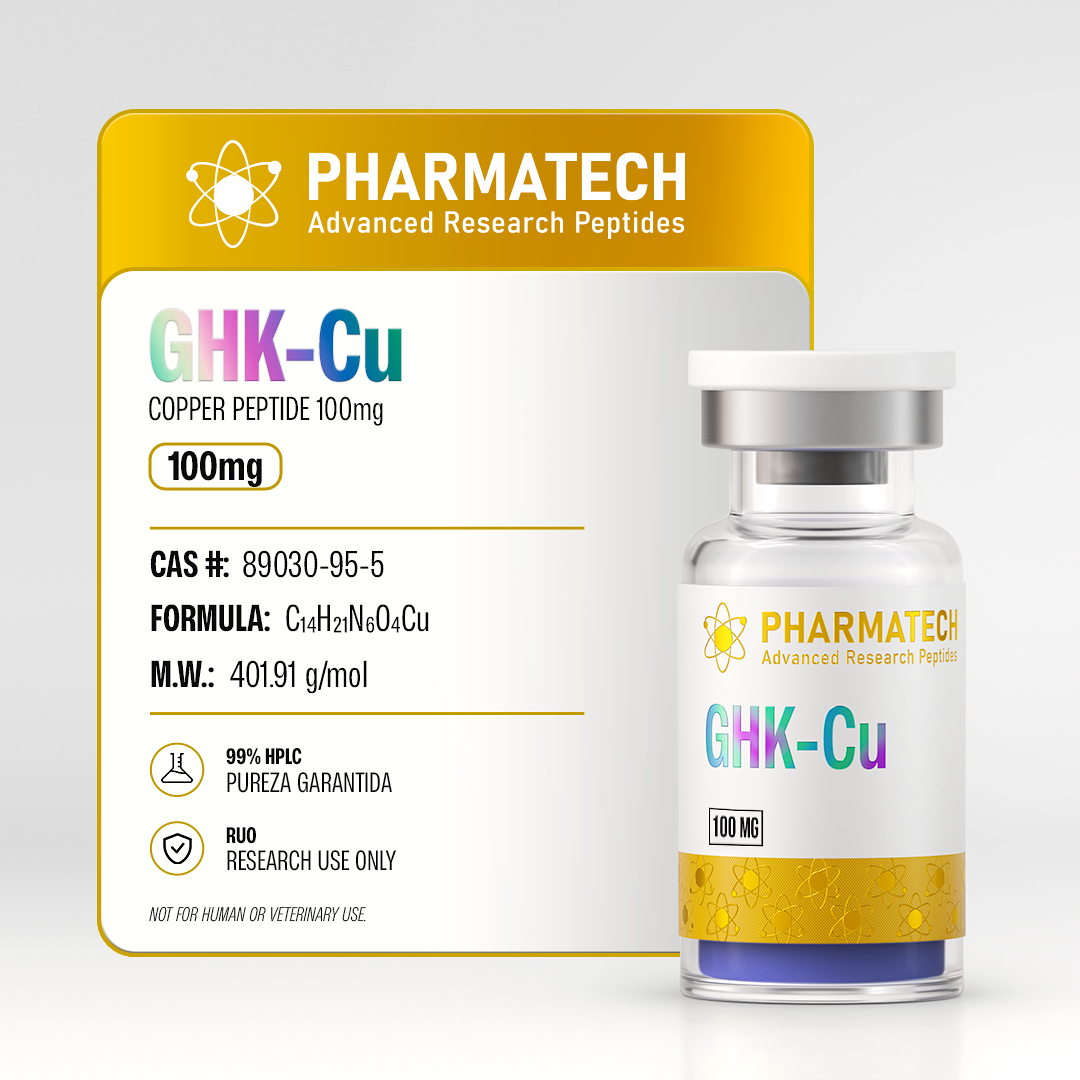
GHK-Cu 100mg – PharmaTech
GHK-Cu, also known as Copper Tripeptide-1 or copper glycyl-L-histidyl-L-lysine, is a copper(II)-complexed tripeptide composed of the naturally occurring tripeptide Gly-His-Lys (GHK) coordinated with copper.
GHK-Cu has been extensively investigated in research involving extracellular-matrix remodeling, collagen and elastin biology, angiogenesis, cellular migration, inflammatory signaling, oxidative stress, wound repair, and skin biology.
The compound is particularly relevant to studies examining the interaction between copper-dependent enzymatic processes and tissue-remodeling pathways.
OVERVIEW
GHK-Cu, also known as Copper Tripeptide-1 or copper glycyl-L-histidyl-L-lysine, is a copper(II)-complexed tripeptide composed of the naturally occurring tripeptide Gly-His-Lys (GHK) coordinated with copper.
GHK-Cu has been extensively investigated in research involving extracellular-matrix remodeling, collagen and elastin biology, angiogenesis, cellular migration, inflammatory signaling, oxidative stress, wound repair, and skin biology.
The compound is particularly relevant to studies examining the interaction between copper-dependent enzymatic processes and tissue-remodeling pathways.
MECHANISM OF ACTION
GHK-Cu is a metallopeptide, meaning that copper is an integral component of its molecular structure and biological activity.
The GHK peptide has a high affinity for copper(II), forming the GHK-Cu complex. Research has associated this complex with multiple biological processes rather than a single defined receptor-mediated pathway.
Extracellular-Matrix Signaling
Experimental studies have associated GHK-Cu with regulation of genes and pathways involved in:
- Collagen synthesis
- Elastin organization
- Proteoglycan and glycosaminoglycan biology
- Matrix metalloproteinases
- Extracellular-matrix remodeling
Fibroblast & Keratinocyte Biology
Research has investigated GHK-Cu effects on fibroblast and keratinocyte activity, including cellular proliferation and migration.
Angiogenic Signaling
GHK-Cu has been investigated in relation to vascular endothelial signaling and angiogenesis, particularly in experimental tissue-repair models.
Inflammatory & Redox Signaling
Experimental literature has associated GHK-Cu with modulation of inflammatory mediators, oxidative stress, and antioxidant-related pathways.
KEY BENEFITS
Research interest in GHK-Cu includes:
- Extracellular-matrix remodeling
- Collagen biology
- Elastin research
- Fibroblast activity
- Keratinocyte biology
- Cellular migration
- Angiogenesis
- Tissue-repair research
- Wound-healing models
- Inflammatory signaling
- Oxidative-stress research
- Skin biology
- Hair-follicle research
- Copper-dependent enzymatic pathways
Preclinical evidence is substantial, while contemporary reviews characterize the human clinical evidence as considerably more limited and heterogeneous.
RESEARCH AREAS
Extracellular-Matrix Biology
Investigation of collagen, elastin, proteoglycans, glycosaminoglycans, and matrix-remodeling enzymes.
Collagen & Connective-Tissue Research
GHK-Cu has been studied in experimental systems involving collagen synthesis and connective-tissue organization.
Skin Biology
Research includes fibroblast activity, keratinocyte responses, extracellular-matrix organization, and cellular responses associated with skin remodeling.
Wound-Healing Research
Experimental models have investigated GHK-Cu in relation to cellular migration, angiogenesis, matrix remodeling, and tissue repair.
Angiogenesis
Research has explored endothelial-cell activity and formation of new vascular structures.
Hair-Follicle Biology
Experimental research has investigated GHK-Cu-associated signaling in hair follicles and dermal biology.
Inflammation & Oxidative Stress
GHK-Cu has been studied for interactions with inflammatory mediators, reactive oxygen species, and antioxidant systems.
SCIENTIFIC EVIDENCE
GHK-Cu has accumulated a substantial preclinical research literature spanning cellular, animal, and tissue models.
Experimental studies have reported associations with extracellular-matrix remodeling, fibroblast and keratinocyte activity, angiogenesis, inflammatory modulation, and tissue-repair mechanisms.
Human evidence is more limited. Recent systematic reviews characterize the clinical literature as relatively small and heterogeneous, with much of the human research focused on topical dermatological and cosmetic applications rather than systemic pharmacology.
The distinction between GHK, 1:1 GHK-Cu complexes, and other copper-peptide formulations is also important because coordination state, counterions, hydration, and formulation can influence molecular identity and analytical characterization.
MOLECULAR PROFILE
| Parameter | GHK-Cu |
|---|---|
| Compound class | Copper(II)-complexed tripeptide |
| Common name | GHK-Cu |
| Alternative name | Copper Tripeptide-1 |
| Peptide sequence | Gly-His-Lys |
| Three-letter sequence | GHK |
| Copper | Cu(II) |
| Primary biological focus | Extracellular-matrix and tissue-remodeling biology |
| Molecular weight | Approximately 402 g/mol, depending on molecular representation |
| Molecular formula | Form-dependent |
| CAS | 89030-95-5 is commonly associated with prezatide copper |
| Physical form | Peptide-copper complex |
PubChem records several chemically related GHK-Cu representations, including different protonation and coordination states; consequently, molecular weight and formula should be tied to the specific analytical form supplied by the manufacturer. PubChem
PHARMACOKINETIC & PHARMACODYNAMIC PROFILE
Pharmacokinetic Profile
The pharmacokinetic characterization of GHK-Cu is strongly dependent on formulation, route of administration, copper coordination state, peptide concentration, and delivery system.
Compared with established therapeutic peptides, comprehensive systemic human pharmacokinetic characterization remains limited.
Research involving topical delivery has demonstrated that formulation and delivery technology can substantially influence tissue exposure. Recent reviews specifically highlight the importance of distinguishing intact GHK-Cu from free GHK and labile copper when evaluating pharmacological exposure.
Pharmacodynamic Profile
GHK-Cu does not appear to operate through a single universally established receptor.
Its experimental pharmacodynamic profile involves several interconnected biological processes:
GHK-Cu → copper-dependent and peptide-associated signaling → extracellular-matrix regulation → collagen/elastin and tissue-remodeling pathways
Additional experimental pathways include:
GHK-Cu → fibroblast/keratinocyte responses → cellular migration and matrix organization
GHK-Cu → vascular signaling → angiogenesis-related processes
GHK-Cu → inflammatory/redox modulation → cellular stress-response pathways
The precise molecular mechanisms remain an active area of research.
RESEARCH HIGHLIGHTS
- Copper-dependent metallopeptide research
- Extracellular-matrix remodeling
- Collagen and elastin biology
- Fibroblast signaling
- Keratinocyte biology
- Cellular migration
- Angiogenesis
- Wound-healing models
- Inflammatory signaling
- Oxidative-stress research
- Skin and connective-tissue biology
- Hair-follicle research
- Copper-dependent enzymatic processes
TECHNICAL SPECIFICATIONS
| Parameter | PharmaTech Specification |
|---|---|
| Product | GHK-Cu |
| Alternative name | Copper Tripeptide-1 |
| Product type | Copper-peptide complex |
| Peptide sequence | Gly-His-Lys |
| Copper state | Cu(II) |
| Total quantity | [PharmaTech specification] |
| Purity | ≥ [PharmaTech specification]% |
| Physical form | Lyophilized powder |
| Appearance | [PharmaTech specification] |
| Molecular form | [PharmaTech specification] |
| Batch | [Batch specification] |
| Storage | Controlled refrigerated storage |
| Research category | Tissue remodeling / extracellular-matrix biology |
STORAGE & HANDLING
Store the lyophilized product under controlled conditions according to the applicable PharmaTech product specification.
Protect from:
- Excessive heat
- Direct light
- Moisture
- Repeated temperature fluctuations
- Physical contamination
Maintain the container sealed until laboratory use and handle under appropriate controlled conditions.