

KLOW Blend 80mg – PharmaTech
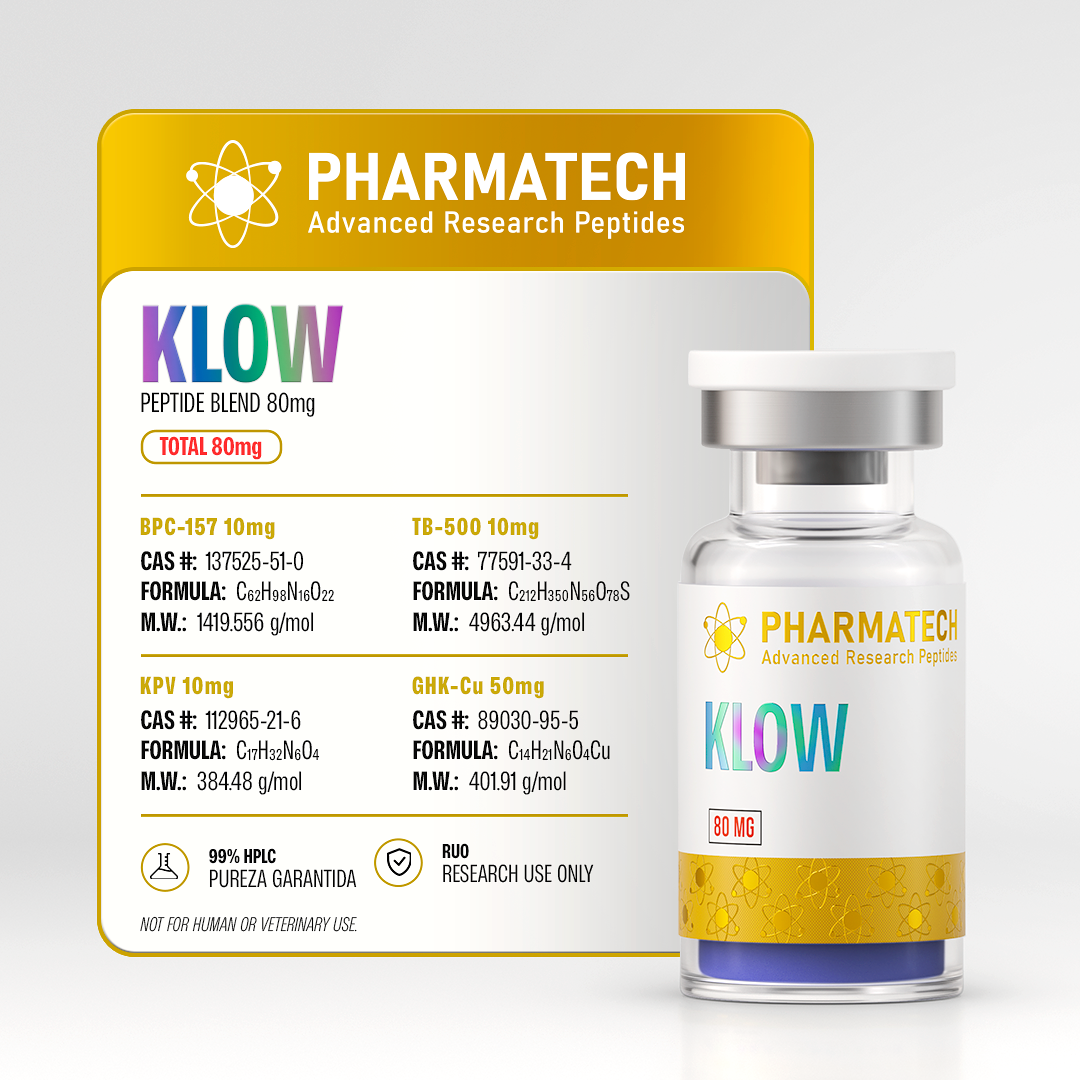
KLOW Blend is a multi-peptide research formulation combining GHK-Cu, BPC-157, TB-500, and KPV into a single lyophilized preparation.
The PharmaTech formulation contains 80 mg of total peptide material, composed of GHK-Cu 50mg, BPC-157 10mg, TB-500 10mg, and KPV 10mg.
The four components represent distinct areas of peptide research, including extracellular matrix biology, cellular migration, tissue remodeling, inflammatory signaling, cytoskeletal dynamics, and cellular recovery pathways.
The scientific rationale for KLOW is based primarily on the complementary biological characteristics of its individual components. Research on the complete four-peptide combination remains limited compared with the substantially larger body of component-level research.
OVERVIEW
KLOW Blend is a multi-peptide research formulation combining GHK-Cu, BPC-157, TB-500, and KPV into a single lyophilized preparation.
The PharmaTech formulation contains 80 mg of total peptide material, composed of:
- GHK-Cu — 50 mg
- BPC-157 — 10 mg
- TB-500 — 10 mg
- KPV — 10 mg
The four components represent distinct areas of peptide research, including extracellular matrix biology, cellular migration, tissue remodeling, inflammatory signaling, cytoskeletal dynamics, and cellular recovery pathways.
The scientific rationale for KLOW is based primarily on the complementary biological characteristics of its individual components. Research on the complete four-peptide combination remains limited compared with the substantially larger body of component-level research.
MECHANISM OF ACTION
KLOW Blend does not operate through a single defined molecular target. Instead, its research rationale involves several complementary biological pathways associated with its individual peptide components.
GHK-Cu
GHK-Cu is a copper-binding tripeptide complex associated with extracellular matrix remodeling, fibroblast biology, collagen-related processes, tissue repair signaling, and cellular responses involved in skin and connective-tissue biology.
BPC-157
BPC-157 is a synthetic pentadecapeptide investigated in preclinical research involving cellular signaling, vascular biology, nitric oxide pathways, angiogenic processes, and tissue-response mechanisms.
TB-500
TB-500 is associated with thymosin beta-4-related biology and research into actin dynamics, cytoskeletal organization, cellular migration, angiogenesis, and tissue remodeling.
KPV
KPV is a tripeptide derived from the C-terminal region of α-melanocyte-stimulating hormone (α-MSH). Research has investigated KPV in inflammatory signaling, melanocortin-related pathways, epithelial biology, and immune-cell responses.
Together, these components provide a multi-pathway research framework involving extracellular matrix regulation, cellular migration, inflammatory signaling, vascular biology, and tissue remodeling.
KEY BENEFITS
From a research perspective, the KLOW formulation provides:
- Four complementary peptide research compounds in a single formulation
- GHK-Cu-centered extracellular matrix and connective-tissue research
- BPC-157-related cellular and vascular research pathways
- TB-500-related cytoskeletal and cellular migration research
- KPV-related inflammatory and melanocortin-pathway research
- Multi-pathway investigation of tissue remodeling
- Research into cellular migration and extracellular matrix biology
- A standardized combined research formulation
- A convenient platform for investigating interactions between distinct peptide pathways
RESEARCH AREAS
KLOW Blend may be investigated across several areas of experimental peptide research, including:
- Tissue remodeling
- Extracellular matrix biology
- Fibroblast research
- Collagen and connective-tissue biology
- Cellular migration
- Angiogenesis
- Inflammatory signaling
- Cytoskeletal dynamics
- Wound-healing research
- Vascular biology
- Skin biology
- Epithelial biology
- Cellular stress responses
- Regenerative biology
- Peptide signaling research
The majority of available evidence concerns the individual components rather than the complete KLOW formulation.
SCIENTIFIC EVIDENCE
GHK-Cu
GHK-Cu has been extensively investigated as a copper-peptide complex in experimental research involving extracellular matrix organization, fibroblast activity, collagen-related processes, skin biology, angiogenesis, and tissue remodeling.
Its biological activity is associated with copper-dependent peptide interactions and modulation of cellular processes involved in matrix homeostasis.
BPC-157
BPC-157 has been studied primarily in preclinical models examining vascular signaling, cellular migration, tissue responses, nitric oxide pathways, and mechanisms associated with tissue recovery.
The existing literature is predominantly experimental, with substantially less evidence available from controlled human studies.
TB-500 / Thymosin Beta-4-Related Research
Thymosin beta-4 is a naturally occurring actin-binding peptide involved in cytoskeletal organization and cellular migration. Research has investigated thymosin beta-4-related mechanisms in angiogenesis, wound biology, tissue remodeling, and cellular movement.
The designation TB-500 is used commercially for research preparations associated with thymosin beta-4 biology, and the exact molecular composition of individual products should be evaluated from product-specific documentation.
KPV
KPV has been investigated as a small melanocortin-derived peptide with potential relevance to inflammatory signaling and epithelial/immune biology. Experimental research has examined interactions with inflammatory pathways and cellular responses.
Combined Formulation
The four components provide a mechanistically diverse research platform. However, the biological effects of the complete KLOW formulation cannot be assumed simply by combining evidence from the individual peptides. Controlled studies specifically evaluating the fixed four-component blend remain limited.
MOLECULAR PROFILE
| Component | Classification | Amount |
|---|---|---|
| GHK-Cu | Copper-binding tripeptide complex | 50 mg |
| BPC-157 | Synthetic pentadecapeptide | 10 mg |
| TB-500 | Thymosin beta-4-related peptide research material | 10 mg |
| KPV | α-MSH-derived tripeptide | 10 mg |
| Total | Multi-peptide formulation | 80 mg |
Individual Molecular Characteristics
| Parameter | GHK-Cu | BPC-157 | TB-500 | KPV |
|---|---|---|---|---|
| Peptide Type | Tripeptide + Cu(II) | Pentadecapeptide | Thymosin beta-4-related | Tripeptide |
| Amino Acid Length | 3 aa | 15 aa | 43 aa* | 3 aa |
| Primary Research Domain | ECM / connective tissue | Cellular & vascular biology | Cytoskeletal biology | Inflammatory signaling |
| Approx. Molecular Weight | ~402.9 Da | ~1,419.5 Da | ~4.96 kDa* | ~342.4 Da |
*Molecular characteristics depend on the specific TB-500 material and molecular definition used by the manufacturer.
PHARMACOKINETIC & PHARMACODYNAMIC PROFILE
Pharmacokinetic Profile
A definitive pharmacokinetic profile for the complete KLOW Blend has not been established.
Each component possesses distinct molecular characteristics, stability profiles, distribution properties, and biological kinetics. Consequently, the pharmacokinetic behavior of the complete formulation cannot be accurately represented by a single half-life or exposure parameter.
Available pharmacokinetic information is primarily component-specific and largely derived from experimental models.
Pharmacodynamic Profile
KLOW does not have a single established pharmacodynamic mechanism.
Its research profile encompasses multiple biological domains:
- Extracellular matrix regulation
- Fibroblast-associated signaling
- Cellular migration
- Actin and cytoskeletal dynamics
- Vascular signaling
- Angiogenic pathways
- Inflammatory signaling
- Melanocortin-related pathways
- Tissue remodeling
The interaction between these pathways within the complete four-peptide formulation remains an area for further investigation.
RESEARCH HIGHLIGHTS
Multi-Pathway Peptide Platform
KLOW combines four peptides with distinct but potentially complementary research mechanisms within a single formulation.
Extracellular Matrix Research
GHK-Cu provides a major research component for investigations involving collagen, fibroblasts, extracellular matrix organization, and connective-tissue biology.
Cellular Migration & Vascular Biology
BPC-157 and TB-500-related research provides additional pathways for investigating cellular migration, vascular responses, and tissue remodeling.
Inflammatory Signaling
KPV expands the research scope of the formulation toward inflammatory and melanocortin-related cellular pathways.
Integrated Research Model
The combination enables researchers to investigate multiple biological pathways simultaneously rather than studying each peptide independently.
Analytical Characterization
The individual components can be evaluated through analytical techniques such as HPLC and mass spectrometry, supporting molecular identity and purity characterization at the lot level.
TECHNICAL SPECIFICATIONS
| Parameter | PharmaTech Specification |
|---|---|
| Product | KLOW Blend |
| Total Peptide Content | 80 mg |
| GHK-Cu | 50 mg |
| BPC-157 | 10 mg |
| TB-500 | 10 mg |
| KPV | 10 mg |
| Formulation | Multi-peptide blend |
| Physical Form | Lyophilized material |
| Appearance | Lyophilized powder |
| Analytical Testing | HPLC / MS, according to lot documentation |
| Lot Documentation | Certificate of Analysis (COA) |
| Identity Testing | Lot-specific |
| Purity Testing | Lot-specific |
| Packaging | PharmaTech research-grade vial |
| Batch Number | PharmaTech lot-specific |
| Storage | According to product label and lot documentation |
STORAGE & HANDLING
Store KLOW Blend according to the temperature and handling specifications indicated on the PharmaTech product label and applicable lot documentation.
The lyophilized material should remain protected from excessive heat, moisture, light, and unnecessary temperature fluctuations.
Maintain the integrity of the original container until required for the intended laboratory application.
For maximum product traceability, retain the original vial, lot number, product documentation, and corresponding Certificate of Analysis throughout the research lifecycle.