

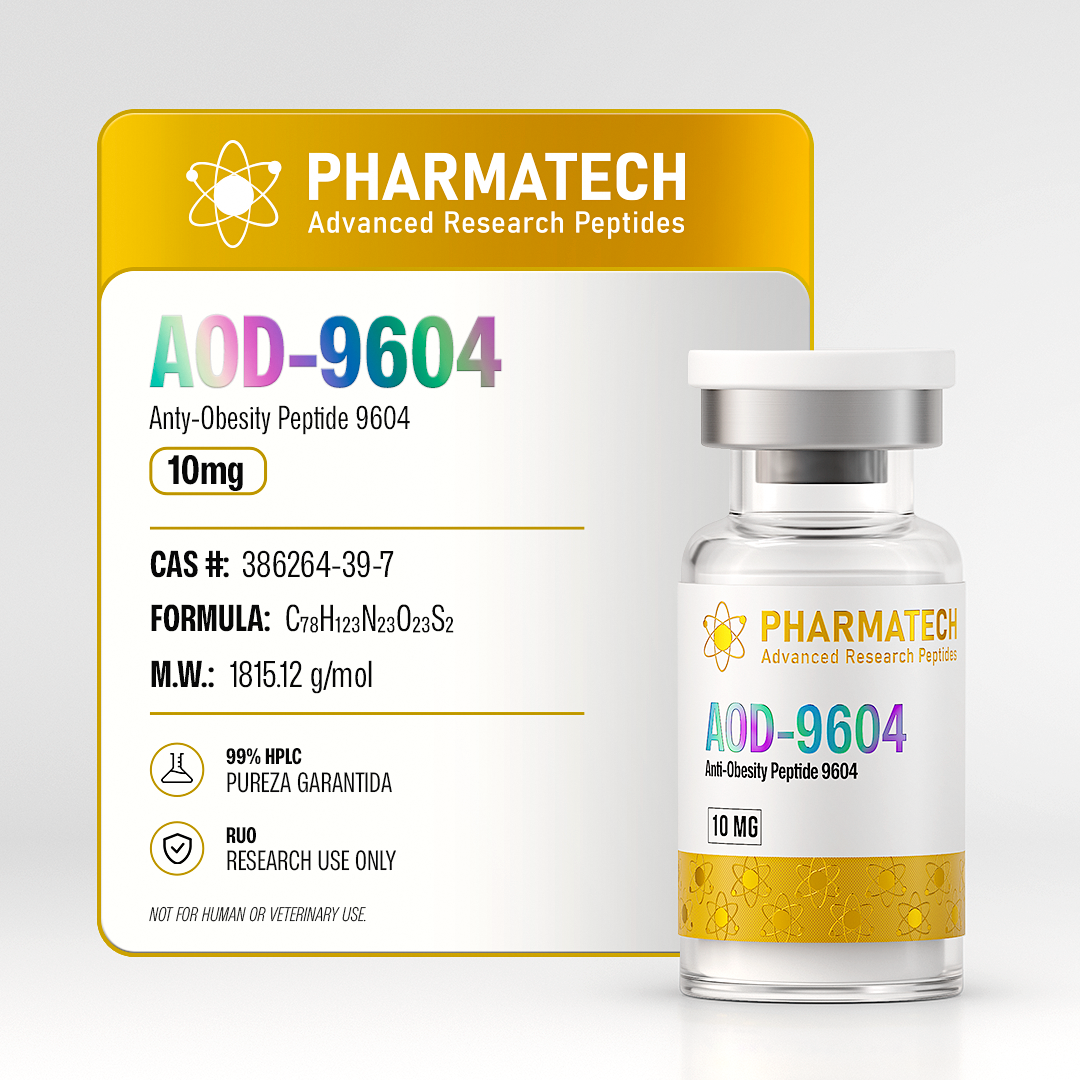
AOD-9604 10mg – PharmaTech
AOD-9604 has been studied in preclinical models of lipolysis, lipid metabolism, obesity, adipose-tissue biology, and metabolic regulation, followed by human clinical development programs. The available human evidence, however, did not establish a statistically significant effect on body weight in the pivotal Phase 2b program.
OVERVIEW
AOD-9604 is a synthetic 16-amino-acid peptide derived from the C-terminal region of human growth hormone (hGH). It is structurally related to the hGH C-terminal 177–191 region and incorporates an N-terminal tyrosine modification.
The peptide was developed to investigate the lipolytic and metabolic activity associated with the C-terminal region of growth hormone, while separating these effects from the broader growth-promoting activity of intact GH.
AOD-9604 has been studied in preclinical models of lipolysis, lipid metabolism, obesity, adipose-tissue biology, and metabolic regulation, followed by human clinical development programs. The available human evidence, however, did not establish a statistically significant effect on body weight in the pivotal Phase 2b program.
MECHANISM OF ACTION
C-Terminal hGH Fragment
AOD-9604 is designed around the C-terminal region of human growth hormone rather than the complete 191-amino-acid GH molecule.
Preclinical research investigated whether this region could reproduce aspects of GH-associated fat metabolism, particularly stimulation of lipolysis and modulation of lipid storage, without reproducing the classical GH receptor-mediated growth pathway.
Lipolytic Signaling
Experimental studies have associated AOD-9604 with pathways involving:
- Adipocyte lipolysis
- Fatty-acid mobilization
- Inhibition of lipogenesis
- Fat oxidation
- Adipose-tissue metabolic regulation
The precise molecular target responsible for these effects has not been definitively established in humans.
Distinction From Intact Growth Hormone
AOD-9604 should not be considered equivalent to recombinant human growth hormone.
The research hypothesis behind AOD-9604 was that the C-terminal region of GH could influence lipid metabolism independently of the classical GH receptor → IGF-1 growth pathway.
KEY BENEFITS
Research interest in AOD-9604 includes:
- Lipolysis research
- Adipocyte biology
- Fatty-acid metabolism
- Lipogenesis research
- Fat oxidation
- Adipose-tissue signaling
- Metabolic regulation
- Obesity research
- C-terminal GH-fragment biology
- Comparative GH-fragment research
- Cartilage and osteoarthritis research
These represent experimental research areas rather than established clinical outcomes.
RESEARCH AREAS
Lipolysis
AOD-9604 has been investigated for its ability to stimulate lipid mobilization in experimental adipocyte and animal models.
Lipogenesis
Preclinical research has examined inhibition of pathways involved in lipid storage and synthesis.
Adipose-Tissue Biology
Research has investigated AOD-9604 in relation to adipocyte metabolism, fatty-acid utilization, and changes in adipose tissue.
Metabolic Research
Experimental models have evaluated the peptide in obesity, insulin sensitivity, energy metabolism, and metabolic dysfunction.
Growth-Hormone Fragment Biology
AOD-9604 provides a research model for investigating biological activity associated with the C-terminal region of GH independently from intact somatotropin.
Cartilage & Joint Biology
AOD-9604 has also been investigated experimentally in models involving cartilage degeneration and osteoarthritis, expanding research beyond its original metabolic development program.
SCIENTIFIC EVIDENCE
The original research program investigated the hypothesis that the lipolytic activity of growth hormone could be separated from its growth-promoting and diabetogenic effects through the use of a C-terminal fragment.
AOD-9604 subsequently entered human obesity-development programs. A 2004 review documented Phase II development underway at that time.
Later FDA review documents describe a Phase 2b study involving approximately 300 participants in which AOD-9604 did not demonstrate a statistically significant difference in body weight versus placebo at the evaluated doses.
Consequently, the current scientific profile should distinguish between:
Preclinical evidence: substantial investigation of lipid metabolism and adipose-tissue biology.
Human evidence: clinical development occurred, but the pivotal weight-loss efficacy endpoint was not successfully demonstrated.
Mechanistic evidence: the precise human molecular target and complete pharmacological mechanism remain incompletely characterized.
MOLECULAR PROFILE
| Parameter | AOD-9604 |
|---|---|
| Compound class | Synthetic C-terminal hGH fragment analogue |
| Peptide length | 16 amino acids |
| Sequence | YLRIVQCRSVEGSCGF |
| Structural relationship | Modified hGH C-terminal fragment |
| Disulfide bond | Cys7–Cys14 |
| Molecular formula | C₇₈H₁₂₃N₂₃O₂₃S₂ |
| Molecular weight | ~1,815.1 Da |
| CAS | 221231-10-3 |
| Primary research focus | Lipid metabolism / adipose biology |
| Parent molecule | Human growth hormone |
| Molecular category | Synthetic peptide |
AOD-9604 is distinct from native hGH Fragment 176–191. The additional N-terminal tyrosine means the two compounds should not be treated as chemically identical.
The intramolecular disulfide bridge between the two cysteine residues is an important structural characteristic of the molecule.
PHARMACOKINETIC & PHARMACODYNAMIC PROFILE
Pharmacokinetic Profile
Human pharmacokinetic characterization of AOD-9604 is limited.
FDA review documentation states that human pharmacokinetic or pharmacodynamic studies were not identified for the proposed routes evaluated in its 2024 review. In nonclinical work, AOD-9604 was rapidly degraded in blood, with an approximately 3-minute intravenous half-life reported in pigs.
In vitro studies also demonstrated rapid hydrolysis of the intact peptide in serum, generating smaller peptide fragments.
Accordingly, pharmacokinetic characteristics depend substantially on:
- Molecular integrity
- Formulation
- Route of administration
- Peptide stability
- Proteolytic degradation
- Salt/counterion form
- Product-specific analytical characteristics
Pharmacodynamic Profile
The proposed experimental pathway can be summarized as:
AOD-9604 → adipose-tissue signaling → lipolytic activity → fatty-acid mobilization
Additional research pathways include:
AOD-9604 → inhibition of lipogenesis → altered lipid-storage dynamics
The precise receptor or molecular target responsible for these effects has not been conclusively established.
Importantly, AOD-9604 should not be assumed to reproduce the complete pharmacodynamic profile of intact human growth hormone.
RESEARCH HIGHLIGHTS
- Synthetic 16-amino-acid hGH fragment analogue
- C-terminal GH biology
- Lipolysis research
- Adipocyte metabolism
- Fatty-acid mobilization
- Lipogenesis research
- Fat oxidation
- Adipose-tissue biology
- Metabolic research
- Obesity research
- GH-fragment pharmacology
- Cartilage research
- Osteoarthritis models
- Peptide stability and degradation research
TECHNICAL SPECIFICATIONS
| Parameter | PharmaTech Specification |
|---|---|
| Product | AOD-9604 |
| Product type | Synthetic peptide |
| Peptide length | 16 amino acids |
| Sequence | YLRIVQCRSVEGSCGF |
| Molecular weight | ~1.815 kDa |
| Disulfide bond | Cys7–Cys14 |
| Total quantity | [PharmaTech specification] |
| Chemical form | [PharmaTech specification] |
| Purity | ≥ [PharmaTech specification]% |
| Physical form | Lyophilized powder |
| Appearance | White to off-white lyophilized material |
| Batch | [Batch specification] |
| Storage | Controlled refrigerated storage |
| Research category | Metabolic / adipose-tissue biology |
STORAGE & HANDLING
Store the lyophilized product under controlled conditions according to the applicable PharmaTech product specification.
Protect from:
- Excessive heat
- Direct light
- Moisture
- Repeated temperature fluctuations
- Physical contamination
Maintain the container sealed until laboratory use and handle under appropriate controlled conditions.