

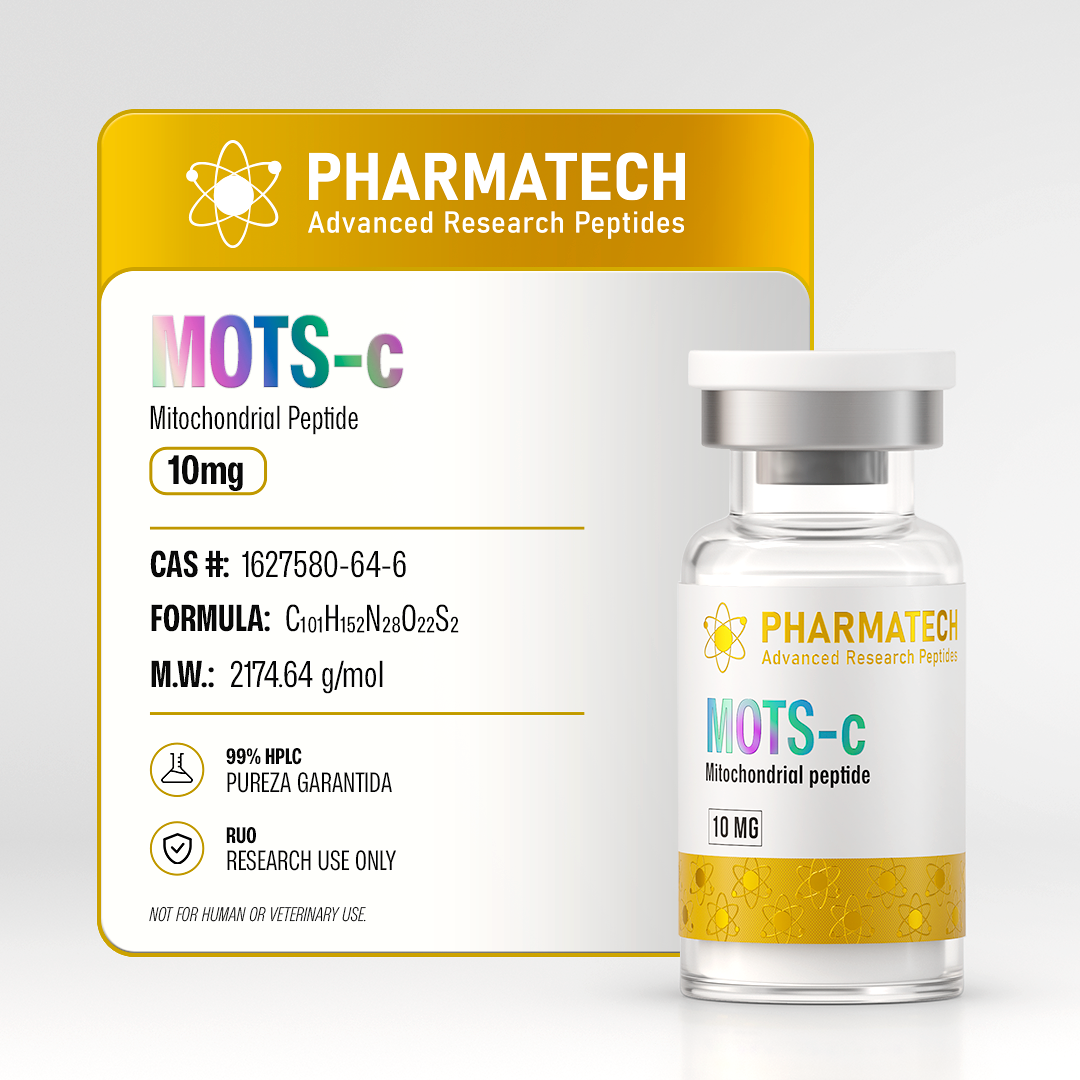
MOTS-c 10mg – PharmaTech
MOTS-c (Mitochondrial Open Reading Frame of the 12S rRNA-c) is a naturally occurring 16-amino-acid mitochondrial-derived peptide (MDP) encoded by a short open reading frame within mitochondrial DNA.
Unlike conventional peptides encoded by nuclear genes, MOTS-c represents a mitochondrial signaling molecule involved in communication between mitochondrial metabolism, cellular energy sensing, and nuclear gene regulation. Experimental research has associated MOTS-c with metabolic homeostasis, insulin sensitivity, cellular stress adaptation, mitochondrial bioenergetics, and exercise-related signaling.
MOTS-c is particularly relevant to research investigating the relationship between mitochondrial function, AMPK signaling, metabolic flexibility, oxidative stress, and cellular adaptation.
OVERVIEW
MOTS-c (Mitochondrial Open Reading Frame of the 12S rRNA-c) is a naturally occurring 16-amino-acid mitochondrial-derived peptide (MDP) encoded by a short open reading frame within mitochondrial DNA.
Unlike conventional peptides encoded by nuclear genes, MOTS-c represents a mitochondrial signaling molecule involved in communication between mitochondrial metabolism, cellular energy sensing, and nuclear gene regulation. Experimental research has associated MOTS-c with metabolic homeostasis, insulin sensitivity, cellular stress adaptation, mitochondrial bioenergetics, and exercise-related signaling.
MOTS-c is particularly relevant to research investigating the relationship between mitochondrial function, AMPK signaling, metabolic flexibility, oxidative stress, and cellular adaptation.
MECHANISM OF ACTION
AMPK & Energy-Sensing Signaling
One of the principal pathways associated with MOTS-c is the AMP-activated protein kinase (AMPK) system.
Experimental research indicates that MOTS-c can influence the folate cycle and de novo purine biosynthesis, increasing intracellular AICAR-related signaling and contributing to AMPK activation. AMPK functions as a major cellular energy sensor regulating glucose utilization, fatty-acid metabolism, and energy homeostasis.
Mitochondria–Nucleus Communication
MOTS-c can translocate from the cytoplasm into the nucleus under metabolic stress.
Within the nucleus, experimental studies have shown that MOTS-c can influence stress-responsive gene expression through an AMPK-dependent mechanism, including interaction with transcriptional pathways associated with antioxidant response elements and NRF2-related signaling.
Mitochondrial Bioenergetics
More recent experimental work has investigated MOTS-c in skeletal-muscle mitochondrial function, with findings linking its activity to AMPK and PGC-1α-dependent pathways involved in mitochondrial bioenergetic performance.
Metabolic Regulation
Research models have associated MOTS-c with:
- Glucose utilization
- Insulin sensitivity
- Fatty-acid oxidation
- Energy expenditure
- Metabolic adaptation
- Mitochondrial efficiency
- Cellular stress responses
KEY BENEFITS
Research interest in MOTS-c includes:
- Mitochondrial metabolism
- Cellular energy homeostasis
- AMPK signaling
- Insulin-sensitivity research
- Glucose metabolism
- Fatty-acid oxidation
- Metabolic flexibility
- Mitochondrial bioenergetics
- Skeletal-muscle metabolism
- Exercise-associated signaling
- Oxidative-stress research
- Cellular stress adaptation
- Aging and longevity biology
- Mitochondria–nucleus communication
These represent research areas associated with MOTS-c biology and should not be interpreted as established therapeutic outcomes.
RESEARCH AREAS
Mitochondrial Biology
MOTS-c is particularly relevant to studies investigating how mitochondria function not only as energy-producing organelles but also as sources of regulatory signaling peptides.
AMPK Signaling
Research into MOTS-c provides a model for studying cellular energy sensing through AMPK and associated metabolic pathways.
Glucose & Insulin Signaling
Preclinical studies have investigated MOTS-c in relation to glucose metabolism, insulin sensitivity, and metabolic homeostasis.
Fatty-Acid Oxidation
Experimental research has associated MOTS-c with increased fatty-acid oxidation and alterations in metabolic pathways associated with lipid utilization.
Skeletal-Muscle Metabolism
MOTS-c has been investigated in skeletal muscle as a regulator of mitochondrial bioenergetics and metabolic adaptation, including pathways involving AMPK and PGC-1α.
Cellular Stress Response
MOTS-c can participate in mitochondrial-to-nuclear signaling under metabolic stress and has been investigated in relation to antioxidant response pathways.
Aging & Longevity Biology
MOTS-c is an active area of research into mitochondrial signaling, cellular senescence, metabolic aging, and age-associated metabolic dysfunction. Recent experimental work has also investigated MOTS-c in pancreatic islet-cell senescence.
SCIENTIFIC EVIDENCE
The original characterization of MOTS-c identified it as a 16-amino-acid peptide encoded by mitochondrial 12S rRNA and demonstrated effects on metabolic homeostasis and insulin sensitivity in experimental models. In mice, MOTS-c treatment was associated with protection against diet-induced metabolic dysfunction and increased AMPK-related signaling.
Subsequent research demonstrated that MOTS-c can translocate to the nucleus under metabolic stress and influence nuclear gene expression through AMPK-dependent mechanisms, including regulation of genes associated with antioxidant response elements.
Additional experimental studies have investigated MOTS-c in skeletal-muscle mitochondrial bioenergetics, reporting involvement of AMPK and PGC-1α pathways.
Human research remains considerably more limited than the preclinical literature. Observational studies have investigated circulating MOTS-c concentrations in relation to insulin sensitivity, while more recent work continues to explore its relationship with metabolic disease and cellular aging.
Accordingly, the strongest current evidence base for MOTS-c remains mechanistic and preclinical, with human pharmacological and therapeutic characterization still developing.
MOLECULAR PROFILE
| Parameter | MOTS-c |
|---|---|
| Full name | Mitochondrial Open Reading Frame of the 12S rRNA-c |
| Compound class | Mitochondrial-derived peptide |
| Peptide length | 16 amino acids |
| Sequence | MRWQEMGYIFYPRKLR |
| Molecular formula | C₁₀₁H₁₅₂N₂₈O₂₂S₂ |
| Molecular weight | ~2,174.6 Da |
| CAS | 1627580-64-6 |
| Genetic origin | Mitochondrial DNA |
| Source region | 12S rRNA short open reading frame |
| Primary research pathways | AMPK / PGC-1α / metabolic stress signaling |
| Cellular distribution | Cytoplasmic and nuclear under metabolic stress |
| Molecular category | Mitochondrial signaling peptide |
The human MOTS-c sequence and molecular characteristics are documented as MRWQEMGYIFYPRKLR, with a calculated molecular weight of approximately 2.17 kDa.
PHARMACOKINETIC & PHARMACODYNAMIC PROFILE
Pharmacokinetic Profile
Comprehensive human pharmacokinetic characterization of exogenously administered MOTS-c remains limited.
The pharmacokinetic behavior of the peptide can be influenced by:
- Peptide stability
- Proteolytic degradation
- Formulation
- Concentration
- Route of administration
- Chemical form or counterion
- Tissue distribution
- Clearance mechanisms
Consequently, pharmacokinetic parameters for a specific PharmaTech formulation should be established through product-specific analytical and pharmacological characterization.
Pharmacodynamic Profile
The principal experimental signaling cascade can be summarized as:
MOTS-c → metabolic stress sensing → AMPK-related signaling → energy metabolism
Additional pathways include:
MOTS-c → folate/purine metabolism → AICAR-related signaling → AMPK activation
and:
MOTS-c → cellular stress → nuclear translocation → NRF2/ARE-associated gene regulation
In skeletal muscle:
MOTS-c → AMPK / PGC-1α signaling → mitochondrial bioenergetic adaptation.
This places MOTS-c within a broader network connecting mitochondrial metabolism, cellular energy sensing, and nuclear stress-response mechanisms.
RESEARCH HIGHLIGHTS
- Mitochondrial-derived signaling peptide
- 16-amino-acid mitochondrial peptide
- AMPK pathway research
- Mitochondria–nucleus communication
- Cellular energy sensing
- Glucose and insulin signaling
- Fatty-acid oxidation
- Mitochondrial bioenergetics
- Skeletal-muscle metabolism
- PGC-1α-associated pathways
- Oxidative-stress research
- NRF2/ARE-related signaling
- Metabolic adaptation
- Aging and cellular-senescence research
TECHNICAL SPECIFICATIONS
| Parameter | PharmaTech Specification |
|---|---|
| Product | MOTS-c |
| Product type | Synthetic mitochondrial-derived peptide |
| Peptide length | 16 amino acids |
| Sequence | MRWQEMGYIFYPRKLR |
| Molecular weight | ~2.17 kDa |
| Total quantity | [PharmaTech specification] |
| Purity | ≥ [PharmaTech specification]% |
| Physical form | Lyophilized powder |
| Appearance | White to off-white lyophilized material |
| Chemical form | [PharmaTech specification] |
| Batch | [Batch specification] |
| Storage | Controlled refrigerated storage |
| Research category | Mitochondrial / metabolic signaling |
STORAGE & HANDLING
Store the lyophilized product under controlled conditions according to the applicable PharmaTech product specification.
Protect from:
- Excessive heat
- Direct light
- Moisture
- Repeated temperature fluctuations
- Physical contamination
Maintain the container sealed until laboratory use and handle under appropriate controlled conditions.