

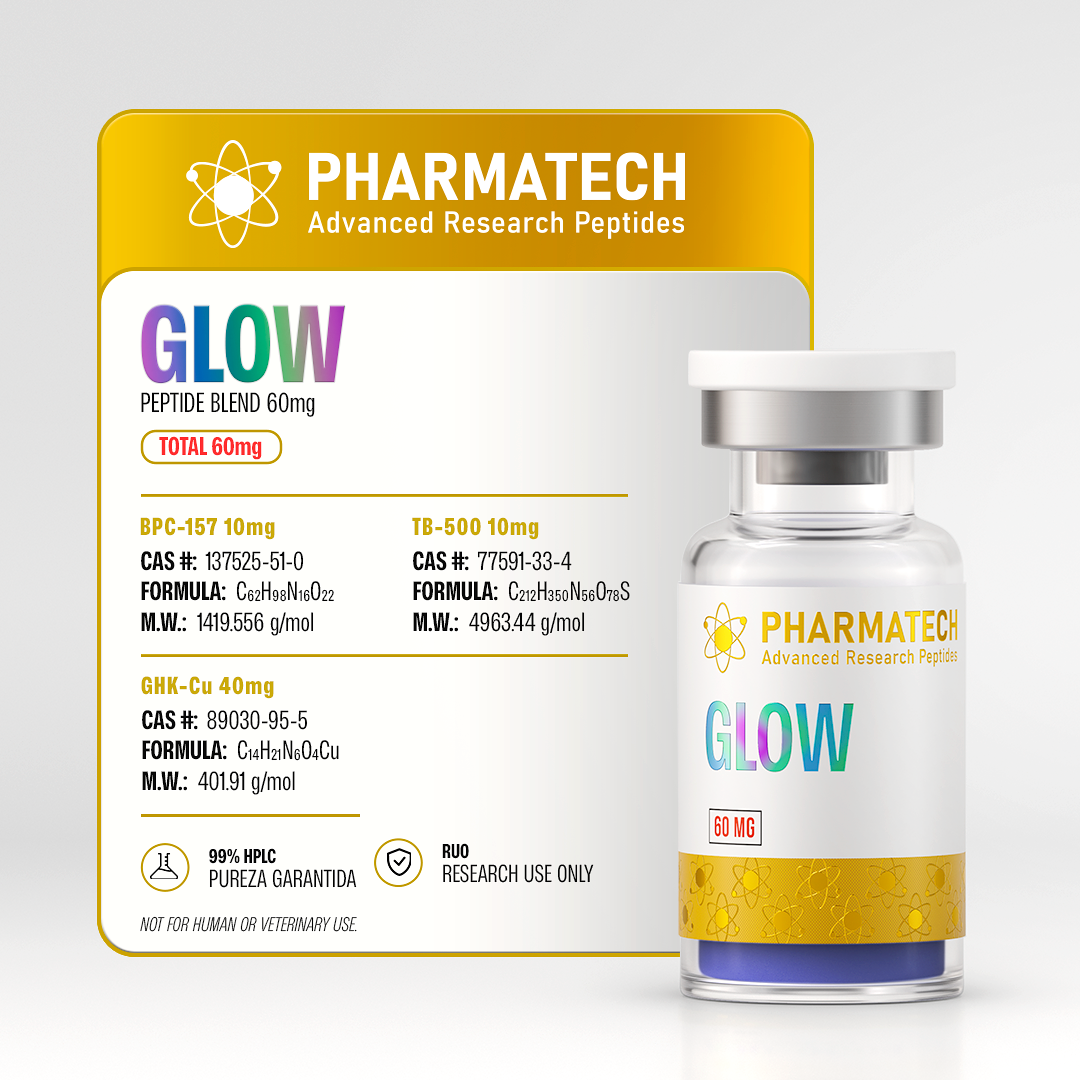
GLOW Blend – PharmaTech
GLOW Blend is a three-peptide combination composed of BPC-157, TB-500, and GHK-Cu, designed around complementary research pathways associated with tissue remodeling, cellular migration, angiogenesis, extracellular-matrix biology, and connective-tissue research.
The three components represent distinct biological mechanisms:
- BPC-157 — investigated in relation to angiogenic signaling, endothelial responses, cellular migration, and tissue-remodeling pathways.
- TB-500 / Thymosin Beta-4-related peptide — associated with actin dynamics, cellular migration, cytoskeletal organization, and angiogenesis.
- GHK-Cu — a copper-binding tripeptide extensively studied in collagen turnover, extracellular-matrix remodeling, fibroblast biology, and skin/tissue research.
The GLOW combination is therefore particularly relevant to research models examining the interaction between vascular response, cellular migration, and extracellular-matrix remodeling.
Importantly, the available literature primarily evaluates the individual components rather than the complete three-peptide blend. Direct peer-reviewed studies specifically evaluating GLOW as a fixed combination remain limited.
OVERVIEW
GLOW Blend is a three-peptide combination composed of BPC-157, TB-500, and GHK-Cu, designed around complementary research pathways associated with tissue remodeling, cellular migration, angiogenesis, extracellular-matrix biology, and connective-tissue research.
The three components represent distinct biological mechanisms:
- BPC-157 — investigated in relation to angiogenic signaling, endothelial responses, cellular migration, and tissue-remodeling pathways.
- TB-500 / Thymosin Beta-4-related peptide — associated with actin dynamics, cellular migration, cytoskeletal organization, and angiogenesis.
- GHK-Cu — a copper-binding tripeptide extensively studied in collagen turnover, extracellular-matrix remodeling, fibroblast biology, and skin/tissue research.
The GLOW combination is therefore particularly relevant to research models examining the interaction between vascular response, cellular migration, and extracellular-matrix remodeling.
Importantly, the available literature primarily evaluates the individual components rather than the complete three-peptide blend. Direct peer-reviewed studies specifically evaluating GLOW as a fixed combination remain limited.
MECHANISM OF ACTION
BPC-157 — Vascular & Cellular Signaling
BPC-157 is a synthetic pentadecapeptide investigated extensively in preclinical models of tissue repair.
Research has associated BPC-157 with pathways involving:
- Angiogenesis
- Endothelial-cell signaling
- Fibroblast migration
- Nitric oxide signaling
- FAK/paxillin-associated pathways
- VEGF-related signaling
- Extracellular-matrix remodeling
Experimental models have investigated these pathways in relation to vascular and soft-tissue biology.
TB-500 — Cytoskeletal & Migration Pathways
TB-500 is commonly associated with thymosin beta-4 biology.
Thymosin beta-4 is an actin-binding peptide involved in cytoskeletal organization and cellular migration. Research has also investigated its relationship with angiogenesis, endothelial responses, wound closure, and tissue remodeling.
GHK-Cu — Extracellular-Matrix Remodeling
GHK-Cu is a copper-complexed tripeptide consisting of glycyl-histidyl-lysine coordinated with Cu²⁺.
Research has associated GHK-Cu with:
- Collagen turnover
- Fibroblast activity
- Extracellular-matrix remodeling
- Matrix metalloproteinase regulation
- Angiogenesis
- Antioxidant pathways
- Skin and connective-tissue biology PMC
Combined Research Model
The three components can therefore be represented as:
BPC-157 → vascular/cellular signaling → angiogenesis & cellular migration
TB-500 → actin/cytoskeletal regulation → cellular migration & tissue remodeling
GHK-Cu → copper-dependent signaling → collagen/ECM remodeling
GLOW Blend → complementary investigation of vascular response + cellular migration + matrix remodeling
KEY BENEFITS
Research interest in GLOW Blend includes:
- Tissue-remodeling biology
- Extracellular-matrix research
- Collagen biology
- Fibroblast activity
- Cellular migration
- Angiogenesis
- Connective-tissue research
- Musculoskeletal tissue biology
- Skin and dermal biology
- Wound-healing models
- Cytoskeletal dynamics
- Inflammatory signaling
- Oxidative-stress research
- Vascular biology
These areas represent research pathways associated with the individual components and should not be interpreted as clinical outcomes established for the combined formulation. Current reviews emphasize that human evidence for these emerging peptide compounds remains limited compared with the extensive preclinical literature.
RESEARCH AREAS
Tissue Remodeling
Investigation of the cellular and molecular mechanisms involved in extracellular-matrix organization, tissue restructuring, and repair-associated signaling.
Extracellular-Matrix Biology
GHK-Cu provides a research component focused on collagen turnover, matrix metalloproteinases, fibroblast biology, and connective-tissue organization.
Cellular Migration
TB-500/thymosin beta-4-related biology provides a model for studying actin-dependent cellular movement and migration.
Angiogenesis
BPC-157 and thymosin beta-4-related research has investigated endothelial activity, vascular signaling, and formation of new microvascular structures.
Connective-Tissue Research
The combination is relevant to experimental investigation of collagen, fibroblasts, extracellular matrix, tendon, ligament, fascia, and other connective tissues.
Skin Biology
GHK-Cu has a substantial research history involving dermal fibroblasts, collagen synthesis, matrix remodeling, and skin biology.
Wound-Healing Models
Preclinical studies involving the individual components have examined cellular migration, angiogenesis, matrix formation, and wound closure.
SCIENTIFIC EVIDENCE
The scientific foundation for GLOW Blend is primarily derived from component-level research.
BPC-157 has been investigated predominantly in animal and laboratory models involving wound healing, vascular responses, tendon and muscle biology, and cellular signaling.
Thymosin beta-4-related research has explored actin dynamics, cellular migration, angiogenesis, wound repair, and tissue remodeling. GHK-Cu has a comparatively broad literature involving extracellular-matrix biology, collagen turnover, fibroblast activity, angiogenesis, and skin research.
A recent 2026 scoping review of BPC-157, TB-500, and GHK-Cu found that the majority of publications were preclinical, with relatively limited and heterogeneous human evidence.
Consequently, the scientific rationale for combining the three peptides is based primarily on their complementary biological pathways, rather than on clinical trials directly evaluating the GLOW formulation.
MOLECULAR PROFILE
| Parameter | BPC-157 | TB-500 / Thymosin Beta-4 | GHK-Cu |
|---|---|---|---|
| Compound class | Synthetic pentadecapeptide | Thymosin beta-4-related peptide | Copper-binding tripeptide |
| Primary research focus | Vascular & cellular signaling | Cytoskeletal dynamics & migration | ECM & collagen biology |
| Peptide length | 15 amino acids | 43 amino acids for full-length Tβ4 | 3 amino acids + Cu²⁺ |
| Sequence | GEPPPGKPADDAGLV | SDKPDMAEIEKFDKSKLKKTETQEKNPLPSKETIEQEKQAGES | Gly-His-Lys |
| Molecular weight | ~1.42 kDa | ~4.96 kDa for full-length Tβ4 | ~0.40 kDa |
| Principal research pathways | VEGF, FAK, eNOS, angiogenesis | Actin, MAPK, FAK, cellular migration | Collagen, MMPs, redox/copper signaling |
| Research focus | Tissue & vascular biology | Tissue remodeling & migration | Matrix & dermal biology |
The molecular characteristics of the individual components are distinct and should not be interpreted as evidence that the three compounds form a single molecular entity.
PHARMACOKINETIC & PHARMACODYNAMIC PROFILE
Pharmacokinetic Profile
Comprehensive human pharmacokinetic characterization of the complete BPC-157 + TB-500 + GHK-Cu combination is not established.
The pharmacokinetic behavior of each component can differ substantially according to:
- Molecular structure
- Peptide stability
- Formulation
- Concentration
- Route of administration
- Proteolytic degradation
- Copper coordination state in GHK-Cu
- Product-specific analytical characteristics
GHK-Cu is particularly formulation-dependent because copper coordination and peptide stability influence its molecular and biological behavior.
Pharmacodynamic Profile
The principal research pathways can be summarized as:
BPC-157 → angiogenic/cellular signaling → endothelial response & cellular migration
TB-500 → actin interaction → cytoskeletal organization & cell migration
GHK-Cu → copper-peptide signaling → fibroblast activity & ECM remodeling
Together, these pathways provide a multidimensional research model involving:
vascular response → cellular migration → matrix remodeling → tissue organization
The exact pharmacodynamic behavior of the complete PharmaTech blend depends on its specific formulation and component ratio.
RESEARCH HIGHLIGHTS
- Three-pathway tissue-remodeling research platform
- BPC-157 vascular and cellular signaling
- TB-500/thymosin beta-4 actin biology
- GHK-Cu extracellular-matrix research
- Angiogenesis
- Cellular migration
- Fibroblast activity
- Collagen biology
- Connective-tissue research
- Skin and dermal biology
- Wound-healing models
- Cytoskeletal dynamics
- Matrix remodeling
- Vascular biology
TECHNICAL SPECIFICATIONS
| Parameter | PharmaTech Specification |
|---|---|
| Product | GLOW Blend |
| Product type | Multi-peptide blend |
| Components | BPC-157 + TB-500 + GHK-Cu |
| Total quantity | [PharmaTech specification] |
| BPC-157 content | [PharmaTech specification] |
| TB-500 content | [PharmaTech specification] |
| GHK-Cu content | [PharmaTech specification] |
| Blend ratio | [PharmaTech specification] |
| Purity | ≥ [PharmaTech specification]% |
| Physical form | Lyophilized powder |
| Container | Sterile sealed vial |
| Appearance | White to off-white lyophilized material |
| Batch | [Batch specification] |
| Storage | Controlled refrigerated storage |
| Research category | Tissue remodeling / regenerative biology |
STORAGE & HANDLING
Store the lyophilized product under controlled conditions according to the applicable PharmaTech product specification.
Protect from:
- Excessive heat
- Direct light
- Moisture
- Repeated temperature fluctuations
- Physical contamination
Maintain the container sealed until laboratory use and handle under appropriate controlled conditions.