

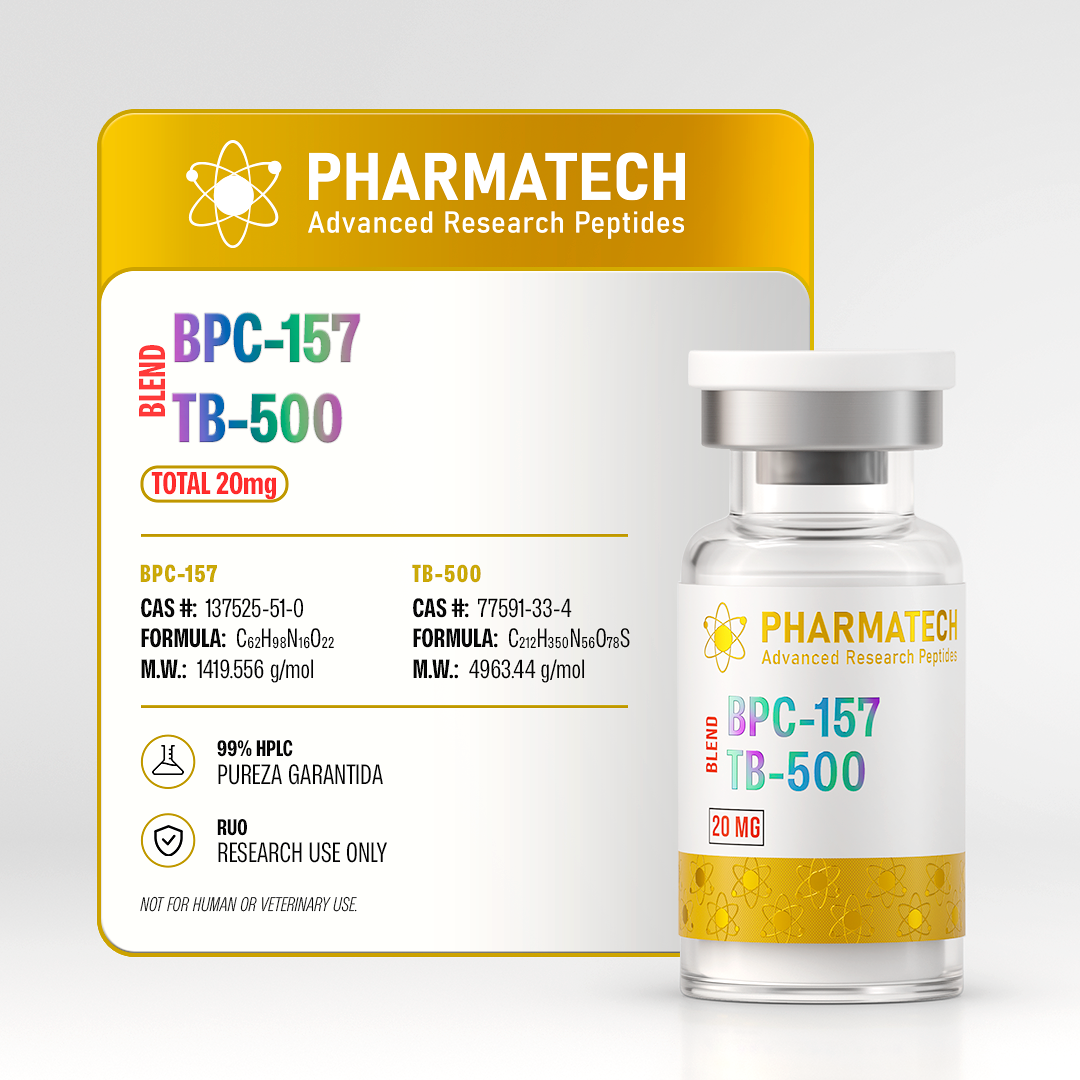
BPC-157 + TB-500 Blend 20mg – PharmaTech
BPC-157 + TB-500 is a complementary peptide blend combining BPC-157, a synthetic 15-amino-acid peptide, with TB-500, commonly associated with the thymosin beta-4 peptide family.
The combination is of interest in experimental research investigating tissue remodeling, cellular migration, angiogenesis, extracellular-matrix organization, cytoskeletal dynamics, and recovery-associated signaling.
OVERVIEW
BPC-157 + TB-500 is a complementary peptide blend combining BPC-157, a synthetic 15-amino-acid peptide, with TB-500, commonly associated with the thymosin beta-4 peptide family.
The combination is of interest in experimental research investigating tissue remodeling, cellular migration, angiogenesis, extracellular-matrix organization, cytoskeletal dynamics, and recovery-associated signaling.
BPC-157 has the sequence GEPPPGKPADDAGLV and a molecular weight of approximately 1.42 kDa. TB-500 preparations are generally associated with the thymosin beta-4 sequence or derivatives thereof; full-length thymosin beta-4 is a 43-residue peptide with a molecular weight of approximately 4.96 kDa.
The two peptides are investigated through different but potentially complementary biological mechanisms, making the blend relevant to research involving soft-tissue biology, wound repair, vascular responses, and musculoskeletal tissue remodeling.
MECHANISM OF ACTION
BPC-157
BPC-157 is a 15-residue peptide whose experimental activity has been associated with several cellular and vascular processes.
Research models have investigated its relationship with:
- Angiogenic signaling
- Endothelial-cell activity
- Fibroblast responses
- Cellular migration
- Nitric-oxide-related pathways
- Extracellular-matrix organization
- Tissue remodeling
- Cytoprotective signaling
Its precise molecular target and complete mechanism of action remain incompletely characterized.
TB-500 / Thymosin Beta-4 Pathway
TB-500 is commonly associated with thymosin beta-4 biology. Thymosin beta-4 is an actin-binding peptide involved in regulation of the intracellular cytoskeleton, cellular migration, and other processes associated with tissue remodeling. PubChem
Experimental research has investigated thymosin beta-4-related signaling in:
- Actin dynamics
- Cell migration
- Angiogenesis
- Endothelial-cell activity
- Fibroblast migration
- Extracellular-matrix remodeling
- Tissue regeneration
Combined Mechanistic Model
The two components can therefore be viewed as complementary research pathways:
BPC-157 → vascular/cellular signaling → cellular migration and tissue-remodeling processes
TB-500 → actin/cytoskeletal regulation → cell migration and tissue remodeling
Combined research model → vascular, cellular, and extracellular-matrix remodeling
This mechanistic rationale should be distinguished from direct clinical evidence for the specific BPC-157 + TB-500 blend.
KEY BENEFITS
Research interest in the combination includes:
- Tissue-repair biology
- Cellular migration
- Angiogenesis research
- Fibroblast activity
- Extracellular-matrix remodeling
- Connective-tissue research
- Musculoskeletal tissue biology
- Skeletal-muscle research
- Tendon and ligament biology
- Wound-healing models
- Vascular biology
- Cytoskeletal dynamics
- Cellular stress and survival pathways
RESEARCH AREAS
Tissue Remodeling
Investigation of cellular processes involved in tissue restructuring, extracellular-matrix organization, and regeneration-associated signaling.
Angiogenesis
Research into endothelial-cell migration, vascular remodeling, and formation of new microvascular structures.
Connective Tissue
Experimental investigation of fibroblast activity, collagen-associated processes, and extracellular-matrix dynamics.
Musculoskeletal Biology
Research involving skeletal muscle, tendon, ligament, and other connective tissues.
Cellular Migration
TB-500/thymosin beta-4 biology is particularly relevant to actin-dependent cellular movement and migration.
Wound-Healing Research
Experimental models investigate interactions between cellular migration, angiogenesis, matrix remodeling, and tissue repair.
Vascular Biology
Research into endothelial signaling, microvascular responses, and angiogenic mechanisms.
SCIENTIFIC EVIDENCE
BPC-157 research has primarily involved preclinical experimental models, with studies investigating vascular, gastrointestinal, musculoskeletal, and tissue-remodeling mechanisms. PubChem identifies BPC-157 as a peptide under investigation in clinical research, but its broader biological evidence remains predominantly experimental.
Thymosin beta-4 has a broader biological literature involving actin sequestration, cytoskeletal organization, cell migration, angiogenesis, and tissue remodeling.
It is important scientifically to distinguish TB-500 from full-length endogenous thymosin beta-4 and from specific thymosin beta-4 fragments. Different preparations may have different molecular structures and pharmacological characteristics.
Direct scientific evidence evaluating the BPC-157 + TB-500 combination as a defined formulation is substantially more limited than the individual literature surrounding each component.
MOLECULAR PROFILE
| Parameter | BPC-157 | TB-500 / Thymosin Beta-4 |
|---|---|---|
| Compound class | Synthetic pentadecapeptide | Thymosin beta-4-related peptide |
| Peptide length | 15 amino acids | 43 amino acids for full-length Tβ4 |
| Primary research focus | Cellular, vascular and tissue-remodeling biology | Cytoskeletal dynamics, migration and tissue remodeling |
| Sequence | GEPPPGKPADDAGLV | SDKPDMAEIEKFDKSKLKKTETQEKNPLPSKETIEQEKQAGES |
| Molecular formula | C₆₂H₉₈N₁₆O₂₂ | C₂₁₂H₃₅₀N₅₆O₇₈S |
| Molecular weight | ~1,419.5 Da | ~4,963 Da |
| CAS | 137525-51-0 | Preparation-dependent |
| Biological category | Experimental peptide | Thymosin beta-4-related peptide |
BPC-157 molecular data are reported by PubChem. Full-length thymosin beta-4 molecular data and sequence are likewise documented by PubChem.
PHARMACOKINETIC & PHARMACODYNAMIC PROFILE
Pharmacokinetic Profile
Comprehensive human pharmacokinetic characterization of BPC-157 and TB-500 remains limited compared with established therapeutic peptides.
The pharmacokinetic profile of a BPC-157 + TB-500 blend depends on:
- Molecular structure of each component
- Peptide purity
- Formulation
- Concentration
- Route of administration
- Stability
- Proteolytic degradation
- Individual peptide disposition
Consequently, pharmacokinetic characteristics of the combined PharmaTech formulation should be determined from product-specific analytical and formulation data.
Pharmacodynamic Profile
The principal research pathways can be summarized as:
BPC-157 → cellular/vascular signaling → endothelial and fibroblast responses → tissue-remodeling processes
TB-500/Tβ4 → actin-associated signaling → cytoskeletal organization → cellular migration
Combined system → angiogenesis + cellular migration + extracellular-matrix remodeling
The biological response is therefore multidimensional rather than dependent on a single receptor target.
RESEARCH HIGHLIGHTS
- Complementary tissue-remodeling peptide system
- BPC-157 cellular and vascular research
- Thymosin beta-4/actin biology
- Cellular migration
- Angiogenesis
- Fibroblast activity
- Extracellular-matrix research
- Connective-tissue biology
- Musculoskeletal research
- Wound-healing models
- Vascular remodeling
- Cytoskeletal dynamics
TECHNICAL SPECIFICATIONS
| Parameter | PharmaTech Specification |
|---|---|
| Product | BPC-157 + TB-500 Blend |
| Product type | Synthetic peptide blend |
| Components | BPC-157 + TB-500 |
| Total quantity | [PharmaTech specification] |
| Ratio | [PharmaTech specification] |
| BPC-157 content | [PharmaTech specification] |
| TB-500 content | [PharmaTech specification] |
| Purity | ≥ [PharmaTech specification]% |
| Physical form | Lyophilized powder |
| Container | Sterile sealed vial |
| Appearance | White to off-white lyophilized material |
| Batch | [Batch specification] |
| Storage | Controlled refrigerated storage |
| Research category | Tissue remodeling / cellular biology |
STORAGE & HANDLING
Store the lyophilized product under controlled conditions according to the applicable PharmaTech product specification.
Protect from:
- Excessive heat
- Direct light
- Moisture
- Repeated temperature fluctuations
- Physical contamination
Maintain the container sealed until laboratory use and handle under appropriate controlled conditions.