

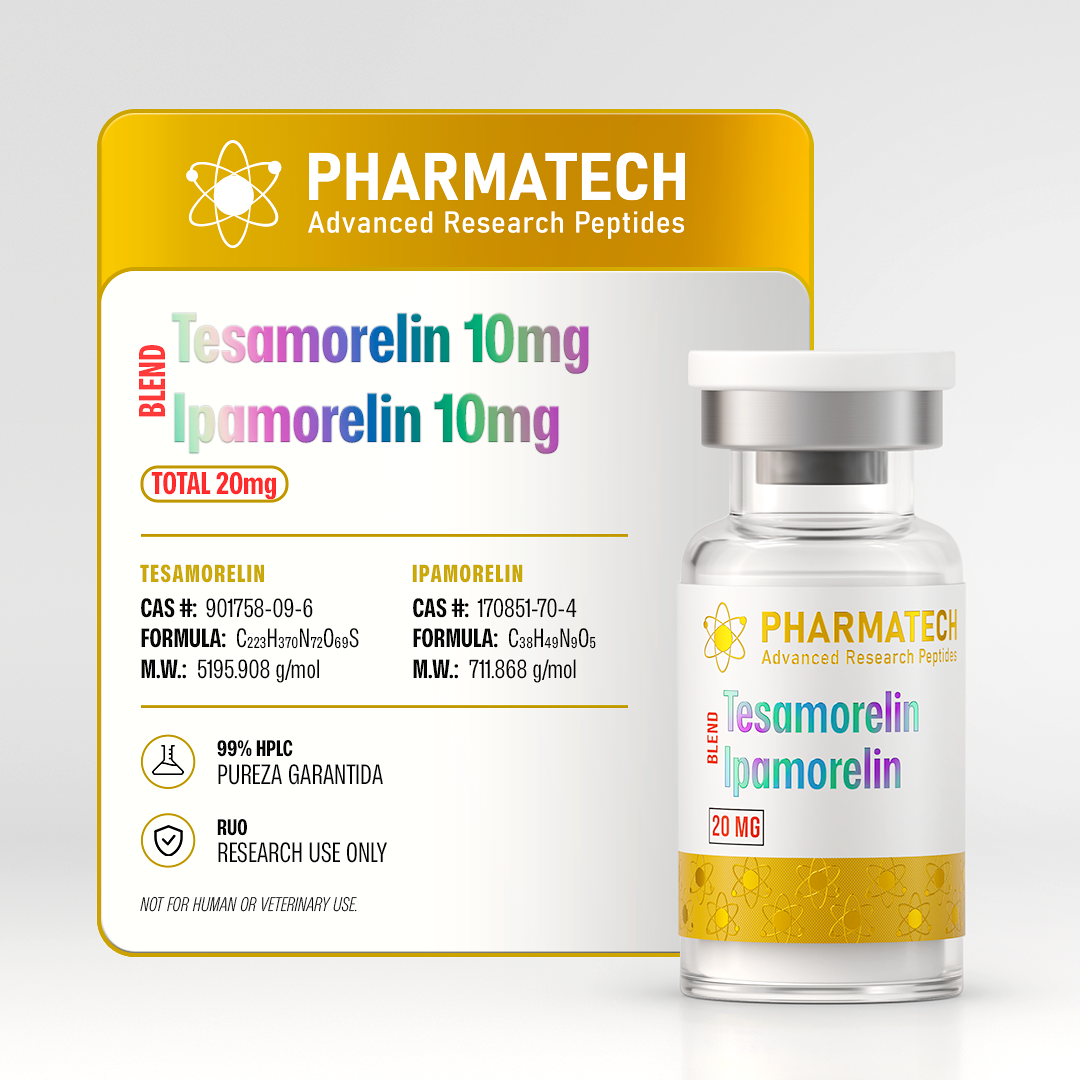
Tesamorelin + Ipamorelin Blend 20mg – PharmaTech
Tesamorelin + Ipamorelin is a dual-peptide combination designed to investigate complementary pathways within the growth hormone (GH) axis.
Tesamorelin is a synthetic analogue of growth hormone-releasing hormone (GHRH) that activates the GHRH receptor (GHRHR) on pituitary somatotroph cells, stimulating endogenous GH secretion. Ipamorelin is a selective growth hormone secretagogue that acts primarily through the ghrelin receptor (GHS-R1a).
The combination provides a research model for studying coordinated stimulation of GH secretion through two distinct receptor systems. Tesamorelin has established human pharmacology and clinical development history, whereas evidence specifically evaluating the Tesamorelin + Ipamorelin combination remains limited.
OVERVIEW
Tesamorelin + Ipamorelin is a dual-peptide combination designed to investigate complementary pathways within the growth hormone (GH) axis.
Tesamorelin is a synthetic analogue of growth hormone-releasing hormone (GHRH) that activates the GHRH receptor (GHRHR) on pituitary somatotroph cells, stimulating endogenous GH secretion. Ipamorelin is a selective growth hormone secretagogue that acts primarily through the ghrelin receptor (GHS-R1a).
The combination provides a research model for studying coordinated stimulation of GH secretion through two distinct receptor systems. Tesamorelin has established human pharmacology and clinical development history, whereas evidence specifically evaluating the Tesamorelin + Ipamorelin combination remains limited.
MECHANISM OF ACTION
Tesamorelin — GHRH Pathway
Tesamorelin binds to and stimulates the growth hormone-releasing hormone receptor (GHRHR) on pituitary somatotroph cells.
Activation of GHRHR promotes intracellular signaling that increases synthesis and pulsatile secretion of endogenous GH. GH subsequently interacts with growth hormone receptors in peripheral tissues and promotes downstream signaling involving IGF-1 and other metabolic pathways.
Ipamorelin — Ghrelin/GHS-R1a Pathway
Ipamorelin is a synthetic pentapeptide growth hormone secretagogue that acts primarily through the growth hormone secretagogue receptor type 1a (GHS-R1a).
GHS-R1a activation stimulates GH secretion through a pathway distinct from GHRHR activation, providing a complementary mechanism for investigating pituitary GH regulation.
Combined Mechanistic Model
The combination can therefore be represented as:
Tesamorelin → GHRHR activation → GH secretion
Ipamorelin → GHS-R1a activation → GH secretion
GH → GH receptor activation → IGF-1 and downstream metabolic signaling
This dual-pathway model is of interest in studies examining pulsatile GH physiology, endocrine signaling, body composition, metabolism, and tissue biology.
KEY BENEFITS
Research interest in the Tesamorelin + Ipamorelin combination includes:
- Investigation of complementary GH-secretagogue pathways
- Study of endogenous GH secretion
- Investigation of the GH/IGF-1 signaling axis
- Research into growth hormone pulsatility
- Metabolic and energy-balance research
- Body-composition research
- Adipose-tissue biology
- Muscle and connective-tissue research
- Cellular growth and regeneration pathways
- Endocrine signaling research
Tesamorelin itself has demonstrated effects on GH secretion and circulating IGF-1 and IGFBP-3 concentrations in human studies.
RESEARCH AREAS
Growth Hormone Physiology
Investigation of endogenous GH synthesis, secretion patterns, pulsatility, and endocrine feedback.
GHRH/GHRHR Signaling
Study of pituitary GHRH receptor activation and downstream intracellular signaling.
GHS-R1a Signaling
Investigation of ghrelin-receptor-mediated GH secretagogue activity.
GH/IGF-1 Axis
Research into the relationship between GH secretion, hepatic and peripheral IGF-1 production, and downstream biological responses.
Metabolic Research
Investigation of lipid metabolism, adipose tissue biology, glucose metabolism, and energy homeostasis.
Body Composition
Research into the biological mechanisms connecting GH signaling with adipose and lean-tissue physiology.
Muscle & Tissue Biology
Investigation of GH/IGF-1-associated pathways involved in muscle, connective tissue, and cellular growth.
SCIENTIFIC EVIDENCE
Tesamorelin has substantially more established human pharmacological data than the combined Tesamorelin + Ipamorelin formulation. FDA-approved tesamorelin formulations have demonstrated stimulation of endogenous GH secretion and subsequent increases in IGF-1 and IGFBP-3.
Ipamorelin has been investigated as a selective GH secretagogue through the GHS-R1a receptor.
The specific combination of Tesamorelin and Ipamorelin should be distinguished from evidence generated with either compound individually. Published evidence directly evaluating this exact combination is limited, so mechanistic rationale should not be interpreted as equivalent to clinical validation of the blend.
MOLECULAR PROFILE
| Parameter | Tesamorelin | Ipamorelin |
|---|---|---|
| Compound class | GHRH analogue | GH secretagogue |
| Primary target | GHRH receptor (GHRHR) | GHS-R1a |
| Biological pathway | GHRH/GH axis | Ghrelin/GH axis |
| Peptide length | 44 amino acids | 5 amino acids |
| Primary biological output | Endogenous GH secretion | Endogenous GH secretion |
| Major downstream mediator | IGF-1 | GH / IGF-1 axis |
| Molecular form | Modified peptide analogue | Synthetic pentapeptide |
Tesamorelin molecular weight: approximately 5.14 kDa as free-base equivalent.
Ipamorelin sequence: Aib-His-D-2-Nal-D-Phe-Lys-NH₂.
PHARMACOKINETIC & PHARMACODYNAMIC PROFILE
Pharmacokinetic Profile
Tesamorelin has been characterized following subcutaneous administration in human pharmacokinetic studies. Reported pharmacokinetics include rapid systemic absorption, with peak plasma concentrations occurring relatively soon after administration. Its reported elimination half-life is measured in tens of minutes.
Ipamorelin exhibits pharmacological activity through GHS-R1a-mediated signaling, with its biological effects primarily related to stimulation of endogenous GH release.
The pharmacokinetic behavior of the combined PharmaTech formulation depends on the specific peptide ratio, formulation, concentration, and presentation.
Pharmacodynamic Profile
The principal pharmacodynamic pathway can be summarized as:
Tesamorelin → GHRHR → pituitary somatotroph → GH release
Ipamorelin → GHS-R1a → GH release
GH → GHR → IGF-1 production and peripheral signaling
Tesamorelin administration has been shown to increase circulating GH and subsequently IGF-1 and IGFBP-3 concentrations.
RESEARCH HIGHLIGHTS
- Dual-pathway investigation of GH secretion
- GHRHR and GHS-R1a pathway modulation
- Investigation of endogenous GH pulsatility
- GH/IGF-1 axis research
- Metabolic signaling research
- Adipose-tissue biology
- Muscle and connective-tissue research
- Endocrine and cellular signaling studies
- Complementary GHRH/secretagogue research model
TECHNICAL SPECIFICATIONS
| Parameter | PharmaTech Specification |
|---|---|
| Product | Tesamorelin + Ipamorelin Blend |
| Product type | Synthetic peptide blend |
| Composition | Tesamorelin + Ipamorelin |
| Total quantity | [PharmaTech specification] |
| Ratio | [PharmaTech specification] |
| Purity | ≥ [PharmaTech specification]% |
| Physical form | Lyophilized powder |
| Container | Sterile sealed vial |
| Appearance | White to off-white lyophilized material |
| Batch | [Batch specification] |
| Storage | Controlled refrigerated storage |
| Intended research area | GH / GHRH / GHS-R1a / IGF-1 signaling |
STORAGE & HANDLING
Store the lyophilized product under controlled conditions according to the applicable PharmaTech product specification.
Protect from:
- Excessive heat
- Direct light
- Moisture
- Repeated temperature fluctuations
- Physical contamination
Maintain the vial sealed until use and handle under appropriate laboratory conditions.