

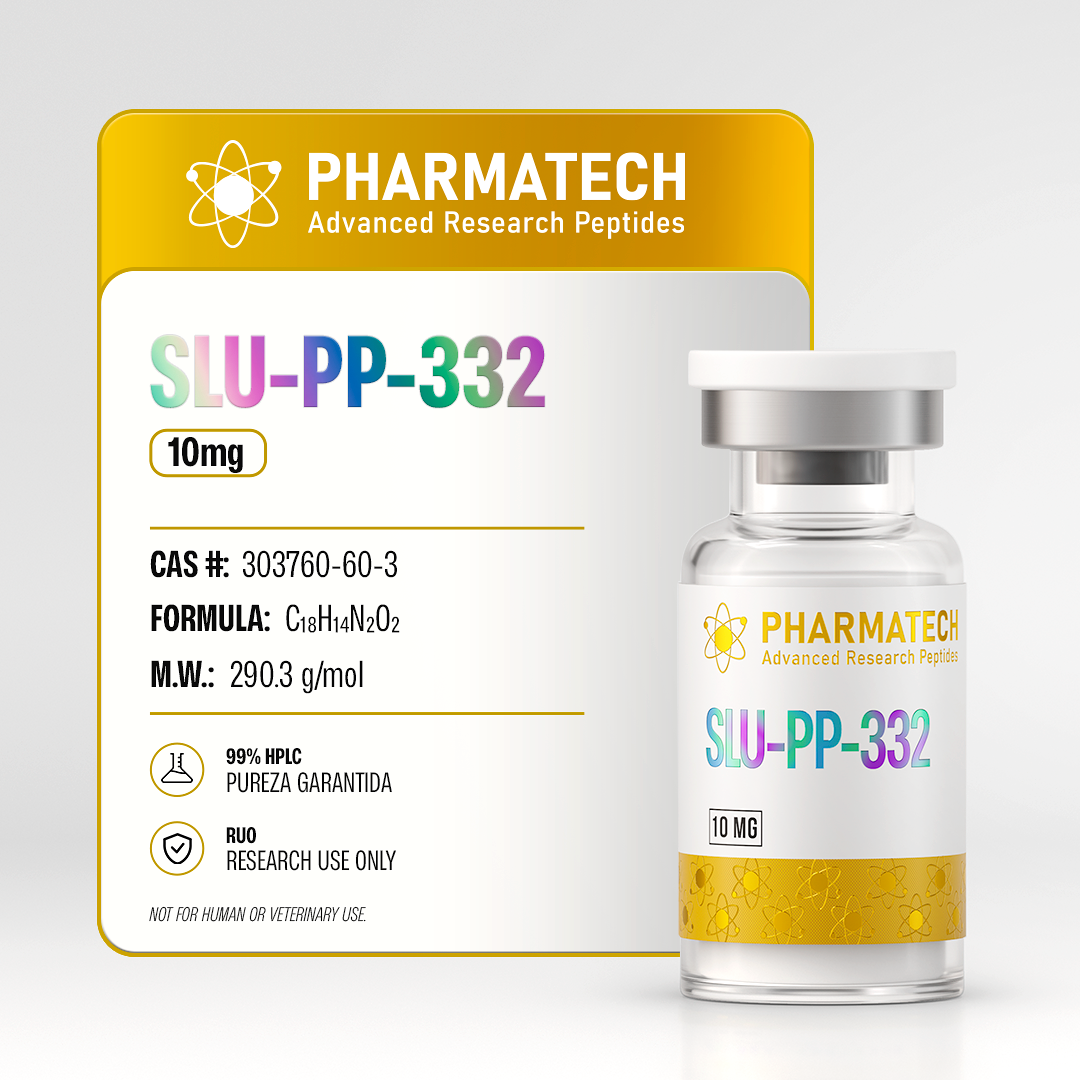
SLU-PP-332 10mg – PharmaTech
SLU-PP-332 is a synthetic small-molecule agonist of the estrogen-related receptor (ERR) family, with activity across ERRα, ERRβ, and ERRγ and comparatively greater potency toward ERRα.
Unlike conventional peptide-based compounds, SLU-PP-332 is a small-molecule metabolic regulator designed to activate nuclear receptor pathways involved in mitochondrial metabolism, oxidative phosphorylation, and energy utilization.
Experimental research has identified SLU-PP-332 as a potent pan-ERR agonist capable of stimulating mitochondrial respiration and transcriptional programs associated with oxidative metabolism.
OVERVIEW
SLU-PP-332 is a synthetic small-molecule agonist of the estrogen-related receptor (ERR) family, with activity across ERRα, ERRβ, and ERRγ and comparatively greater potency toward ERRα.
Unlike conventional peptide-based compounds, SLU-PP-332 is a small-molecule metabolic regulator designed to activate nuclear receptor pathways involved in mitochondrial metabolism, oxidative phosphorylation, and energy utilization.
Experimental research has identified SLU-PP-332 as a potent pan-ERR agonist capable of stimulating mitochondrial respiration and transcriptional programs associated with oxidative metabolism.
MECHANISM OF ACTION
SLU-PP-332 acts primarily through activation of the estrogen-related receptor family, a group of orphan nuclear receptors that play important roles in regulating genes involved in mitochondrial and metabolic function.
The compound demonstrates activity toward:
- ERRα
- ERRβ
- ERRγ
Among these receptors, ERRα represents the most potent target.
Activation of ERR signaling can influence transcriptional programs associated with:
- Mitochondrial oxidative metabolism
- Fatty-acid oxidation
- Oxidative phosphorylation
- Mitochondrial respiration
- Energy expenditure
- Skeletal-muscle metabolism
- Exercise-associated metabolic adaptations
Experimental studies have reported EC₅₀ values of approximately 98 nM for ERRα, 230 nM for ERRβ, and 430 nM for ERRγ.
KEY BENEFITS
Research involving SLU-PP-332 has focused on:
- Mitochondrial activation
- Enhanced oxidative metabolism
- Fatty-acid oxidation
- Mitochondrial respiration
- Energy expenditure
- Skeletal-muscle oxidative metabolism
- Exercise-related metabolic signaling
- Oxidative muscle-fiber development
- Glucose and insulin metabolism
- Metabolic disease research
- Cellular energy utilization
RESEARCH AREAS
Mitochondrial Biology
SLU-PP-332 is investigated for its ability to activate ERR-dependent transcriptional programs associated with mitochondrial respiration and oxidative metabolism.
Energy Metabolism
Research has examined the compound’s effects on cellular energy expenditure, substrate utilization, and oxidative metabolic pathways.
Fatty-Acid Oxidation
ERR activation regulates multiple genes involved in fatty-acid utilization and mitochondrial oxidation, making SLU-PP-332 an important experimental tool for metabolic research.
Skeletal Muscle Biology
Studies have investigated SLU-PP-332 in skeletal-muscle models, particularly its effects on oxidative fiber characteristics and mitochondrial activity.
Exercise Physiology
SLU-PP-332 has been investigated as a molecular tool for studying transcriptional programs normally associated with aerobic exercise and endurance adaptation.
Metabolic Research
Experimental models have explored its potential effects on glucose metabolism, insulin sensitivity, adiposity, and metabolic syndrome.
Mitochondrial Respiration
Cellular research has demonstrated increased mitochondrial respiratory activity following ERR activation with SLU-PP-332.
SCIENTIFIC EVIDENCE
SLU-PP-332 was characterized as a synthetic pan-ERR agonist with activity across ERRα, ERRβ, and ERRγ.
In skeletal-muscle cell models, SLU-PP-332 increased mitochondrial function and cellular respiration while activating transcriptional programs associated with oxidative metabolism.
Animal research has further demonstrated increased oxidative skeletal-muscle fibers and enhanced exercise endurance following experimental administration of SLU-PP-332.
Studies in metabolic-disease models have also reported increased energy expenditure, enhanced fatty-acid oxidation, reduced fat mass, and improvements in insulin sensitivity.
These findings have established SLU-PP-332 as an experimental pharmacological tool for investigating the relationship between ERR signaling, mitochondrial function, skeletal-muscle metabolism, and systemic energy homeostasis.
The available evidence remains predominantly preclinical, with the majority of mechanistic and efficacy data derived from cellular and animal models.
MOLECULAR PROFILE
| Property | Specification |
|---|---|
| Molecule | SLU-PP-332 |
| Chemical Class | Synthetic small molecule |
| Target Class | Estrogen-related receptors |
| Primary Targets | ERRα, ERRβ, ERRγ |
| Preferred Target | ERRα |
| Molecular Formula | C₁₈H₁₄N₂O₂ |
| Molecular Weight | 290.32 g/mol |
| CAS Number | 303760-60-3 |
| IUPAC Name | 4-Hydroxy-N′-(naphthalen-2-ylmethylene)benzohydrazide |
| Chemical Type | Non-peptide small molecule |
| Physical Form | Solid / powder |
| Primary Cellular Location | Nuclear receptor signaling |
PHARMACOKINETIC & PHARMACODYNAMIC PROFILE
Pharmacokinetic Profile
SLU-PP-332 is a low-molecular-weight synthetic compound with physicochemical properties suitable for experimental pharmacological investigation.
Preclinical studies have demonstrated sufficient pharmacokinetic characteristics to support in vivo investigation in animal models.
The compound is metabolized through multiple biotransformation pathways, with recent analytical studies identifying oxidative metabolic transformations including hydroxylation.
Comprehensive human pharmacokinetic data are not established.
Pharmacodynamic Profile
The principal pharmacodynamic pathway can be represented as:
SLU-PP-332 → ERRα/ERRβ/ERRγ activation → Transcriptional regulation → Mitochondrial oxidative metabolism → Increased respiration & energy utilization
Downstream research endpoints include:
- Increased mitochondrial respiration
- Enhanced fatty-acid oxidation
- Increased oxidative muscle-fiber characteristics
- Activation of exercise-associated gene programs
- Increased energy expenditure
- Modulation of glucose metabolism
RESEARCH HIGHLIGHTS
Pan-ERR Agonism
SLU-PP-332 activates all three major estrogen-related receptor subtypes: ERRα, ERRβ, and ERRγ.
ERRα Activity
ERRα is the most potent molecular target of SLU-PP-332 and plays a central role in regulation of mitochondrial and oxidative metabolic gene programs.
Mitochondrial Respiration
Cellular research has demonstrated increased mitochondrial respiratory activity following treatment with SLU-PP-332.
Oxidative Skeletal Muscle
Animal studies have reported increased oxidative skeletal-muscle fiber characteristics following experimental exposure.
Exercise-Associated Gene Programs
SLU-PP-332 has been investigated for its ability to activate transcriptional programs associated with aerobic exercise and endurance adaptation.
Energy Expenditure
Preclinical metabolic research has demonstrated increased energy expenditure and enhanced fatty-acid oxidation in experimental models.
Metabolic Research
The compound represents a valuable experimental tool for studying the relationship between nuclear receptor signaling, mitochondrial metabolism, skeletal-muscle physiology, and systemic energy balance.
TECHNICAL SPECIFICATIONS
| Specification | SLU-PP-332 — PharmaTech |
|---|---|
| Product Name | SLU-PP-332 |
| Chemical Class | Synthetic small molecule |
| Target | ERRα / ERRβ / ERRγ |
| Primary Target | ERRα |
| Formula | C₁₈H₁₄N₂O₂ |
| Molecular Weight | 290.32 g/mol |
| CAS Number | 303760-60-3 |
| IUPAC Name | 4-Hydroxy-N′-(naphthalen-2-ylmethylene)benzohydrazide |
| Physical Form | Powder |
| Purity | [PharmaTech specification] |
| Presentation | [PharmaTech specification] |
STORAGE & HANDLING
- Store the material under controlled conditions according to the applicable PharmaTech specification.
- Protect from excessive heat, moisture, and direct light.
- Maintain the original container tightly sealed.
- Minimize exposure to atmospheric moisture during handling.
- Handle the material using appropriate laboratory procedures.
- Prepared solutions should be handled according to the applicable PharmaTech product specification.