

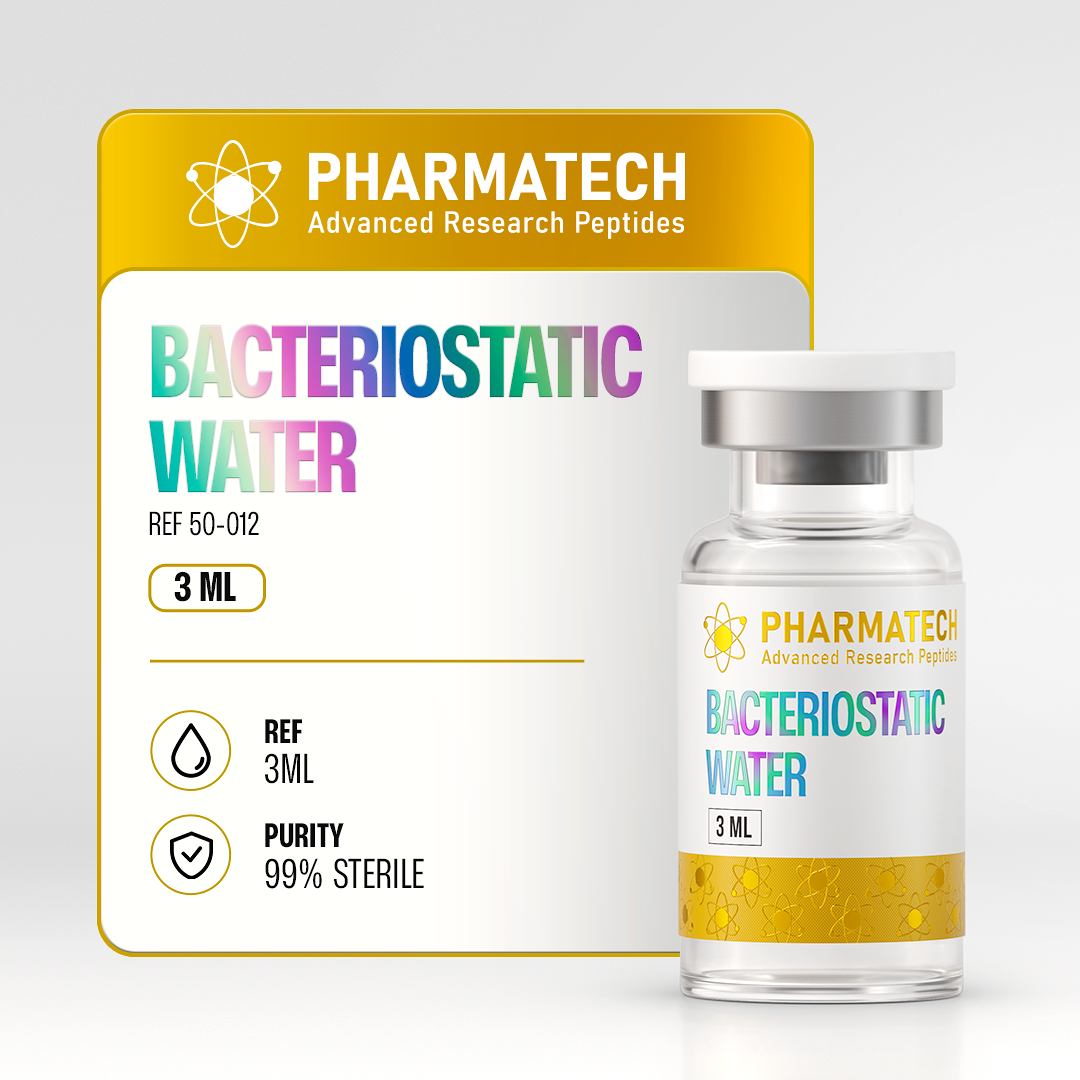
Bacteriostatic Water — PharmaTech
Bacteriostatic Water for Injection is a sterile, nonpyrogenic aqueous preparation designed as a pharmaceutical diluent or solvent for injectable substances that require reconstitution or dilution before administration.
The formulation consists of Water for Injection (WFI) containing benzyl alcohol as a bacteriostatic preservative. USP-recognized formulations commonly contain approximately 0.9% benzyl alcohol, although concentrations may vary according to the specific pharmaceutical presentation.
Bacteriostatic Water is supplied in a multidose format, allowing repeated withdrawal when appropriate aseptic handling procedures are followed.
OVERVIEW
Bacteriostatic Water for Injection is a sterile, nonpyrogenic aqueous preparation designed as a pharmaceutical diluent or solvent for injectable substances that require reconstitution or dilution before administration.
The formulation consists of Water for Injection (WFI) containing benzyl alcohol as a bacteriostatic preservative. USP-recognized formulations commonly contain approximately 0.9% benzyl alcohol, although concentrations may vary according to the specific pharmaceutical presentation.
Bacteriostatic Water is supplied in a multidose format, allowing repeated withdrawal when appropriate aseptic handling procedures are followed.
MECHANISM OF ACTION
Bacteriostatic Water does not provide an independent pharmacological effect from the water vehicle itself. Its primary pharmaceutical function is to provide a sterile aqueous medium for the reconstitution or dilution of compatible injectable compounds.
The bacteriostatic characteristic is provided by benzyl alcohol, which acts as an antimicrobial preservative within the formulation.
The resulting solution characteristics depend on the substance being reconstituted, including its concentration, stability, solubility, pH requirements, and compatibility with the vehicle.
KEY BENEFITS
- Sterile aqueous vehicle for injectable pharmaceutical preparations
- Nonpyrogenic formulation
- Benzyl alcohol-based bacteriostatic preservation
- Suitable for multidose container formats
- Designed for reconstitution or dilution of compatible injectable compounds
- Provides a consistent aqueous medium for pharmaceutical preparation
- Compatible with compounds whose manufacturer specifies bacteriostatic water as the appropriate diluent
RESEARCH AREAS
Bacteriostatic Water is utilized as a pharmaceutical vehicle in research and pharmaceutical preparation involving:
- Injectable peptide reconstitution
- Protein and peptide stability studies
- Pharmaceutical formulation research
- Injectable drug preparation
- Aqueous solubility studies
- Concentration and dilution studies
- Pharmaceutical compounding research
- Parenteral formulation development
- Stability and compatibility assessment
SCIENTIFIC EVIDENCE
Bacteriostatic Water for Injection is defined as Water for Injection that has been sterilized and appropriately packaged with one or more suitable antimicrobial agents.
Commercial USP formulations commonly contain benzyl alcohol at approximately 0.9% (9 mg/mL) or 1.1% (11 mg/mL), depending on the specific presentation. Typical labeled formulations have a pH around 5.7, with an accepted range of approximately 4.5–7.0.
Its principal pharmaceutical role is as a diluent or solvent for compatible injectable preparations rather than as an active therapeutic substance.
MOLECULAR PROFILE
| Parameter | Specification |
|---|---|
| Product Name | Bacteriostatic Water |
| Pharmaceutical Name | Bacteriostatic Water for Injection |
| Primary Component | Water for Injection |
| Chemical Formula | H₂O |
| Preservative | Benzyl Alcohol |
| Common Preservative Concentration | 0.9% w/v |
| Alternative USP Presentation | 1.1% w/v |
| Physical Form | Sterile aqueous solution |
| Pharmaceutical Function | Diluent / Solvent |
| Container Type | Multidose vial |
| pH | Typically approximately 5.7 |
PHARMACOKINETIC & PHARMACODYNAMIC PROFILE
Pharmacokinetic Profile
Bacteriostatic Water itself is not intended to produce a pharmacological therapeutic effect. Its disposition following administration is primarily associated with the water vehicle and depends on the route and the pharmaceutical substance with which it is combined.
The pharmacokinetic properties of the final preparation are therefore determined principally by the active compound being reconstituted rather than by the aqueous vehicle.
Pharmacodynamic Profile
Bacteriostatic Water has no intended receptor-mediated pharmacodynamic activity.
Its functional role is physicochemical and pharmaceutical: providing a sterile aqueous environment for the dissolution or dilution of compatible substances intended for parenteral administration.
RESEARCH HIGHLIGHTS
Sterile Pharmaceutical Vehicle
Provides a sterile aqueous medium based on Water for Injection.
Bacteriostatic Preservation
Benzyl alcohol provides antimicrobial preservation appropriate for multidose formulations.
Multidose Format
The formulation can be supplied in multidose containers designed for repeated withdrawal under appropriate aseptic conditions.
Pharmaceutical Compatibility
The appropriate vehicle for a specific injectable compound depends on the manufacturer’s formulation and compatibility specifications.
Controlled Aqueous Environment
Provides a consistent water-based medium for compounds requiring reconstitution or dilution prior to administration.
TECHNICAL SPECIFICATIONS
| Parameter | PharmaTech Specification |
|---|---|
| Product | Bacteriostatic Water |
| Grade | Pharmaceutical |
| Form | Sterile aqueous solution |
| Active Vehicle | Water for Injection |
| Preservative | Benzyl Alcohol |
| Preservative Concentration | 0.9% w/v* |
| Container | Multidose Vial |
| Appearance | Clear, colorless solution |
| Sterility | Sterile |
| Pyrogen Status | Nonpyrogenic |
| pH | Approximately 5.7* |
| Intended Function | Pharmaceutical diluent / solvent |
*Specifications may vary according to the individual PharmaTech manufacturing presentation.
STORAGE & HANDLING
Store according to the temperature and handling specifications established for the individual PharmaTech presentation.
Commercial USP bacteriostatic water products are commonly labeled for controlled room-temperature storage, with one current formulation specifying 20–25°C (68–77°F).
Maintain the integrity of the vial and closure system. Appropriate aseptic technique should be used when accessing multidose containers.
Inspect the solution and container before use for visible particulate matter, discoloration, leakage, or compromised container integrity.