

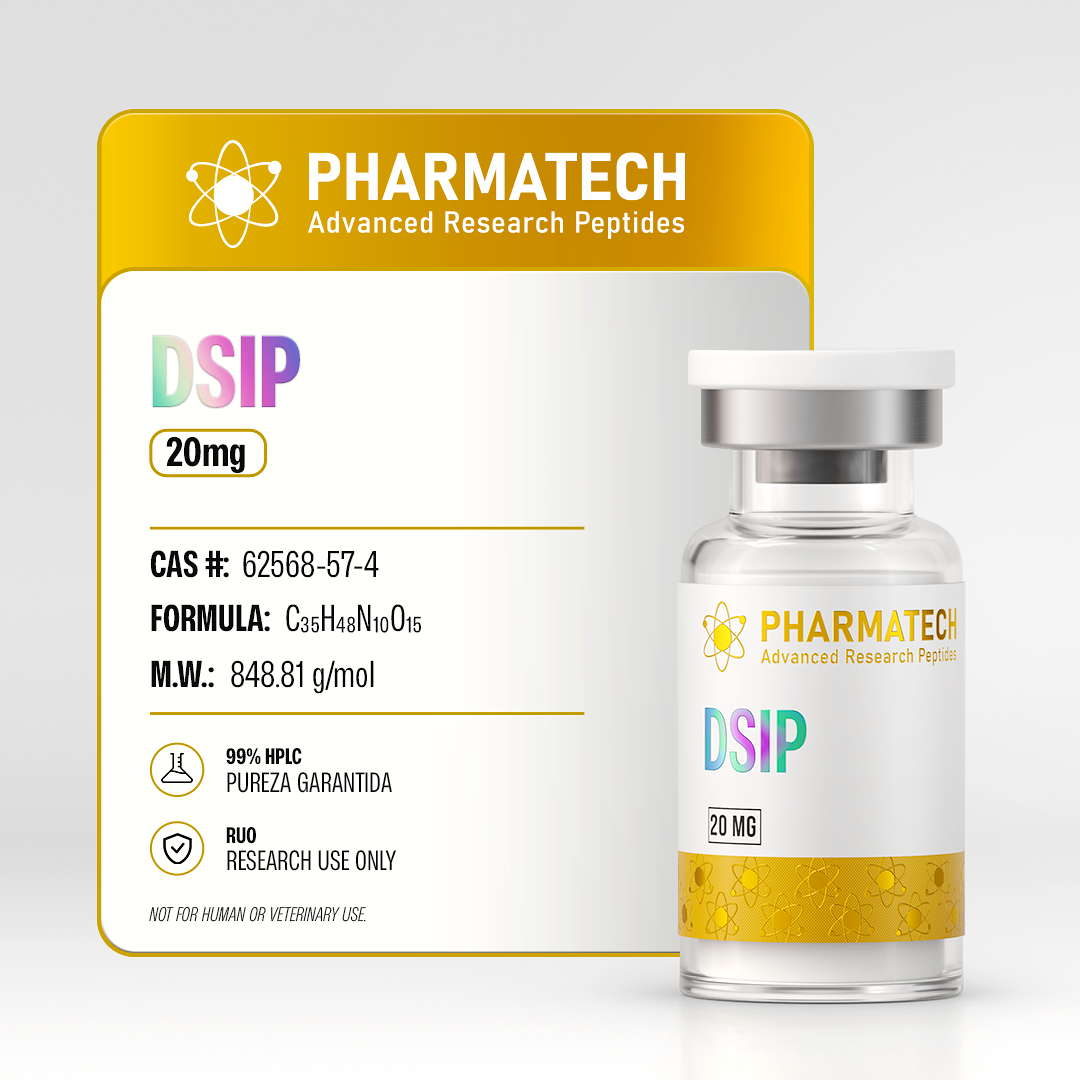
DSIP 20mg – PharmaTech
Delta Sleep-Inducing Peptide (DSIP) is a naturally occurring neuropeptide originally identified in research investigating endogenous factors associated with sleep regulation.
DSIP is a short peptide composed of nine amino acids and has been investigated for its potential involvement in sleep architecture, neuroendocrine regulation, stress responses, and circadian physiology.
Research on DSIP has explored its interactions with central nervous system pathways and its potential role as a modulatory peptide rather than a conventional neurotransmitter.
OVERVIEW
Delta Sleep-Inducing Peptide (DSIP) is a naturally occurring neuropeptide originally identified in research investigating endogenous factors associated with sleep regulation.
DSIP is a short peptide composed of nine amino acids and has been investigated for its potential involvement in sleep architecture, neuroendocrine regulation, stress responses, and circadian physiology.
Research on DSIP has explored its interactions with central nervous system pathways and its potential role as a modulatory peptide rather than a conventional neurotransmitter.
MECHANISM OF ACTION
The precise molecular mechanism of DSIP remains incompletely characterized.
Experimental research suggests that DSIP may interact with multiple neurophysiological systems involved in sleep regulation, stress adaptation, and neuroendocrine signaling.
Studies have investigated potential effects on:
- Sleep-related neural activity
- Neuroendocrine signaling
- Stress-response pathways
- Cortisol regulation
- Circadian processes
- Autonomic nervous system activity
Unlike peptides with a clearly defined single receptor target, DSIP appears to have a more complex modulatory profile, and its precise molecular targets remain an active area of research.
KEY BENEFITS
Scientific research involving DSIP has primarily focused on:
- Sleep physiology
- Sleep architecture
- Neuroendocrine regulation
- Stress-response research
- Cortisol and endocrine signaling
- Circadian biology
- Central nervous system research
- Neurophysiological recovery
The available literature includes both experimental and human research, although findings across studies have not always been consistent.
RESEARCH AREAS
Sleep Research
Investigation of DSIP in relation to sleep initiation, sleep architecture, and endogenous sleep-regulatory mechanisms.
Neuroendocrine Research
Studies examining interactions between DSIP and endocrine signaling systems.
Stress Physiology
Research into potential relationships between DSIP and physiological responses to stress.
Circadian Biology
Investigation of peptide-mediated mechanisms associated with sleep-wake regulation and biological rhythms.
Central Nervous System Research
Research exploring the effects of DSIP on neuronal and neurophysiological processes.
SCIENTIFIC EVIDENCE
DSIP has been studied for several decades since its original identification as a putative sleep-related peptide.
Early experimental studies reported changes in sleep-related parameters following administration of DSIP, leading to extensive investigation of its potential role in sleep regulation.
Subsequent research has produced mixed findings, with differences observed according to experimental model, administration method, peptide preparation, and study design.
Research has also examined DSIP in relation to stress responses, endocrine signaling, and neurophysiological regulation.
Overall, DSIP remains an interesting subject within sleep and neuropeptide research, while its precise physiological role and molecular mechanism remain incompletely established.
MOLECULAR PROFILE
| Parameter | Specification |
|---|---|
| Compound | Delta Sleep-Inducing Peptide |
| Abbreviation | DSIP |
| Molecular Class | Neuropeptide |
| Peptide Length | 9 amino acids |
| Sequence | Trp-Ala-Gly-Gly-Asp-Ala-Ser-Gly-Glu |
| One-Letter Sequence | WAGGDSGGE |
| Molecular Formula | C₃₅H₄₉N₉O₁₀ |
| Molecular Weight | ~849.9 Da |
| Primary Research Area | Sleep & Neurophysiology |
| Presentation | 20 mg |
PHARMACOKINETIC & PHARMACODYNAMIC PROFILE
The pharmacokinetic profile of DSIP has not been comprehensively characterized in modern clinical studies.
Experimental research suggests that DSIP is subject to rapid biological processing, while its observed physiological effects may involve interactions across multiple neuroendocrine and central nervous system pathways.
The relationship between circulating peptide concentrations and central nervous system activity remains an area of investigation.
RESEARCH HIGHLIGHTS
Sleep Regulation
DSIP was originally identified through research investigating endogenous mechanisms associated with sleep.
Neuropeptide Signaling
The peptide provides a model for investigating how endogenous neuropeptides may modulate central nervous system activity.
Neuroendocrine Activity
Research has examined potential relationships between DSIP and endocrine responses, including stress-related hormonal signaling.
Stress Physiology
Experimental studies have investigated DSIP in models involving physiological and environmental stress.
Multisystem Modulation
Rather than being characterized by a single established receptor pathway, DSIP research involves multiple potentially interconnected neurophysiological systems.
TECHNICAL SPECIFICATIONS
| Specification | Details |
|---|---|
| Product | DSIP |
| Brand | PharmaTech |
| Presentation | 20 mg |
| Category | Neuropeptide |
| Peptide Length | 9 amino acids |
| Sequence | WAGGDSGGE |
| Molecular Formula | C₃₅H₄₉N₉O₁₀ |
| Molecular Weight | ~849.9 Da |
| Physical Form | Lyophilized peptide |
| Purity | [PharmaTech specification] |
| Net Content | 20 mg |
| Storage | [PharmaTech specification] |
| Batch / Lot | [Batch-specific information] |
STORAGE & HANDLING
Store according to the specific storage conditions established for the PharmaTech product and its formulation.
Protect the material from excessive heat, moisture, direct light, and inappropriate environmental exposure.
Product-specific storage and handling specifications should follow the information provided with the product and its technical documentation.
SCIENTIFIC REFERENCES
- I. I. I. Krueger et al. Research concerning endogenous sleep-regulatory substances and peptide-mediated sleep mechanisms.
- Monnier M, et al. Early experimental investigations into Delta Sleep-Inducing Peptide and sleep-related physiological activity.
- Schwartz WJ, et al. Experimental studies investigating DSIP and sleep-related neurophysiological responses.
- PubChem. Delta Sleep-Inducing Peptide — molecular structure and chemical information.
- NCBI / PubMed. Published literature concerning DSIP, sleep regulation, neuroendocrine activity, and stress physiology.