

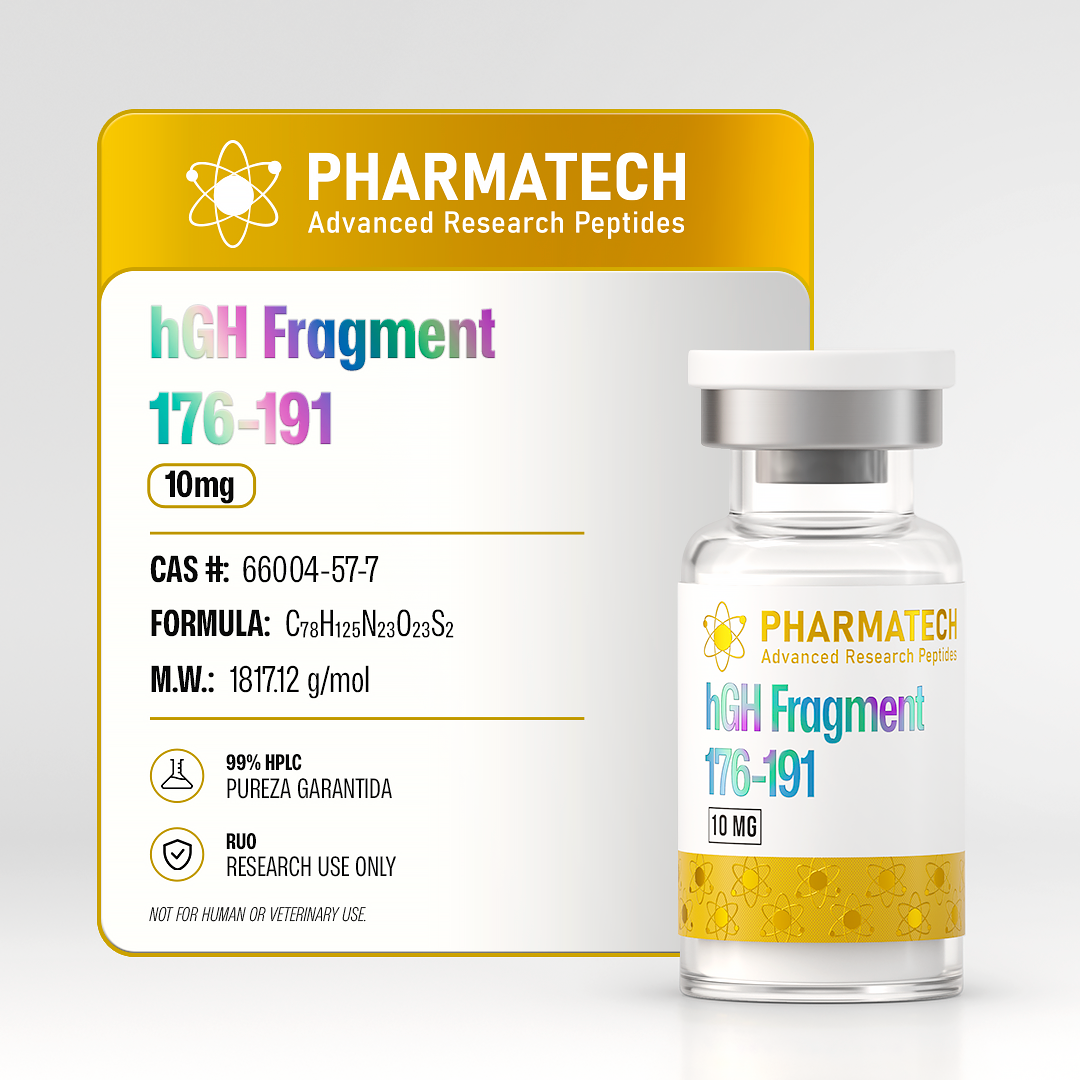
hGH Frag 176-191 10mg – PharmaTech
hGH Fragment 176–191 is a synthetic 16-amino-acid peptide corresponding to the C-terminal region of human growth hormone (hGH).
This peptide fragment has been investigated primarily for its relationship to the lipolytic region of growth hormone and its potential role in lipid metabolism, fat oxidation, and adipose tissue physiology. Unlike full-length human growth hormone, the fragment represents a specific portion of the parent hormone rather than the complete somatotropic molecule.
The peptide contains the amino-acid sequence FLRIVQCRSVEGSCGF and features a disulfide bond between the two cysteine residues.
OVERVIEW
hGH Fragment 176–191 is a synthetic 16-amino-acid peptide corresponding to the C-terminal region of human growth hormone (hGH).
This peptide fragment has been investigated primarily for its relationship to the lipolytic region of growth hormone and its potential role in lipid metabolism, fat oxidation, and adipose tissue physiology. Unlike full-length human growth hormone, the fragment represents a specific portion of the parent hormone rather than the complete somatotropic molecule.
The peptide contains the amino-acid sequence FLRIVQCRSVEGSCGF and features a disulfide bond between the two cysteine residues.
MECHANISM OF ACTION
hGH Fragment 176–191 has been investigated for biological activity associated with the C-terminal region of human growth hormone.
Preclinical research has focused on mechanisms related to lipolysis, fatty-acid oxidation, and adipose tissue metabolism. Experimental studies have reported increased lipolytic activity and enhanced fat oxidation following exposure to related hGH-derived fragments.
The precise molecular target responsible for these effects has not been definitively established. Available research suggests that the biological activity of hGH-derived lipolytic fragments may occur through mechanisms distinct from the classical growth hormone receptor pathway.
KEY BENEFITS
Research involving hGH Fragment 176–191 and related hGH-derived lipolytic peptides has focused on:
- Lipid metabolism research
- Lipolytic activity
- Fat oxidation
- Adipose tissue physiology
- Energy metabolism
- Body-weight regulation research
- C-terminal hGH peptide biology
These areas primarily reflect experimental and preclinical research rather than established clinical applications.
RESEARCH AREAS
Lipid Metabolism
Investigation of pathways involved in lipid mobilization, fatty-acid utilization, and adipose tissue metabolism.
Lipolysis
Research examining the breakdown of stored triglycerides within adipose tissue.
Fat Oxidation
Experimental studies have investigated changes in fatty-acid oxidation and energy utilization.
Adipose Tissue Research
Investigation of the biological activity of hGH-derived peptide fragments within adipose tissue models.
Growth Hormone Biology
Research into the biological properties of specific regions of the human growth hormone molecule.
SCIENTIFIC EVIDENCE
Research into the C-terminal region of human growth hormone has identified biological activity associated with lipid metabolism and lipolysis.
Experimental studies using hGH-derived lipolytic fragments have reported increased fat oxidation, enhanced lipolytic activity, and reductions in body-weight gain in animal models.
Research involving related compounds such as AOD-9604 has also explored mechanisms associated with adipose tissue metabolism and fatty-acid oxidation. However, the biological properties of AOD-9604 should not be assumed to be identical to those of the native hGH 176–191 fragment.
Current evidence for hGH Fragment 176–191 itself is predominantly preclinical, and the precise molecular mechanism underlying its reported biological effects remains an area of investigation.
MOLECULAR PROFILE
| Parameter | Specification |
|---|---|
| Compound | hGH Fragment 176–191 |
| Alternative Name | Human Growth Hormone Fragment 176–191 |
| Molecular Class | Synthetic peptide |
| Peptide Length | 16 amino acids |
| Parent Protein | Human Growth Hormone (hGH) |
| Residues | 176–191 |
| Sequence | FLRIVQCRSVEGSCGF |
| Disulfide Bond | Cys7–Cys14 |
| Molecular Formula | C₇₈H₁₂₃N₂₃O₂₂S₂ |
| Molecular Weight | ~1.80 kDa |
| CAS Number | 66004-57-7 |
PHARMACOKINETIC & PHARMACODYNAMIC PROFILE
The pharmacokinetic and pharmacodynamic characteristics of hGH Fragment 176–191 have not been established to the same extent as those of full-length recombinant human growth hormone.
Available research has primarily focused on experimental biological activity involving lipid metabolism, lipolysis, and fatty-acid oxidation.
The precise receptor interactions, tissue distribution, metabolic clearance, and systemic half-life of the native 176–191 fragment remain incompletely characterized.
RESEARCH HIGHLIGHTS
C-Terminal hGH Fragment
A defined 16-amino-acid region corresponding to residues 176–191 of human growth hormone.
Lipolytic Research
Investigated for biological activity associated with lipid mobilization and adipose tissue metabolism.
Fat Oxidation
Preclinical research involving hGH-derived fragments has examined increased fatty-acid oxidation and changes in energy metabolism.
Distinct Molecular Profile
The fragment represents a specific region of hGH rather than the complete growth hormone molecule, allowing researchers to investigate the biological properties of the C-terminal domain independently.
TECHNICAL SPECIFICATIONS
| Specification | Details |
|---|---|
| Product | hGH Fragment 176–191 |
| Brand | PharmaTech |
| Presentation | 10 mg |
| Category | Synthetic Peptide |
| Peptide Length | 16 amino acids |
| Sequence | FLRIVQCRSVEGSCGF |
| Parent Protein | Human Growth Hormone |
| Residues | 176–191 |
| Molecular Formula | C₇₈H₁₂₃N₂₃O₂₂S₂ |
| Molecular Weight | ~1.80 kDa |
| CAS Number | 66004-57-7 |
| Physical Form | Lyophilized peptide |
| Purity | [PharmaTech specification] |
| Net Content | 10 mg |
| Batch / Lot | [Batch-specific information] |
STORAGE & HANDLING
Store according to the specific storage conditions established for the PharmaTech product and its formulation.
Protect the material from excessive heat, moisture, direct light, and inappropriate environmental exposure.
Product-specific storage and handling specifications should follow the information provided with the product and its technical documentation.
SCIENTIFIC REFERENCES
- PubChem — Somatotropin (176-191). Molecular structure, sequence, molecular formula, molecular weight and chemical identifiers.
- Ng FM, et al. Metabolic studies of a synthetic lipolytic domain (AOD9604) of human growth hormone. Growth Hormone & IGF Research. 2000.
- Heffernan MA, et al. Increase of fat oxidation and weight loss in obese mice caused by chronic treatment with human growth hormone or a modified C-terminal fragment. Endocrinology. 2001.
- Ng FM, et al. The effects of human GH and its lipolytic fragment (AOD9604) on lipid metabolism following chronic treatment in obese mice and beta(3)-AR knockout mice. Endocrinology. 2001.