

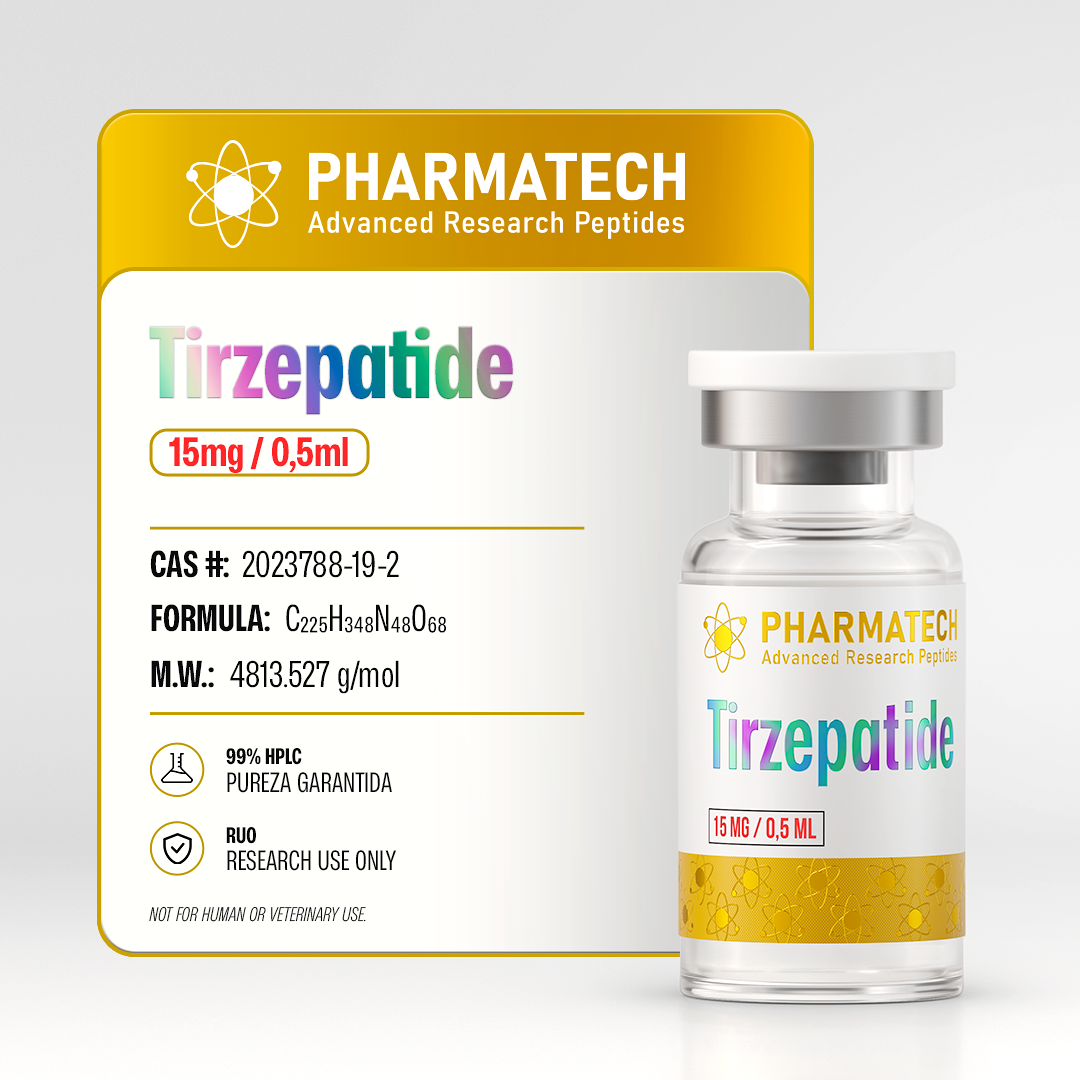
Tirzepatide 60mg, 4 x 15mg 0,5mL, Solução Líquida – PharmaTech
Tirzepatide is a long-acting synthetic peptide designed to selectively activate both the glucose-dependent insulinotropic polypeptide (GIP) receptor and the glucagon-like peptide-1 (GLP-1) receptor. This dual incretin receptor activity has made tirzepatide an important subject of research in metabolic regulation, glucose homeostasis, appetite control, and body-weight management.
Structurally, tirzepatide is a 39-amino-acid peptide derived from the GIP sequence and modified with a C20 fatty diacid moiety. This lipid modification promotes albumin binding and contributes to its extended pharmacokinetic profile.
OVERVIEW
Tirzepatide is a long-acting synthetic peptide designed to selectively activate both the glucose-dependent insulinotropic polypeptide (GIP) receptor and the glucagon-like peptide-1 (GLP-1) receptor. This dual incretin receptor activity has made tirzepatide an important subject of research in metabolic regulation, glucose homeostasis, appetite control, and body-weight management.
Structurally, tirzepatide is a 39-amino-acid peptide derived from the GIP sequence and modified with a C20 fatty diacid moiety. This lipid modification promotes albumin binding and contributes to its extended pharmacokinetic profile.
MECHANISM OF ACTION
Tirzepatide acts as a dual GIP and GLP-1 receptor agonist.
Activation of the GIP receptor (GIPR) and GLP-1 receptor (GLP-1R) influences several physiological pathways involved in metabolic regulation. Tirzepatide promotes glucose-dependent insulin secretion, reduces glucagon secretion, increases insulin sensitivity, and influences appetite and caloric intake.
GLP-1 receptor activity is also associated with delayed gastric emptying, while signaling through incretin pathways contributes to regulation of food intake and glucose metabolism.
The C20 fatty diacid component facilitates reversible albumin binding, extending systemic exposure and contributing to the compound’s approximately five-day half-life.
KEY BENEFITS
Research involving tirzepatide has focused on several areas of metabolic physiology, including:
- Dual GIP/GLP-1 receptor activation
- Glucose metabolism and glycemic regulation
- Insulin secretion and insulin sensitivity
- Appetite and caloric intake regulation
- Body-weight and body-composition research
- Metabolic health and energy balance
- Gastrointestinal motility and gastric emptying
Clinical pharmacology data indicate that tirzepatide can reduce food intake and body weight while producing greater reductions in fat mass than lean mass in studied populations.
RESEARCH AREAS
Tirzepatide is extensively investigated in:
Metabolic Research
Studies involving glucose homeostasis, insulin signaling, and metabolic regulation.
Weight Management Research
Research examining appetite, caloric intake, body weight, and body composition.
Incretin Biology
Investigation of the complementary roles of GIP and GLP-1 receptor signaling.
Glucose Regulation
Research involving insulin secretion, glucagon regulation, and insulin sensitivity.
Energy Balance
Studies examining the relationship between appetite signaling, caloric intake, and energy metabolism.
SCIENTIFIC EVIDENCE
Tirzepatide has been extensively evaluated in clinical development programs investigating metabolic and glycemic outcomes. Its pharmacological profile is supported by mechanistic, pharmacodynamic, pharmacokinetic, and clinical research.
Regulatory clinical pharmacology data describe glucose-dependent enhancement of insulin secretion, reduction of glucagon secretion, increased insulin sensitivity, decreased caloric intake, and effects on gastric emptying.
The compound’s dual-receptor mechanism distinguishes it from selective GLP-1 receptor agonists and has established tirzepatide as a significant subject of research within modern incretin-based metabolic science.
MOLECULAR PROFILE
| Parameter | Specification |
|---|---|
| Compound | Tirzepatide |
| Alternative Name | LY3298176 |
| Molecular Class | Synthetic peptide |
| Peptide Length | 39 amino acids |
| Primary Targets | GIPR / GLP-1R |
| Lipid Modification | C20 fatty diacid |
| Molecular Formula | C₂₂₅H₃₄₈N₄₈O₆₈ |
| Molecular Weight | 4813.53 Da |
| CAS Number | 2023788-19-2 |
| PubChem CID | 156588324 |
The molecular formula, molecular weight, CAS number and structural information are consistent with current PubChem data and regulatory documentation.
PHARMACOKINETIC & PHARMACODYNAMIC PROFILE
Tirzepatide has an extended pharmacokinetic profile resulting from its fatty-acid modification and albumin binding.
Key characteristics include:
- Approximate half-life: 5 days
- Steady-state concentrations: generally reached after approximately 4 weeks of once-weekly administration
- Exposure: increases approximately proportionally with dose
- Metabolic effects: glucose-dependent insulin secretion and reduced glucagon secretion
- Appetite effects: reduction in caloric intake
- Gastric effects: delayed gastric emptying, with the greatest effect following the initial dose
RESEARCH HIGHLIGHTS
Dual Incretin Signaling
Simultaneous activation of GIP and GLP-1 receptors provides a distinctive pharmacological profile.
Metabolic Regulation
Investigated extensively in relation to glucose metabolism, insulin sensitivity, and energy balance.
Appetite Signaling
Research indicates effects on appetite regulation and caloric intake through central and peripheral mechanisms.
Body Composition
Clinical pharmacology data indicate reductions in body weight with greater fat-mass loss than lean-mass loss.
TECHNICAL SPECIFICATIONS
| Specification | Details |
|---|---|
| Product | Tirzepatide |
| Brand | PharmaTech |
| Category | Peptide |
| Molecular Formula | C₂₂₅H₃₄₈N₄₈O₆₈ |
| Molecular Weight | 4813.53 Da |
| CAS Number | 2023788-19-2 |
| Peptide Length | 39 amino acids |
| Primary Targets | GIPR / GLP-1R |
| Physical Form | Lyophilized peptide |
| Purity | [PharmaTech specification] |
| Net Content | [Product specification] |
| Storage | [PharmaTech specification] |
| Batch / Lot | [Batch-specific information] |
STORAGE & HANDLING
Store according to the specific storage conditions established for the PharmaTech product and its formulation. Protect the material from inappropriate temperature exposure, excessive moisture, and direct light.
Product-specific storage and handling specifications should always follow the information provided on the product label and accompanying technical documentation.
SCIENTIFIC REFERENCES
Primary scientific and technical sources
- U.S. Food and Drug Administration — Tirzepatide prescribing information and clinical pharmacology documentation. FDA Access Data
- PubChem — Tirzepatide molecular and chemical information. PubChem
- DailyMed — Tirzepatide clinical pharmacology and product information. DailyMed
- Coskun T, et al. LY3298176, a novel dual GIP and GLP-1 receptor agonist for the treatment of type 2 diabetes mellitus. Molecular Metabolism. Lilly Medical