

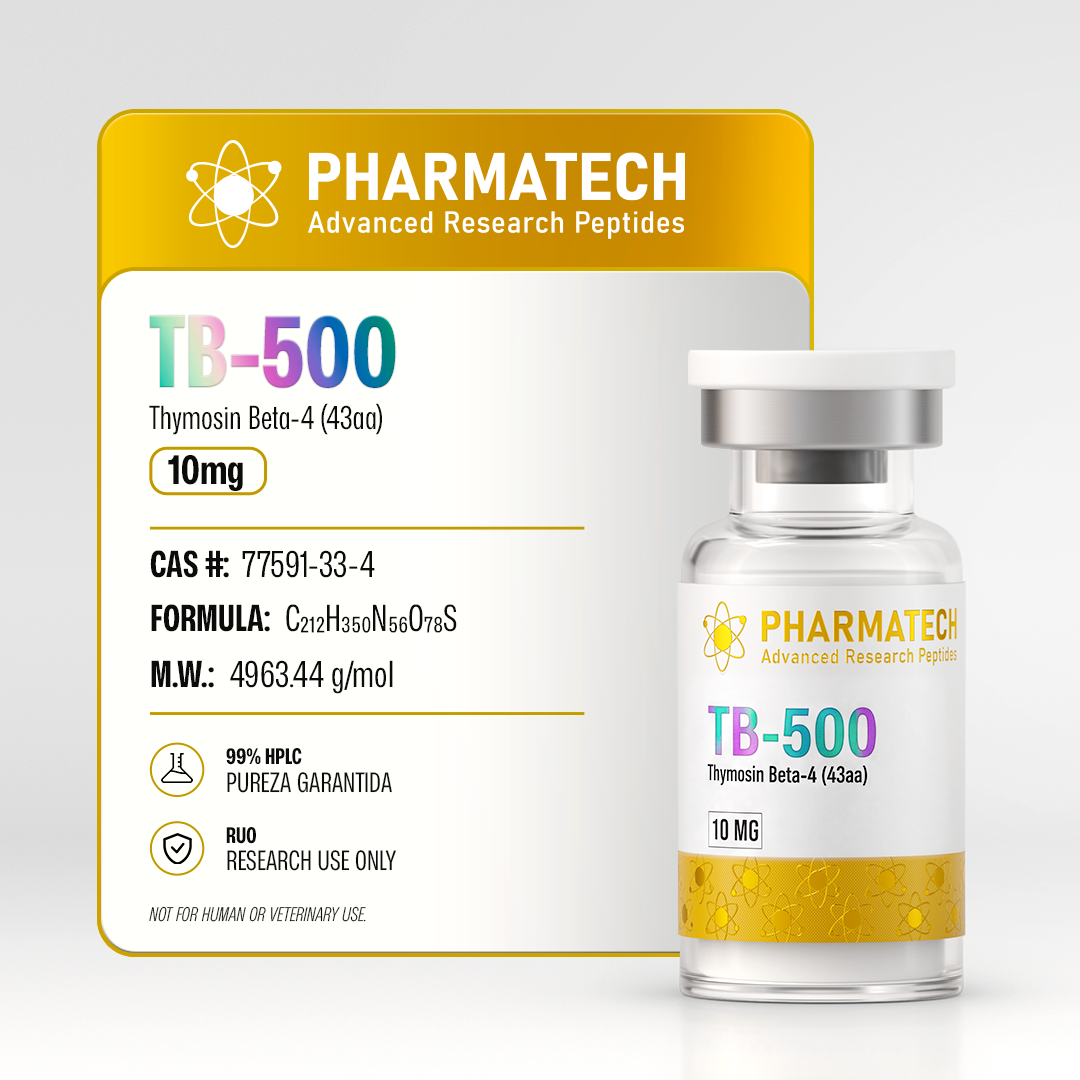
TB-500 10mg – PharmaTech
TB-500 is commonly used as the designation for a synthetic peptide related to Thymosin Beta-4 (Tβ4). However, the terminology is inconsistent across the peptide industry: TB-500 may refer either to the N-acetylated seven-amino-acid fragment Ac-LKKTETQ corresponding to residues 17–23 of Tβ4, or, in some commercial contexts, to full-length synthetic Thymosin Beta-4. These are chemically distinct molecules with substantially different molecular weights.
For analytical accuracy, PharmaTech product specifications should identify the exact molecular form, sequence, molecular weight, and lot-specific analytical results.
The research described below focuses primarily on the TB-500 fragment Ac-LKKTETQ and the biological literature surrounding the Thymosin Beta-4 actin-binding region.
OVERVIEW
TB-500 is commonly used as the designation for a synthetic peptide related to Thymosin Beta-4 (Tβ4). However, the terminology is inconsistent across the peptide industry: TB-500 may refer either to the N-acetylated seven-amino-acid fragment Ac-LKKTETQ corresponding to residues 17–23 of Tβ4, or, in some commercial contexts, to full-length synthetic Thymosin Beta-4. These are chemically distinct molecules with substantially different molecular weights.
For analytical accuracy, PharmaTech product specifications should identify the exact molecular form, sequence, molecular weight, and lot-specific analytical results.
The research described below focuses primarily on the TB-500 fragment Ac-LKKTETQ and the biological literature surrounding the Thymosin Beta-4 actin-binding region.
MECHANISM OF ACTION
The TB-500 fragment corresponds to the region of Thymosin Beta-4 associated with actin binding. Actin is a central component of the cytoskeleton and plays an important role in cellular morphology, migration, adhesion, and tissue remodeling.
Research involving the Thymosin Beta-4 actin-binding motif has demonstrated biological activity associated with endothelial-cell migration and angiogenic processes. Experimental studies identified the seven-amino-acid actin-binding motif as an important region for these activities.
Principal Research Pathway
TB-500 / Tβ4-related signaling → actin dynamics → cytoskeletal organization → cellular migration & tissue-remodeling processes
Additional research involving full-length Tβ4 has investigated pathways associated with:
- Actin polymerization
- Cellular migration
- Angiogenesis
- Extracellular matrix remodeling
- Fibroblast activity
- Tissue regeneration
The extent to which these observations from full-length Tβ4 can be directly attributed to the short TB-500 fragment remains an important distinction in interpreting the scientific literature.
KEY BENEFITS
Cellular & Cytoskeletal Research
- Actin-related signaling
- Cytoskeletal organization
- Cellular migration
- Cell adhesion
- Cellular remodeling
Tissue Biology
- Tissue remodeling research
- Extracellular matrix biology
- Fibroblast activity
- Regenerative biology
- Wound-healing models
Angiogenesis Research
- Endothelial-cell migration
- Vascular remodeling
- Vessel formation models
- Angiogenic signaling
Musculoskeletal Research
- Connective-tissue biology
- Tendon and ligament research
- Muscle tissue remodeling
- Cellular responses to tissue injury
RESEARCH AREAS
| Research Area | Primary Focus |
|---|---|
| Actin Biology | G-actin interaction and cytoskeletal regulation |
| Cell Migration | Cellular movement and directional migration |
| Angiogenesis | Endothelial migration and vascular remodeling |
| Tissue Remodeling | Cellular and extracellular matrix processes |
| Wound-Healing Research | Experimental tissue-repair models |
| Musculoskeletal Biology | Muscle, tendon and connective-tissue research |
| Regenerative Biology | Cellular responses associated with tissue remodeling |
| Cellular Signaling | Cytoskeletal and migration-associated pathways |
SCIENTIFIC EVIDENCE
The strongest mechanistic evidence relevant to TB-500 comes from research on Thymosin Beta-4 and its actin-binding region.
Experimental studies demonstrated that the seven-amino-acid actin-binding motif of Tβ4 can reproduce important angiogenic activity in experimental systems, including endothelial-cell migration and vessel-sprouting models.
Separate studies with full-length Tβ4 demonstrated stimulation of endothelial-cell migration and angiogenic responses in vitro and in vivo experimental models.
It is important scientifically to distinguish these findings from direct evidence for commercially designated TB-500. Much of the regenerative literature concerns full-length Thymosin Beta-4, rather than the isolated TB-500 fragment.
Therefore, PharmaTech’s scientific positioning should distinguish TB-500 fragment identity from the broader Thymosin Beta-4 research literature.
MOLECULAR PROFILE
TB-500 Fragment — Ac-LKKTETQ
| Parameter | Specification |
|---|---|
| Compound Name | TB-500 |
| Chemical Description | N-acetylated Thymosin Beta-4 fragment |
| Parent Protein | Thymosin Beta-4 |
| Residues | 17–23 |
| Peptide Length | 7 amino acids |
| Sequence | Ac-LKKTETQ |
| Molecular Formula | C₃₈H₆₈N₁₀O₁₄ |
| Molecular Weight | ~889.0 Da |
| CAS Number | 885340-08-9 |
| Structural Modification | N-terminal acetylation |
| Molecular Class | Synthetic heptapeptide |
Current chemical references identify Ac-LKKTETQ as the seven-residue acetylated fragment corresponding to residues 17–23 of Thymosin Beta-4.
Peptide Sequence
Ac-Leu-Lys-Lys-Thr-Glu-Thr-Gln
Ac-LKKTETQ
THYMOSIN BETA-4 DISTINCTION
Because the name TB-500 is inconsistently used commercially, analytical identification is particularly important.
TB-500 Fragment
- 7 amino acids
- Ac-LKKTETQ
- ~889 Da
- Corresponds to residues 17–23 of Tβ4
Full-Length Thymosin Beta-4
- 43 amino acids
- ~4,963 Da
- Full-length TMSB4X gene product
- Contains the LKKTETQ actin-binding region
These molecules should not be treated as chemically identical simply because both are marketed under the TB-500 designation.
PHARMACOKINETIC & PHARMACODYNAMIC PROFILE
Pharmacodynamic Profile
The pharmacodynamic research associated with the TB-500/Tβ4 family centers on cytoskeletal and cellular processes involving:
- Actin interaction
- Cell migration
- Endothelial-cell behavior
- Angiogenesis
- Tissue remodeling
- Extracellular matrix dynamics
For the isolated TB-500 fragment specifically, comprehensive human pharmacodynamic characterization remains limited.
Pharmacokinetic Profile
A definitive human pharmacokinetic profile for the isolated TB-500 fragment has not been comprehensively established.
Available information does not support assigning a definitive human half-life, bioavailability, clearance rate, or tissue-distribution profile to TB-500 without specifying the exact molecular form and route of administration.
| Parameter | Research Profile |
|---|---|
| Molecular Type | Synthetic heptapeptide |
| Sequence | Ac-LKKTETQ |
| Molecular Weight | ~889 Da |
| Primary Biological Domain | Actin/cytoskeletal biology |
| Human PK Characterization | Limited |
| Human PD Characterization | Limited |
| Metabolic Fate | Under investigation |
RESEARCH HIGHLIGHTS
Actin-Associated Biology
The LKKTETQ region represents a key actin-binding motif within Thymosin Beta-4. Experimental research has connected this region with actin-dependent cellular processes.
Cellular Migration
Tβ4 research has demonstrated effects on endothelial-cell migration, an important component of angiogenesis and tissue remodeling.
Angiogenesis
The actin-binding region of Tβ4 has been investigated in endothelial migration and vessel-sprouting models, providing mechanistic interest in vascular remodeling research.
Tissue Remodeling
Thymosin Beta-4 research encompasses cellular migration, extracellular matrix interactions and tissue-remodeling processes, making the Tβ4/TB-500 family relevant to regenerative biology research.
Analytical Identity
Because TB-500 is used inconsistently to describe both the fragment and full-length Tβ4, mass spectrometry and lot-specific molecular characterization are particularly important when establishing product identity.
TECHNICAL SPECIFICATIONS
| Specification | PharmaTech Standard |
|---|---|
| Product Name | TB-500 |
| Molecular Form | N-acetylated Tβ4 fragment |
| Peptide Length | 7 amino acids |
| Sequence | Ac-LKKTETQ |
| Molecular Formula | C₃₈H₆₈N₁₀O₁₄ |
| Molecular Weight | ~889.0 Da |
| CAS | 885340-08-9 |
| Appearance | White to off-white lyophilized powder |
| Identity Testing | Mass Spectrometry |
| Purity Testing | HPLC |
| Sequence Verification | MS/MS / analytical characterization |
| Packaging | PharmaTech specification |
| Lot Number | PharmaTech lot-specific |
| Certificate of Analysis | Available by lot |
STORAGE & HANDLING
TB-500 should be maintained in its lyophilized form under controlled storage conditions and protected from:
- Excessive heat
- Moisture
- Direct light
- Repeated temperature fluctuations
PharmaTech lot-specific storage and handling specifications should be followed according to the corresponding product documentation and Certificate of Analysis.