

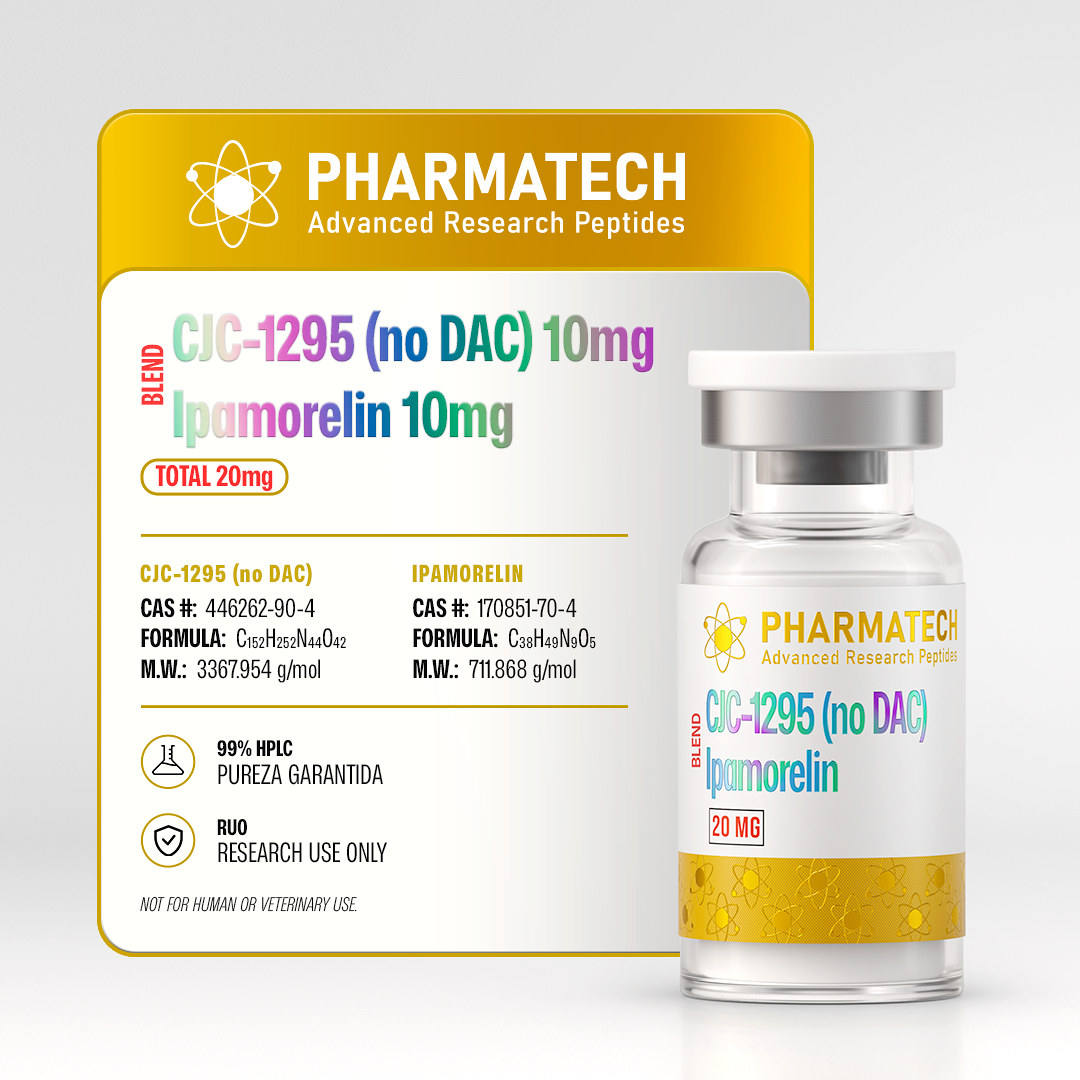
CJC-1295 + Ipamorelin Blend 20mg – PharmaTech
CJC-1295 + Ipamorelin is a dual-peptide combination designed to investigate complementary mechanisms regulating growth hormone (GH) secretion.
CJC-1295 is a synthetic analogue of growth hormone-releasing hormone (GHRH) that activates the GHRH receptor (GHRHR) on pituitary somatotroph cells. Ipamorelin is a selective growth hormone secretagogue acting primarily through the growth hormone secretagogue receptor type 1a (GHS-R1a).
The combination therefore provides a research model involving two distinct upstream pathways of the GH axis:
CJC-1295 → GHRHR → GH secretion
Ipamorelin → GHS-R1a → GH secretion
The exact pharmacological profile depends importantly on whether the CJC-1295 component is formulated with DAC or without DAC. Human pharmacokinetic data demonstrating multi-day exposure apply specifically to CJC-1295 with DAC and should not automatically be transferred to the no-DAC form.
OVERVIEW
CJC-1295 + Ipamorelin is a dual-peptide combination designed to investigate complementary mechanisms regulating growth hormone (GH) secretion.
CJC-1295 is a synthetic analogue of growth hormone-releasing hormone (GHRH) that activates the GHRH receptor (GHRHR) on pituitary somatotroph cells. Ipamorelin is a selective growth hormone secretagogue acting primarily through the growth hormone secretagogue receptor type 1a (GHS-R1a).
The combination therefore provides a research model involving two distinct upstream pathways of the GH axis:
CJC-1295 → GHRHR → GH secretion
Ipamorelin → GHS-R1a → GH secretion
The exact pharmacological profile depends importantly on whether the CJC-1295 component is formulated with DAC or without DAC. Human pharmacokinetic data demonstrating multi-day exposure apply specifically to CJC-1295 with DAC and should not automatically be transferred to the no-DAC form.
MECHANISM OF ACTION
CJC-1295 — GHRH Pathway
CJC-1295 is a modified GHRH analogue designed to stimulate the growth hormone-releasing hormone receptor (GHRHR).
GHRHR activation in pituitary somatotrophs promotes intracellular signaling associated with GH synthesis and secretion. The resulting increase in GH can subsequently stimulate peripheral IGF-1 production and downstream GH/IGF-1 signaling.
For the DAC form, the modification enables prolonged association with circulating albumin, substantially extending systemic exposure compared with shorter-acting GHRH analogues.
Ipamorelin — GHS-R1a Pathway
Ipamorelin is a synthetic pentapeptide growth hormone secretagogue that acts primarily through GHS-R1a, also known as the ghrelin receptor.
Activation of GHS-R1a stimulates pituitary GH secretion through a pathway distinct from GHRHR activation.
Combined Mechanistic Model
The combination can be represented as:
CJC-1295 → GHRHR activation → pituitary somatotroph signaling → GH release
Ipamorelin → GHS-R1a activation → pituitary GH release
GH → GHR activation → IGF-1 production → downstream tissue signaling
This complementary receptor architecture makes the combination relevant to research into GH-axis regulation and endocrine signaling.
KEY BENEFITS
Research applications for the combination include:
- Investigation of GH secretion
- Study of complementary GHRH and GHS-R1a pathways
- GH/IGF-1 axis research
- Investigation of GH pulsatility
- Endocrine signaling research
- Metabolic physiology
- Body-composition biology
- Muscle and tissue biology
- Cellular growth signaling
- Pituitary GH regulation
Human studies of CJC-1295 with DAC demonstrated sustained increases in GH and IGF-1 in healthy adults, with preserved pulsatile GH secretion in a separate study.
RESEARCH AREAS
Growth Hormone Physiology
Investigation of pituitary GH synthesis, secretion, pulsatility, feedback regulation, and endocrine responses.
GHRH/GHRHR Signaling
Study of GHRH receptor activation and its role in somatotroph GH secretion.
GHS-R1a Signaling
Investigation of ghrelin-receptor-mediated stimulation of GH release.
GH/IGF-1 Axis
Research into the relationship between GH secretion, IGF-1 production, and downstream growth-factor signaling.
Metabolic Research
Investigation of GH-associated pathways involving lipid metabolism, glucose regulation, energy balance, and substrate utilization.
Body Composition
Experimental investigation of GH/IGF-1 signaling in adipose and lean-tissue biology.
Muscle & Tissue Biology
Research into GH- and IGF-1-associated cellular pathways relevant to muscle and connective-tissue physiology.
SCIENTIFIC EVIDENCE
The strongest human evidence within this combination concerns CJC-1295 with DAC. In randomized, placebo-controlled studies of healthy adults, single administration produced dose-dependent increases in mean plasma GH and IGF-1, with estimated CJC-1295 half-lives of approximately 5.8–8.1 days.
A separate human study demonstrated that GH secretion remained pulsatile following CJC-1295 administration, while basal and mean GH concentrations increased and IGF-1 concentrations rose.
The pharmacological rationale for combining CJC-1295 and Ipamorelin derives from their different receptor targets: GHRHR for CJC-1295 and GHS-R1a for Ipamorelin. However, evidence directly evaluating a specific fixed-ratio CJC-1295 + Ipamorelin formulation is substantially more limited than the evidence available for CJC-1295 alone.
For this reason, component-level evidence should be distinguished from clinical evidence specifically validating the combined PharmaTech formulation.
MOLECULAR PROFILE
| Parameter | CJC-1295 | Ipamorelin |
|---|---|---|
| Compound class | Modified GHRH analogue | Synthetic GH secretagogue |
| Primary target | GHRH receptor (GHRHR) | GHS-R1a |
| Peptide length | Modified GRF(1–29) | 5 amino acids |
| Primary pathway | GHRH/GH axis | Ghrelin/GH axis |
| Major downstream mediator | GH → IGF-1 | GH → IGF-1 |
| Molecular weight | Form-dependent | ~711.9 Da |
| DAC modification | Form-dependent | Not applicable |
| Biological focus | Pituitary GH stimulation | Pituitary GH stimulation |
Ipamorelin Sequence
Aib-His-D-2-Nal-D-Phe-Lys-NH₂
CJC-1295
CJC-1295 is a modified GHRH(1–29)-related peptide containing amino-acid substitutions designed to improve resistance to enzymatic degradation. The DAC version additionally incorporates the drug-affinity complex responsible for prolonged albumin association.
PHARMACOKINETIC & PHARMACODYNAMIC PROFILE
Pharmacokinetic Profile
The pharmacokinetic characteristics depend substantially on the CJC-1295 variant.
For CJC-1295 with DAC, human studies reported an estimated half-life of approximately 5.8–8.1 days, with measurable concentrations persisting for multiple days after administration.
By contrast, published human pharmacokinetic data for CJC-1295 without DAC are considerably more limited. Therefore, pharmacokinetic values established for the DAC variant should not automatically be applied to a no-DAC formulation.
Ipamorelin has a substantially different pharmacological profile because it acts as a GHS-R1a agonist rather than a long-acting GHRH analogue.
The pharmacokinetic profile of the complete PharmaTech blend ultimately depends on:
- CJC-1295 variant
- CJC-1295/Ipamorelin ratio
- Formulation
- Concentration
- Peptide purity
- Route of administration
- Product-specific stability characteristics
Pharmacodynamic Profile
The principal signaling cascade can be summarized as:
CJC-1295 → GHRHR → pituitary somatotroph → GH secretion
Ipamorelin → GHS-R1a → pituitary somatotroph → GH secretion
GH → GHR → IGF-1 → peripheral biological signaling
Human CJC-1295 DAC studies demonstrated sustained increases in GH and IGF-1, while preserving the pulsatile nature of GH secretion.
RESEARCH HIGHLIGHTS
- Dual-pathway GH secretagogue system
- GHRHR and GHS-R1a pathway research
- Investigation of endogenous GH secretion
- GH pulsatility research
- GH/IGF-1 axis modulation
- Pituitary endocrine signaling
- Metabolic signaling research
- Body-composition biology
- Muscle and tissue research
- Comparative investigation of GHRH and ghrelin pathways
TECHNICAL SPECIFICATIONS
| Parameter | PharmaTech Specification |
|---|---|
| Product | CJC-1295 + Ipamorelin Blend |
| Product type | Synthetic peptide blend |
| Components | CJC-1295 + Ipamorelin |
| CJC-1295 variant | [DAC / No-DAC — PharmaTech specification] |
| Total quantity | [PharmaTech specification] |
| Ratio | [PharmaTech specification] |
| CJC-1295 content | [PharmaTech specification] |
| Ipamorelin content | [PharmaTech specification] |
| Purity | ≥ [PharmaTech specification]% |
| Physical form | Lyophilized powder |
| Container | Sterile sealed vial |
| Appearance | White to off-white lyophilized material |
| Batch | [Batch specification] |
| Storage | Controlled refrigerated storage |
| Research category | GH / GHRH / GHS-R1a / IGF-1 signaling |
STORAGE & HANDLING
Store the lyophilized product under controlled conditions according to the applicable PharmaTech product specification.
Protect from:
- Excessive heat
- Direct light
- Moisture
- Repeated temperature fluctuations
- Physical contamination
Keep the container sealed until laboratory use and handle under appropriate controlled conditions.