

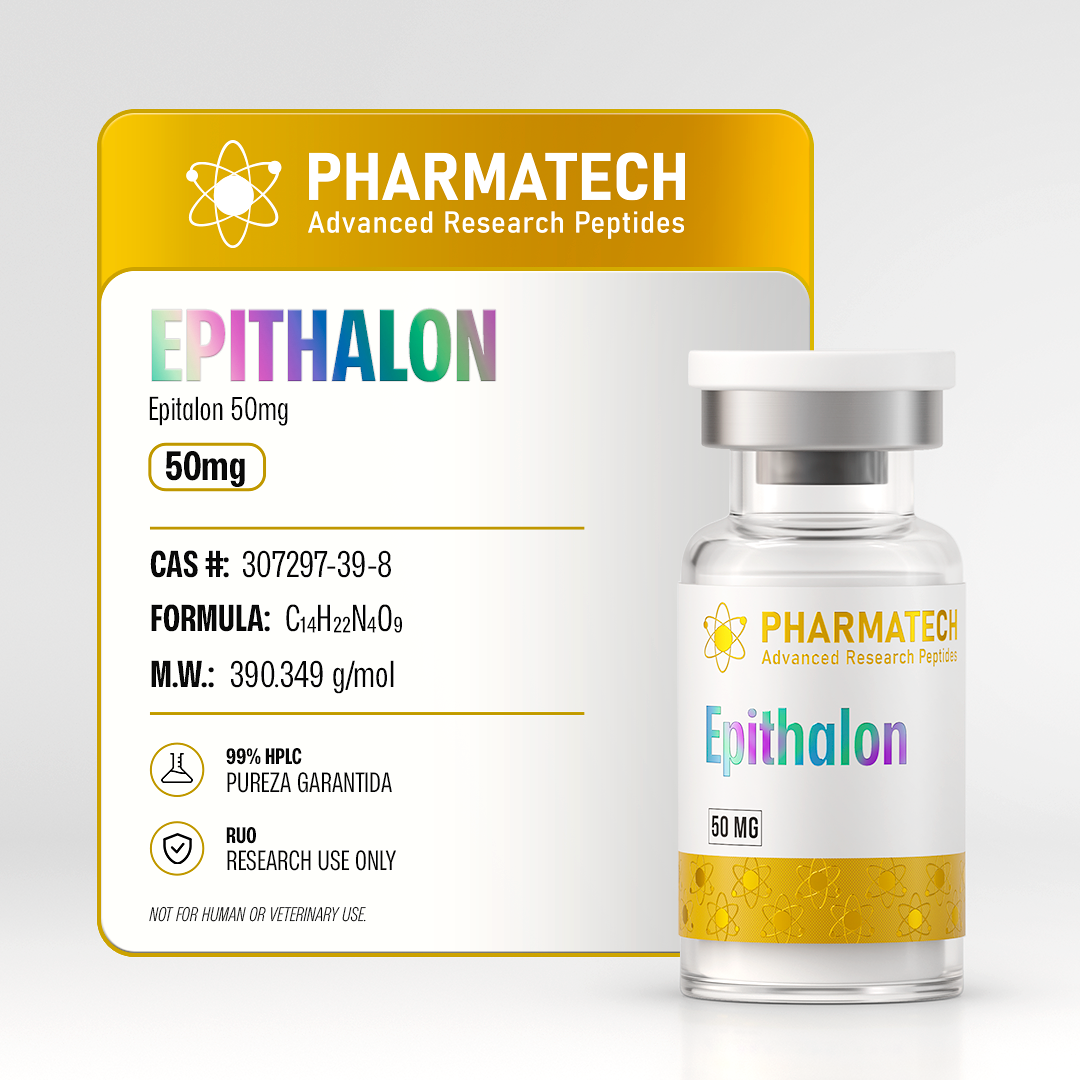
Epithalon 50mg – PharmaTech
Epithalon, also known as Epitalon or Epithalone, is a synthetic tetrapeptide composed of the amino acids Alanine–Glutamic Acid–Aspartic Acid–Glycine (AEDG).
The peptide was developed from research involving Epithalamin, a pineal-derived peptide complex, and has been investigated extensively in the fields of pineal biology, cellular aging, telomere biology, telomerase activity, circadian regulation, melatonin signaling, oxidative stress, and neuroendocrine physiology.
Epithalon is particularly notable for research examining its relationship with telomerase activity and telomere maintenance, although the available evidence remains predominantly experimental.
OVERVIEW
Epithalon, also known as Epitalon or Epithalone, is a synthetic tetrapeptide composed of the amino acids Alanine–Glutamic Acid–Aspartic Acid–Glycine (AEDG).
The peptide was developed from research involving Epithalamin, a pineal-derived peptide complex, and has been investigated extensively in the fields of pineal biology, cellular aging, telomere biology, telomerase activity, circadian regulation, melatonin signaling, oxidative stress, and neuroendocrine physiology.
Epithalon is particularly notable for research examining its relationship with telomerase activity and telomere maintenance, although the available evidence remains predominantly experimental.
MECHANISM OF ACTION
The precise molecular mechanism of Epithalon has not been completely established.
Research has proposed several interconnected biological mechanisms involving telomerase regulation, gene expression, pineal signaling, circadian biology, and cellular stress responses.
Investigated mechanisms include:
- Modulation of telomerase activity
- Regulation of hTERT expression
- Effects on telomere-associated pathways
- Modulation of gene expression
- Interaction with chromatin-associated proteins
- Regulation of pineal signaling
- Modulation of melatonin-related pathways
- Effects on oxidative-stress responses
- Neuroendocrine signaling
- Potential effects on cellular senescence pathways
Recent laboratory research has reported telomere-length changes following Epithalon exposure in human cell lines, with different molecular mechanisms observed depending on the cellular model. PMC
KEY BENEFITS
Research involving Epithalon has focused on:
- Telomere biology
- Telomerase activity
- Cellular aging
- Pineal gland physiology
- Melatonin regulation
- Circadian biology
- Oxidative-stress research
- Neuroendocrine signaling
- Cellular longevity
- Gene-expression regulation
- Chromatin biology
- Neurobiological research
RESEARCH AREAS
Telomere Biology
Epithalon has been investigated for its potential influence on telomerase activity, telomere maintenance, and molecular mechanisms associated with cellular replicative capacity.
Cellular Aging
Research has explored Epithalon in experimental models involving cellular senescence, age-associated molecular changes, and mechanisms related to cellular longevity.
Pineal Biology
Epithalon originated from research surrounding pineal peptide complexes and has therefore been investigated in connection with pineal signaling and endocrine regulation.
Melatonin & Circadian Regulation
Experimental research has examined potential effects on melatonin synthesis and circadian rhythmicity, particularly in models involving age-related alterations in pineal function.
Neuroendocrine Research
The peptide has been studied in the context of interactions between pineal signaling, endocrine regulation, and age-associated physiological processes.
Oxidative Stress
Experimental studies have investigated Epithalon in relation to cellular antioxidant mechanisms and oxidative-stress responses.
Molecular & Cellular Biology
Research has examined potential effects on gene expression, chromatin organization, telomerase-related pathways, and cellular signaling.
SCIENTIFIC EVIDENCE
Epithalon has been studied for more than two decades through in vitro, in vivo, and molecular research models. A 2025 scientific review summarized research involving its proposed effects on pineal biology, aging-related processes, oxidative stress, telomere regulation, and cellular signaling. MDPI
Early experimental research reported that Epithalon could induce telomerase activity and telomere elongation in cultured human somatic cells.
More recent research has investigated the phenomenon using modern molecular and cellular techniques. A 2025 study reported telomere-length changes in human cell lines following Epithalon exposure and investigated the involvement of hTERT/telomerase and alternative lengthening of telomeres (ALT) pathways. PMC
The current research profile therefore places Epithalon primarily within the fields of telomere biology, cellular aging, pineal physiology, circadian biology, and molecular gerontology.
MOLECULAR PROFILE
| Property | Specification |
|---|---|
| Molecule | Epithalon |
| Alternative Names | Epitalon, Epithalone, AEDG |
| Peptide Class | Synthetic tetrapeptide |
| Sequence | Ala-Glu-Asp-Gly |
| One-Letter Sequence | AEDG |
| Peptide Length | 4 amino acids |
| Molecular Formula | C₁₄H₂₂N₄O₉ |
| Molecular Weight | ~390.35 g/mol |
| CAS Number | 307297-39-8 |
| Structural Type | Linear tetrapeptide |
| Primary Research Areas | Telomerase, telomeres, pineal signaling, cellular aging |
PHARMACOKINETIC & PHARMACODYNAMIC PROFILE
Pharmacokinetic Profile
Comprehensive human pharmacokinetic characterization of Epithalon remains limited compared with established therapeutic peptides.
Available research has focused primarily on experimental models, with substantially less information regarding systemic absorption, tissue distribution, metabolism, and elimination in humans.
As a short peptide, Epithalon is expected to be subject to enzymatic peptide degradation and metabolic processing.
Pharmacodynamic Profile
The proposed pharmacodynamic framework can be represented as:
Epithalon → Molecular signaling → Telomerase / gene-expression pathways → Telomere & cellular-aging research
A second research pathway involves:
Epithalon → Pineal signaling → Melatonin-related pathways → Circadian biology
Additional experimental mechanisms include modulation of oxidative stress, chromatin-associated processes, and neuroendocrine signaling.
RESEARCH HIGHLIGHTS
Telomerase Research
Epithalon has been investigated extensively for its potential effects on telomerase activity and regulation of telomerase-associated genes.
Telomere Research
Telomere length represents one of the principal molecular endpoints investigated in Epithalon research. Recent human-cell experiments have further examined telomere dynamics following peptide exposure. PMC
Pineal Biology
Epithalon emerged from research involving pineal-derived peptide complexes and remains strongly associated with research into pineal molecular signaling.
Melatonin Research
Experimental studies have examined relationships between Epithalon, pineal function, and melatonin-related signaling.
Circadian Biology
The relationship between pineal activity and circadian regulation has made Epithalon a subject of research involving biological rhythms.
Cellular Longevity
Research has investigated Epithalon in relation to telomere maintenance, cellular senescence, oxidative stress, and other molecular mechanisms associated with cellular aging.
Molecular Gerontology
Epithalon continues to attract research interest in gerontology, molecular biology, peptide science, cellular biology, and neuroendocrinology.
TECHNICAL SPECIFICATIONS
| Specification | Epithalon — PharmaTech |
|---|---|
| Product Name | Epithalon |
| Alternative Names | Epitalon / Epithalone |
| Chemical Class | Synthetic tetrapeptide |
| Sequence | Ala-Glu-Asp-Gly (AEDG) |
| Formula | C₁₄H₂₂N₄O₉ |
| Molecular Weight | ~390.35 g/mol |
| CAS Number | 307297-39-8 |
| Peptide Length | 4 amino acids |
| Physical Form | Lyophilized peptide |
| Purity | [PharmaTech specification] |
| Presentation | [PharmaTech specification] |
STORAGE & HANDLING
- Store the lyophilized peptide under controlled conditions according to the applicable PharmaTech specification.
- Protect from excessive heat, moisture, and direct light.
- Keep the original container sealed until laboratory handling.
- Minimize exposure to repeated freeze–thaw cycles after reconstitution.
- Handle peptide material using appropriate laboratory procedures.
- Reconstituted material should be handled according to the applicable PharmaTech product specification.