

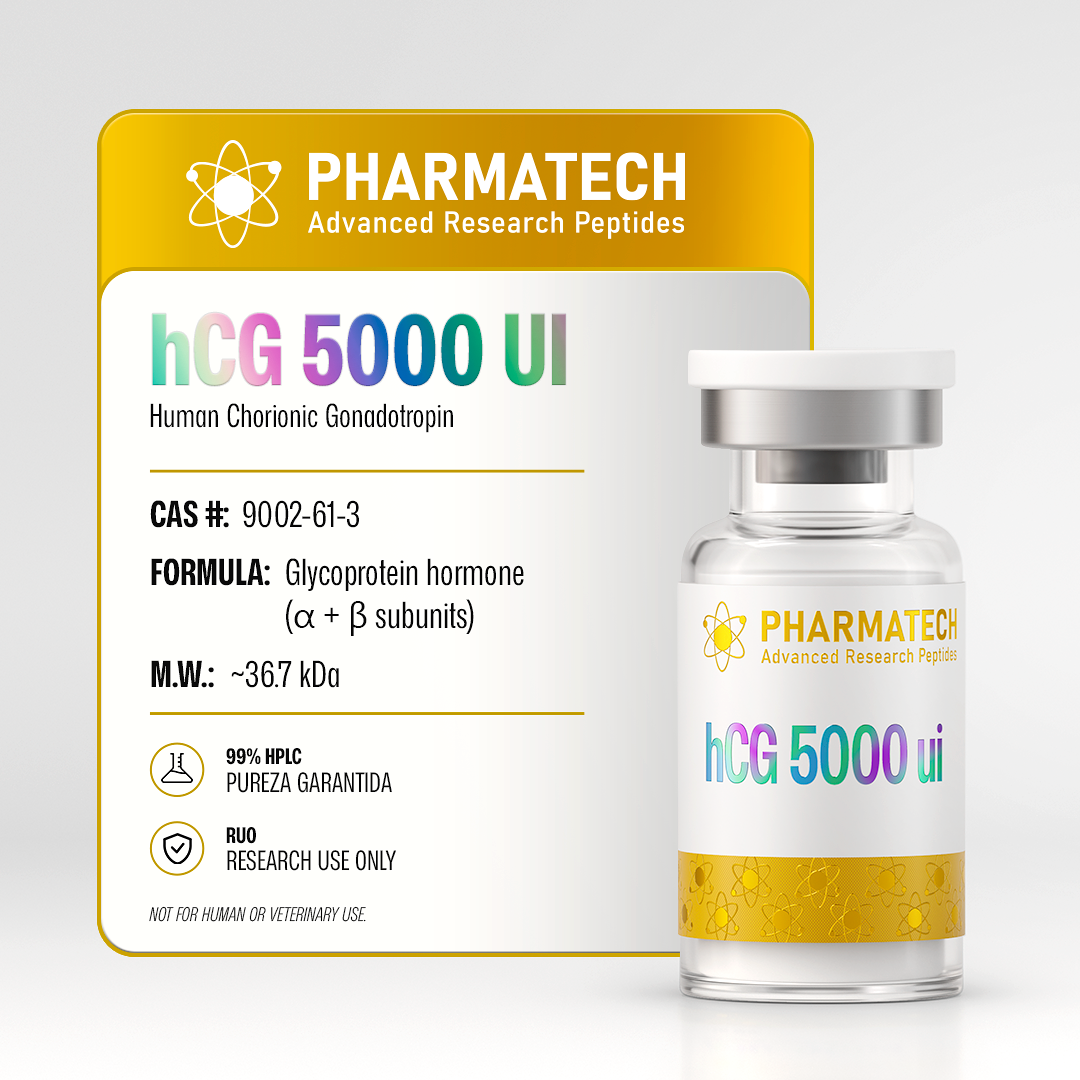
HCG 5.000UI – PharmaTech
Human Chorionic Gonadotropin (hCG) is a naturally occurring glycoprotein hormone belonging to the gonadotropin family. It is structurally related to luteinizing hormone (LH), follicle-stimulating hormone (FSH), and thyroid-stimulating hormone (TSH).
hCG is composed of two non-covalently associated subunits, alpha (α) and beta (β). The alpha subunit is shared among the glycoprotein hormones, while the beta subunit provides the molecular specificity of hCG.
Its biological activity is closely related to that of LH, with hCG acting primarily through the LH/hCG receptor and influencing gonadal steroidogenesis and reproductive physiology.
MECHANISM OF ACTION
hCG binds to the luteinizing hormone/chorionic gonadotropin receptor (LH/hCG receptor), a G-protein-coupled receptor expressed primarily in reproductive tissues.
Receptor activation stimulates intracellular signaling pathways, particularly the adenylyl cyclase–cAMP pathway, leading to activation of protein kinase signaling and downstream steroidogenic processes.
In the testes, hCG stimulates Leydig cells, promoting androgen production.
In the ovaries, hCG can mimic the biological activity of LH and participate in processes associated with follicular maturation, ovulation, and corpus luteum function.
The extended biological activity of hCG compared with LH is partly associated with structural differences in the beta subunit and its glycosylation pattern.
KEY BENEFITS
Research and clinical applications involving hCG have primarily focused on:
- Gonadal function
- Androgen production
- Reproductive endocrinology
- Follicular maturation
- Ovulation induction
- Corpus luteum support
- Steroidogenesis research
- LH receptor signaling
In male reproductive endocrinology, hCG has been investigated for its ability to stimulate testicular Leydig-cell activity and endogenous testosterone production.
In female reproductive medicine, hCG is used as an LH-like signal in controlled fertility protocols to induce final follicular maturation and ovulation.
RESEARCH AREAS
Reproductive Endocrinology
Research into gonadotropin signaling and the regulation of reproductive function.
Leydig Cell Biology
Investigation of LH/hCG receptor activation and androgen synthesis in testicular Leydig cells.
Steroidogenesis
Research into the cellular pathways involved in the conversion of cholesterol into steroid hormones.
Ovarian Function
Investigation of follicular maturation, ovulation, and corpus luteum physiology.
Gonadotropin Signaling
Research into the molecular and intracellular pathways activated by the LH/hCG receptor.
SCIENTIFIC EVIDENCE
hCG has been extensively characterized in reproductive endocrinology and has a well-established biological relationship with the LH receptor.
Experimental and clinical research demonstrates that hCG activates LH/hCG receptors and stimulates steroidogenic activity in gonadal tissues.
In males, receptor activation in Leydig cells promotes testosterone production. In females, hCG provides an LH-like signal that can trigger final follicular maturation and ovulation in appropriately controlled reproductive protocols.
The extensive physiological and clinical literature surrounding hCG makes it one of the most thoroughly characterized gonadotropic hormones.
MOLECULAR PROFILE
| Parameter | Specification |
|---|---|
| Compound | Human Chorionic Gonadotropin |
| Abbreviation | hCG |
| Molecular Class | Glycoprotein hormone |
| Subunits | Alpha + Beta |
| Primary Receptor | LH/hCG receptor |
| Receptor Type | G-protein-coupled receptor |
| Approx. Molecular Weight | ~36.7 kDa |
| Alpha Subunit | ~14.5 kDa |
| Beta Subunit | ~22.2 kDa |
| Primary Biological Role | Gonadotropic signaling |
| Primary Research Areas | Reproductive endocrinology & steroidogenesis |
PHARMACOKINETIC & PHARMACODYNAMIC PROFILE
hCG has a substantially longer biological half-life than endogenous LH.
The glycosylated structure of the hCG molecule, particularly the C-terminal region of its beta subunit, contributes to its extended circulation time.
The reported terminal half-life of hCG is approximately 32–37 hours, compared with the considerably shorter half-life of LH.
Following receptor binding, hCG activates intracellular signaling pathways involving cAMP and protein kinase activity, ultimately influencing steroidogenic processes in gonadal tissues.
RESEARCH HIGHLIGHTS
LH-Like Biological Activity
hCG activates the same primary receptor system responsible for many of the biological effects of luteinizing hormone.
Leydig Cell Signaling
Research demonstrates stimulation of Leydig-cell steroidogenesis following LH/hCG receptor activation.
Gonadal Steroidogenesis
hCG participates in signaling pathways regulating the production of gonadal steroid hormones.
Reproductive Biology
The hormone has an established role in reproductive physiology and is extensively studied in fertility research.
Extended Biological Activity
Its glycoprotein structure and beta-subunit characteristics contribute to a longer circulating half-life compared with LH.
TECHNICAL SPECIFICATIONS
| Specification | Details |
|---|---|
| Product | Human Chorionic Gonadotropin |
| Brand | PharmaTech |
| Abbreviation | hCG |
| Category | Glycoprotein Hormone |
| Molecular Structure | Heterodimeric |
| Subunits | α + β |
| Approx. Molecular Weight | ~36.7 kDa |
| Primary Target | LH/hCG Receptor |
| Receptor Class | GPCR |
| Physical Form | Lyophilized protein |
| Purity | [PharmaTech specification] |
| Net Content | [Product specification] |
| Activity | [IU specification] |
| Storage | [PharmaTech specification] |
| Batch / Lot | [Batch-specific information] |
STORAGE & HANDLING
Store according to the specific storage conditions established for the PharmaTech formulation.
Protect the product from excessive heat, moisture, direct light, and inappropriate environmental exposure.
Product-specific storage and handling specifications should follow the information provided with the product and its technical documentation.
SCIENTIFIC REFERENCES
- U.S. Food and Drug Administration (FDA). Human Chorionic Gonadotropin — Clinical Pharmacology and Mechanism of Action.
- NCBI Bookshelf — StatPearls. Human Chorionic Gonadotropin. Updated 2025.
- Endotext — Endocrinology of Pregnancy. Human Chorionic Gonadotropin and placental hormone physiology.
- National Library of Medicine — MeSH. Chorionic Gonadotropin.
- PubMed / NCBI. Scientific literature concerning hCG, LH/hCG receptor signaling, gonadal steroidogenesis, and reproductive endocrinology.