

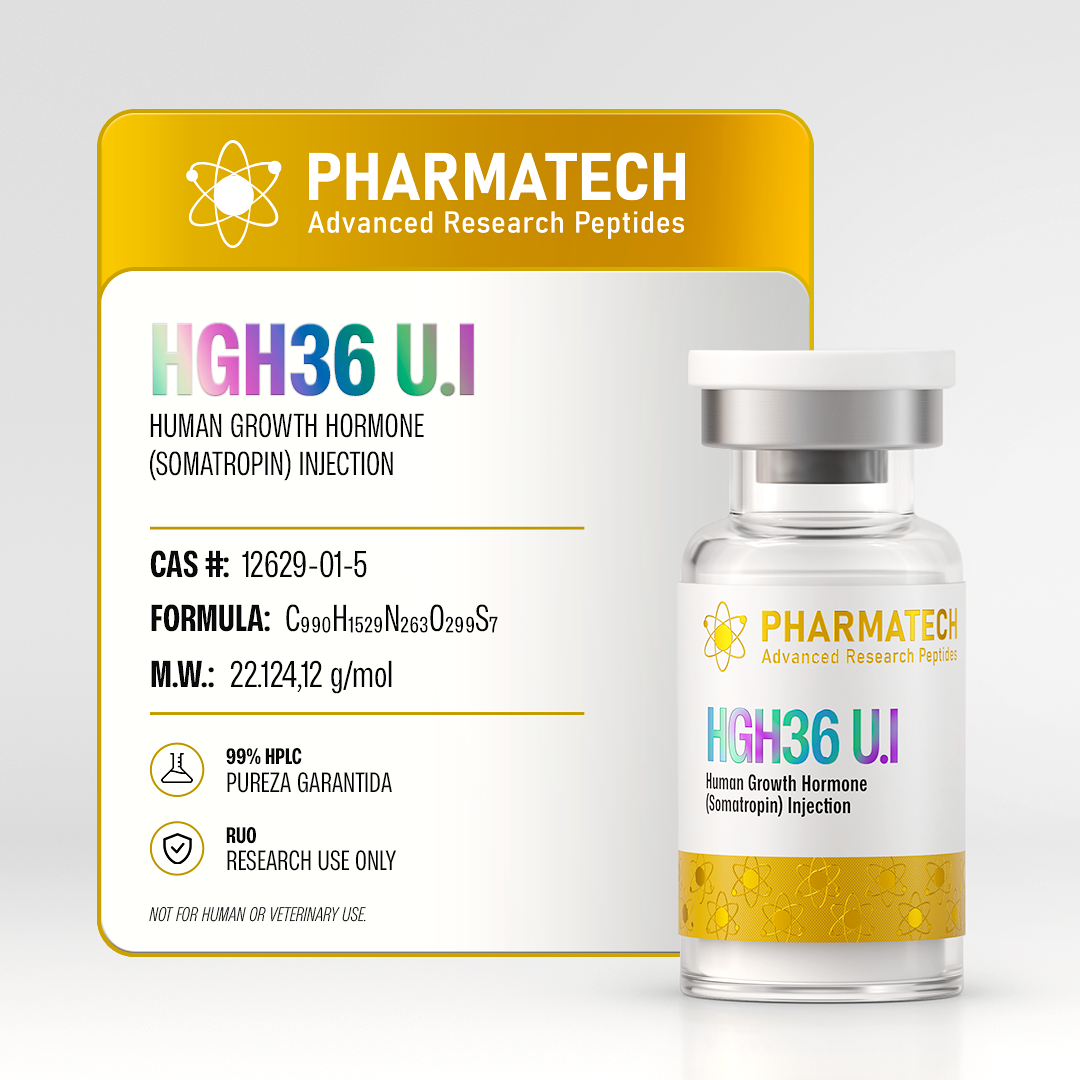
HGH 36UI (Somatropin) – PharmaTech
HGH (Human Growth Hormone), also known as Somatropin or recombinant human growth hormone (rhGH), is a recombinant protein structurally equivalent to the predominant form of naturally occurring human growth hormone.
Somatropin is a 191-amino-acid single-chain polypeptide with a molecular weight of approximately 22.1 kDa. Its structure contains two intramolecular disulfide bonds and is identical in amino-acid sequence to human pituitary growth hormone.
The HGH 36 IU — PharmaTech presentation provides a defined quantity of recombinant somatropin for applications involving research into growth hormone signaling, IGF-1 biology, protein metabolism, lipid metabolism, glucose homeostasis, tissue growth, and cellular regeneration pathways.
OVERVIEW
HGH (Human Growth Hormone), also known as Somatropin or recombinant human growth hormone (rhGH), is a recombinant protein structurally equivalent to the predominant form of naturally occurring human growth hormone.
Somatropin is a 191-amino-acid single-chain polypeptide with a molecular weight of approximately 22.1 kDa. Its structure contains two intramolecular disulfide bonds and is identical in amino-acid sequence to human pituitary growth hormone.
The HGH 36 IU — PharmaTech presentation provides a defined quantity of recombinant somatropin for applications involving research into growth hormone signaling, IGF-1 biology, protein metabolism, lipid metabolism, glucose homeostasis, tissue growth, and cellular regeneration pathways.
MECHANISM OF ACTION
Somatropin exerts its biological effects primarily through interaction with the growth hormone receptor (GHR) located on the surface of target cells.
Binding of GH to its receptor initiates intracellular signaling pathways that regulate the expression and activity of multiple growth- and metabolism-related proteins.
A major component of its biological activity occurs through stimulation of IGF-1 (Insulin-like Growth Factor-1) production, particularly in the liver, while other effects result directly from GH receptor activation.
Key signaling mechanisms include:
- Growth hormone receptor activation
- JAK2/STAT signaling
- Increased hepatic IGF-1 production
- IGF-1 receptor signaling
- Stimulation of protein synthesis
- Regulation of lipid metabolism
- Modulation of glucose metabolism
- Stimulation of connective-tissue and skeletal pathways
The physiological actions of somatropin therefore involve both direct GH receptor signaling and indirect IGF-1-mediated signaling.
KEY BENEFITS
Research involving recombinant human growth hormone has focused on:
- Growth hormone signaling
- IGF-1 production
- Protein synthesis
- Nitrogen metabolism
- Lipid metabolism
- Lipolytic activity
- Glucose homeostasis
- Skeletal growth
- Connective-tissue biology
- Cellular growth and differentiation
- Muscle and tissue metabolism
- Endocrine physiology
RESEARCH AREAS
Growth Hormone Biology
Investigation of GH receptor activation, downstream signaling, endocrine regulation, and physiological growth pathways.
IGF-1 Signaling
Somatropin is extensively studied for its ability to stimulate hepatic and local IGF-1 production and the subsequent activation of IGF-1-dependent pathways.
Protein Metabolism
Research examines GH-mediated stimulation of amino-acid uptake, protein synthesis, and nitrogen retention.
Lipid Metabolism
Somatropin has direct metabolic effects involving adipose tissue and lipid mobilization, including stimulation of lipolysis.
Glucose Metabolism
Research investigates the interaction between GH signaling, hepatic glucose production, insulin sensitivity, and glucose homeostasis.
Skeletal Biology
Growth hormone and IGF-1 play central roles in chondrocyte activity, bone growth, and skeletal development.
Muscle Biology
Research includes GH/IGF-1 signaling in skeletal muscle, protein turnover, tissue growth, and metabolic regulation.
Regenerative Biology
GH and IGF-1 pathways are studied in relation to connective tissue, extracellular matrix regulation, cellular proliferation, and tissue remodeling.
SCIENTIFIC EVIDENCE
Somatropin is one of the most extensively characterized peptide hormones in modern endocrinology.
Recombinant somatropin has the same amino-acid sequence as endogenous human growth hormone and has been studied extensively in clinical and experimental settings.
Its biological effects are mediated through the growth hormone receptor and downstream signaling involving IGF-1, protein synthesis, lipid metabolism, glucose metabolism, and tissue growth.
Clinical pharmacology studies demonstrate measurable increases in circulating IGF-1 following administration of somatropin, with IGF-1 serving as an important pharmacodynamic biomarker of GH activity.
Because of its extensive characterization, somatropin provides a well-established experimental model for investigating GH/GHR/IGF-1 signaling and endocrine regulation.
MOLECULAR PROFILE
| Property | Specification |
|---|---|
| Molecule | Somatropin |
| Common Name | Human Growth Hormone (HGH) |
| Alternative Names | rhGH, Recombinant Human Growth Hormone |
| Protein Class | Recombinant peptide hormone |
| Amino Acids | 191 |
| Molecular Formula | C₉₉₀H₁₅₂₈N₂₆₂O₃₀₀S₇ |
| Molecular Weight | ~22,124 Da |
| Primary Receptor | Growth Hormone Receptor (GHR) |
| Major Secondary Mediator | IGF-1 |
| Structural Type | Single-chain polypeptide |
| Disulfide Bonds | 2 intramolecular disulfide bonds |
| Biological Class | Growth hormone |
| Presentation | 36 IU |
Somatropin consists of 191 amino-acid residues with two intramolecular disulfide bonds and a molecular mass of approximately 22.1 kDa.
PHARMACOKINETIC & PHARMACODYNAMIC PROFILE
Pharmacokinetic Profile
Following subcutaneous administration, somatropin is absorbed into systemic circulation and produces measurable increases in circulating GH and IGF-1.
Pharmacokinetic characteristics vary according to formulation, route of administration, dose, and individual physiological factors.
In a clinical pharmacology study of subcutaneous somatropin, peak serum concentrations occurred several hours after administration, with an absolute bioavailability of approximately 70% for the studied formulation.
Somatropin undergoes systemic metabolism and clearance through multiple pathways, including hepatic and renal processes.
Pharmacodynamic Profile
The principal signaling cascade can be summarized as:
Somatropin → GHR activation → JAK/STAT signaling → IGF-1 production → IGF-1 receptor activation → Cellular growth & metabolic signaling
Direct GH receptor effects additionally influence:
- Lipolysis
- Protein synthesis
- Glucose metabolism
- Amino-acid utilization
- Connective-tissue metabolism
- Skeletal biology
RESEARCH HIGHLIGHTS
Recombinant Human Growth Hormone
Somatropin is structurally equivalent in amino-acid sequence to endogenous human growth hormone and has been extensively characterized through recombinant biotechnology.
GHR Signaling
The growth hormone receptor represents the primary molecular interface through which somatropin initiates intracellular signaling.
IGF-1 Axis
The GH–IGF-1 axis represents one of the principal endocrine pathways involved in somatropin biology.
Protein Synthesis
GH/IGF-1 signaling plays a major role in regulation of protein synthesis and tissue growth.
Lipid Metabolism
Somatropin has direct effects on adipose tissue and lipid mobilization, making GH signaling an important area of metabolic research.
Glucose Regulation
The interaction between GH signaling, hepatic glucose production, insulin sensitivity, and IGF-1 represents an important area of endocrine research.
Skeletal & Tissue Biology
The GH/IGF-1 axis is extensively studied in relation to skeletal development, connective tissue, cellular proliferation, and tissue remodeling.
TECHNICAL SPECIFICATIONS
| Specification | HGH 36 IU — PharmaTech |
|---|---|
| Product Name | HGH 36 IU |
| Active Molecule | Somatropin |
| Alternative Name | Recombinant Human Growth Hormone |
| Protein Length | 191 amino acids |
| Molecular Weight | ~22.1 kDa |
| Molecular Formula | C₉₉₀H₁₅₂₈N₂₆₂O₃₀₀S₇ |
| Primary Receptor | Growth Hormone Receptor |
| Major Mediator | IGF-1 |
| Structural Type | Single-chain recombinant protein |
| Disulfide Bonds | 2 |
| Physical Form | Lyophilized protein |
| Potency | 36 IU |
| Purity | [PharmaTech specification] |
| Presentation | [PharmaTech specification] |
STORAGE & HANDLING
- Store the lyophilized material under controlled conditions according to the applicable PharmaTech specification.
- Protect from excessive heat, moisture, and direct light.
- Maintain the original container sealed until laboratory handling.
- Avoid unnecessary agitation of the reconstituted protein.
- Minimize repeated freeze–thaw exposure.
- Handle the material using appropriate laboratory procedures.
- Reconstituted material should be stored and handled according to the applicable PharmaTech product specification.