

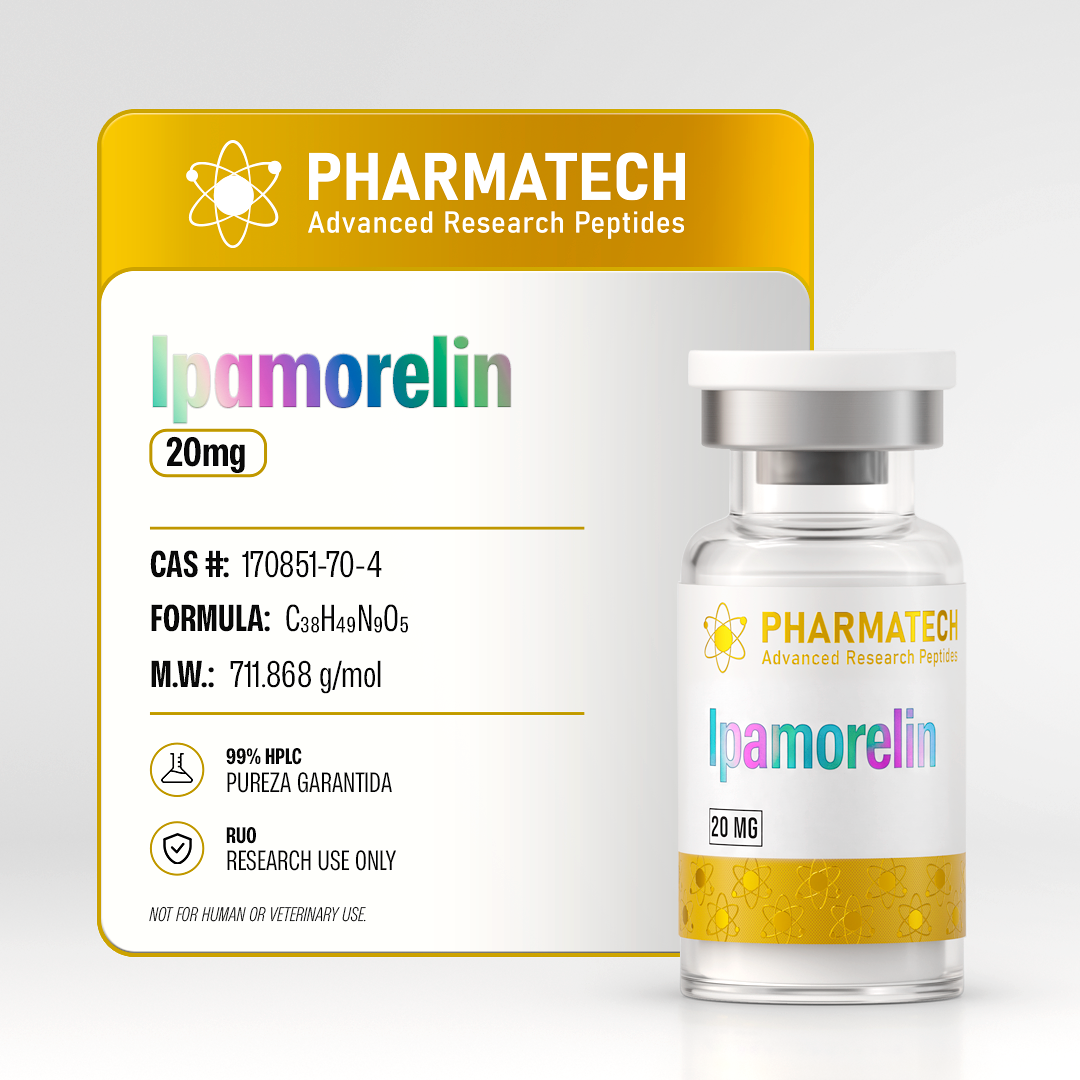
Ipamorelin 20mg – PharmaTech
Ipamorelin is a synthetic pentapeptide growth hormone secretagogue and selective agonist of the growth hormone secretagogue receptor (GHS-R1a), also known as the ghrelin receptor.
Unlike native growth hormone or GHRH analogues, Ipamorelin acts through the ghrelin receptor system to stimulate endogenous growth hormone (GH) secretion. Its molecular structure was developed to provide potent GH-releasing activity with a high degree of selectivity within the growth hormone secretagogue class.
Ipamorelin has been investigated extensively in growth hormone physiology, endocrine signaling, gastrointestinal biology, metabolic research, and pharmacokinetic/pharmacodynamic studies.
OVERVIEW
Ipamorelin is a synthetic pentapeptide growth hormone secretagogue and selective agonist of the growth hormone secretagogue receptor (GHS-R1a), also known as the ghrelin receptor.
Unlike native growth hormone or GHRH analogues, Ipamorelin acts through the ghrelin receptor system to stimulate endogenous growth hormone (GH) secretion. Its molecular structure was developed to provide potent GH-releasing activity with a high degree of selectivity within the growth hormone secretagogue class.
Ipamorelin has been investigated extensively in growth hormone physiology, endocrine signaling, gastrointestinal biology, metabolic research, and pharmacokinetic/pharmacodynamic studies.
MECHANISM OF ACTION
Ipamorelin binds to and activates GHS-R1a, a G-protein-coupled receptor expressed in the pituitary and several peripheral tissues.
Activation of GHS-R1a initiates intracellular signaling involving Gαq/11, phospholipase C and downstream calcium-dependent signaling, ultimately promoting GH release from pituitary somatotroph cells.
Principal Signaling Axis
Ipamorelin → GHS-R1a → Gαq/11 → PLC → intracellular Ca²⁺ signaling → GH secretion
Circulating GH subsequently interacts with the GH/IGF-1 axis, including stimulation of hepatic IGF-1 production.
Early pharmacological studies demonstrated that Ipamorelin produces potent GH release while showing substantially greater selectivity for GH secretion than several earlier growth hormone secretagogues.
KEY BENEFITS
Growth Hormone Research
- Selective stimulation of endogenous GH secretion
- GHS-R1a receptor activation
- Investigation of pulsatile GH physiology
- GH/IGF-1 axis research
Endocrine Research
- Pituitary somatotroph signaling
- Growth hormone secretagogue pathways
- Neuroendocrine regulation
- GHRH-independent GH stimulation
Metabolic Research
- GH-associated lipid metabolism
- Glucose homeostasis
- Energy metabolism
- Body-composition research
Gastrointestinal Research
- Ghrelin-receptor signaling
- Gastric motility
- Gastrointestinal endocrine biology
- Intestinal physiological responses
RESEARCH AREAS
| Research Area | Primary Focus |
|---|---|
| Growth Hormone Biology | GH secretion and pituitary signaling |
| GHS-R1a Pharmacology | Ghrelin-receptor activation |
| Endocrinology | GH/IGF-1 axis |
| Neuroendocrinology | Hypothalamic-pituitary signaling |
| Metabolic Research | Energy, lipid and glucose metabolism |
| Gastrointestinal Biology | Ghrelin signaling and gastrointestinal motility |
| Pharmacokinetics | Peptide exposure and systemic clearance |
| Pharmacodynamics | Relationship between Ipamorelin exposure and GH response |
SCIENTIFIC EVIDENCE
Ipamorelin was originally characterized as a potent GH-releasing peptide with activity demonstrated in both in vitro pituitary-cell systems and animal models. Its pharmacological profile distinguished it from earlier secretagogues through its comparatively selective stimulation of GH.
Human pharmacokinetic/pharmacodynamic research has also been conducted. In healthy male volunteers receiving controlled intravenous infusions, Ipamorelin demonstrated dose-proportional pharmacokinetics and a reported terminal half-life of approximately 2 hours. GH concentrations reached a peak approximately 0.67 hours after administration in the studied model.
More recent regulatory review has continued to characterize Ipamorelin as a synthetic pentapeptide ghrelin mimetic acting primarily through GHS-R1a. The FDA review also notes that available nonclinical and clinical evidence does not establish Ipamorelin as an FDA-approved drug product.
MOLECULAR PROFILE
| Parameter | Specification |
|---|---|
| Compound Name | Ipamorelin |
| Synonyms | NNC-26-0161 |
| Molecular Class | Synthetic growth hormone secretagogue |
| Peptide Length | 5 amino acids |
| Sequence | Aib-His-D-2-Nal-D-Phe-Lys-NH₂ |
| Molecular Formula | C₃₈H₄₉N₉O₅ |
| Molecular Weight | ~711.9 Da |
| CAS Number | 170851-70-4 |
| Primary Target | GHS-R1a / Ghrelin Receptor |
| Receptor Class | G-protein-coupled receptor |
| Molecular Form | Synthetic pentapeptide |
The molecular sequence and physicochemical characteristics are consistent with the established chemical identity of Ipamorelin.
Peptide Sequence
Aib-His-D-2-Nal-D-Phe-Lys-NH₂
Where:
- Aib = α-methylalanine
- D-2-Nal = D-2-naphthylalanine
- D-Phe = D-phenylalanine
The incorporation of non-standard and D-amino-acid residues contributes to the characteristic pharmacological profile of the molecule.
PHARMACOKINETIC & PHARMACODYNAMIC PROFILE
Pharmacodynamic Profile
Ipamorelin produces its primary pharmacodynamic effect through activation of GHS-R1a and stimulation of pituitary GH secretion.
Experimental pharmacology demonstrated high GH-releasing potency, while human studies confirmed a measurable relationship between circulating Ipamorelin concentrations and GH response.
The principal downstream endocrine pathway can be represented as:
GHS-R1a activation → GH release → GH receptor signaling → IGF-1 production
Pharmacokinetic Profile
Human pharmacokinetic research has reported:
| Parameter | Reported Profile |
|---|---|
| Population Studied | Healthy adult male volunteers |
| Administration Studied | Intravenous infusion |
| Terminal Half-Life | ~2 hours |
| Clearance | ~0.078 L/h/kg |
| Volume of Distribution at Steady State | ~0.22 L/kg |
| GH Peak Response | ~0.67 h |
| Dose Relationship | Dose-proportional PK in studied range |
These values derive from a controlled human PK/PD study and should not automatically be extrapolated to other formulations or routes of administration.
RESEARCH HIGHLIGHTS
Selective GH Secretagogue Activity
Ipamorelin was developed as a potent growth hormone secretagogue and demonstrated substantial selectivity for GH stimulation in early pharmacological studies.
GHS-R1a Activation
The peptide acts as an agonist at GHS-R1a, linking it mechanistically to the endogenous ghrelin signaling system.
Distinct From GHRH Analogues
Ipamorelin stimulates GH through the ghrelin/GHS-R1a pathway, which is pharmacologically distinct from direct activation of the growth hormone-releasing hormone receptor.
Human PK/PD Characterization
Controlled human studies have characterized the relationship between Ipamorelin exposure and GH secretion, providing substantially more pharmacokinetic information than is available for many experimental peptide secretagogues.
Gastrointestinal Biology
Because GHS-R1a is expressed in multiple peripheral tissues, Ipamorelin has also been investigated in gastrointestinal physiology, including gastric and intestinal motility research.
TECHNICAL SPECIFICATIONS
| Specification | PharmaTech Standard |
|---|---|
| Product Name | Ipamorelin |
| Molecular Class | Synthetic pentapeptide |
| Sequence | Aib-His-D-2-Nal-D-Phe-Lys-NH₂ |
| Molecular Formula | C₃₈H₄₉N₉O₅ |
| Molecular Weight | ~711.9 Da |
| CAS | 170851-70-4 |
| Appearance | White to off-white lyophilized powder |
| Identity Testing | Mass Spectrometry |
| Purity Testing | HPLC |
| Sequence Verification | MS/MS / analytical characterization |
| Packaging | PharmaTech specification |
| Lot Number | PharmaTech lot-specific |
| Certificate of Analysis | Available by lot |
STORAGE & HANDLING
Ipamorelin should be maintained in its lyophilized form under controlled storage conditions and protected from:
- Excessive heat
- Moisture
- Direct light
- Repeated temperature fluctuations
PharmaTech lot-specific storage and handling specifications should be followed according to the corresponding product documentation and Certificate of Analysis.