

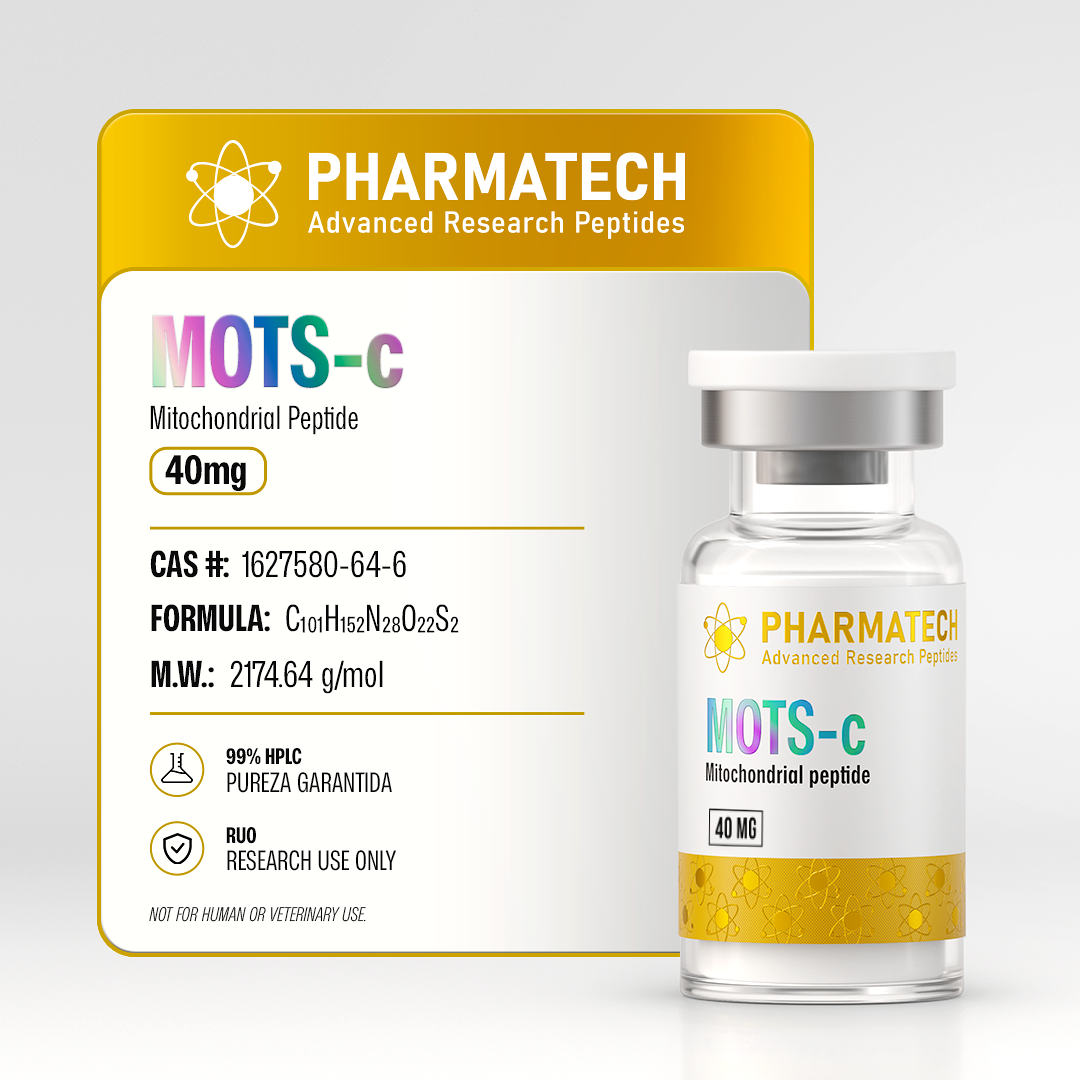
MOTS-c 40mg – PharmaTech
MOTS-c (Mitochondrial Open Reading Frame of the 12S rRNA-c) is a naturally occurring mitochondrial-derived peptide (MDP) encoded by the mitochondrial genome. The mature human peptide consists of 16 amino acids and is associated with cellular metabolic regulation, mitochondrial signaling, and adaptive responses to metabolic and cellular stress.
MOTS-c has become an important subject of research in mitochondrial biology, metabolic physiology, exercise-associated signaling, glucose homeostasis, oxidative stress, and age-related cellular processes.
OVERVIEW
MOTS-c (Mitochondrial Open Reading Frame of the 12S rRNA-c) is a naturally occurring mitochondrial-derived peptide (MDP) encoded by the mitochondrial genome. The mature human peptide consists of 16 amino acids and is associated with cellular metabolic regulation, mitochondrial signaling, and adaptive responses to metabolic and cellular stress.
MOTS-c has become an important subject of research in mitochondrial biology, metabolic physiology, exercise-associated signaling, glucose homeostasis, oxidative stress, and age-related cellular processes.
MECHANISM OF ACTION
MOTS-c is investigated as a mitochondrial signaling peptide capable of influencing metabolic and stress-response pathways.
Research has associated MOTS-c with regulation of AMP-activated protein kinase (AMPK) and cellular metabolic adaptation. Experimental studies have also investigated interactions with pathways involving NRF2/ARE, mitochondrial function, oxidative stress, and glucose metabolism.
Rather than functioning through a single classical receptor, MOTS-c appears to participate in a broader network of intracellular metabolic signaling.
Principal Research Signaling
MOTS-c → metabolic stress sensing → AMPK / NRF2-related signaling → metabolic adaptation and cellular homeostasis
The precise molecular mechanisms underlying MOTS-c activity remain an active area of investigation.
KEY BENEFITS
Mitochondrial Research
- Mitochondrial bioenergetics
- Cellular energy regulation
- Oxidative metabolism
- Mitochondrial stress responses
- Cellular metabolic adaptation
Metabolic Research
- Glucose metabolism
- Insulin sensitivity
- Fatty-acid utilization
- Energy homeostasis
- AMPK-associated signaling
Exercise & Muscle Research
- Skeletal muscle metabolism
- Exercise-associated metabolic adaptation
- Mitochondrial activity
- Oxidative capacity
- Cellular energy utilization
Cellular Protection Research
- Oxidative stress
- Reactive oxygen species regulation
- Cellular stress responses
- Mitochondrial homeostasis
- Aging-associated cellular processes
RESEARCH AREAS
| Research Area | Primary Focus |
|---|---|
| Mitochondrial Biology | Mitochondrial signaling and bioenergetics |
| Metabolic Research | Glucose, lipid and energy metabolism |
| AMPK Signaling | Cellular energy sensing and metabolic adaptation |
| Exercise Physiology | Skeletal muscle and exercise-associated metabolism |
| Insulin Signaling | Glucose utilization and metabolic regulation |
| Oxidative Stress | ROS regulation and cellular stress responses |
| Aging Research | Mitochondrial function and cellular aging |
| Cellular Homeostasis | Adaptive responses to metabolic stress |
SCIENTIFIC EVIDENCE
MOTS-c was identified as a peptide encoded within the mitochondrial 12S rRNA region and subsequently investigated as a signaling molecule involved in metabolic regulation.
Experimental research has associated MOTS-c with improved metabolic adaptation, AMPK-related signaling, glucose utilization, and mitochondrial function in cellular and animal models.
More recent research has expanded investigation into the immunomodulatory and tissue-protective properties of MOTS-c. A recent experimental study, for example, reported effects on oxidative stress, mitochondrial membrane potential, autophagy, inflammatory signaling, and tissue survival in an ischemic tissue model.
The available evidence remains predominantly preclinical and mechanistic, and the complete biological role of MOTS-c in humans continues to be investigated.
MOLECULAR PROFILE
| Parameter | Specification |
|---|---|
| Compound Name | MOTS-c |
| Full Name | Mitochondrial Open Reading Frame of the 12S rRNA-c |
| Molecular Class | Mitochondrial-Derived Peptide |
| Peptide Length | 16 amino acids |
| Sequence | MRWQEMGYIFYPRKLR |
| Molecular Formula | C₁₀₁H₁₅₂N₂₈O₂₂S₂ |
| Molecular Weight | ~2,174.6 Da |
| CAS Number | 1627580-64-6 |
| Origin | Human mitochondrial genome |
| Primary Biological Domain | Mitochondrial and metabolic signaling |
The human MOTS-c sequence is MRWQEMGYIFYPRKLR, with a calculated molecular weight of approximately 2,174.6 Da. PubChem
Peptide Sequence
MRWQEMGYIFYPRKLR
PHARMACOKINETIC & PHARMACODYNAMIC PROFILE
Pharmacodynamic Profile
MOTS-c research focuses primarily on its biological activity in metabolic and mitochondrial signaling systems.
Experimental findings have associated the peptide with:
- AMPK-related metabolic signaling
- Glucose utilization
- Fatty-acid metabolism
- Mitochondrial bioenergetics
- Oxidative-stress regulation
- Cellular stress adaptation
- NRF2-associated antioxidant signaling
MOTS-c may also interact with metabolic pathways that respond to changes in cellular energy availability.
Pharmacokinetic Profile
The pharmacokinetic characterization of exogenously administered MOTS-c remains substantially less developed than that of established therapeutic peptides.
Available research has investigated peptide exposure and biological activity in experimental models, but a comprehensive human PK profile—including definitive distribution, metabolism, clearance, and terminal half-life parameters—has not been fully established.
| Parameter | Research Profile |
|---|---|
| Molecular Type | Mitochondrial-derived peptide |
| Length | 16 amino acids |
| Molecular Weight | ~2.17 kDa |
| Primary Biological Domain | Metabolic / mitochondrial signaling |
| PK Characterization | Limited |
| Human PK Data | Limited |
| Metabolic Pathways | Under investigation |
RESEARCH HIGHLIGHTS
Mitochondrial-Derived Signaling
MOTS-c represents a distinct class of mitochondrial-derived signaling peptides encoded directly by mitochondrial DNA.
AMPK & Metabolic Adaptation
MOTS-c has been extensively investigated in relation to AMPK-associated energy sensing and metabolic adaptation, particularly under conditions of metabolic stress.
Glucose Metabolism
Experimental research has examined MOTS-c in relation to glucose utilization, insulin sensitivity, and metabolic homeostasis.
Skeletal Muscle & Exercise Biology
MOTS-c has attracted significant interest in exercise and muscle research because of its relationship with mitochondrial energy metabolism and cellular adaptation to energetic demand.
Oxidative Stress
Research has investigated the peptide’s potential role in regulating oxidative stress and maintaining mitochondrial homeostasis.
Cellular Stress & Longevity Research
MOTS-c is also being studied in the context of aging biology, metabolic resilience, and cellular responses to stress.
TECHNICAL SPECIFICATIONS
| Specification | PharmaTech Standard |
|---|---|
| Product Name | MOTS-c |
| Peptide Length | 16 amino acids |
| Sequence | MRWQEMGYIFYPRKLR |
| Molecular Formula | C₁₀₁H₁₅₂N₂₈O₂₂S₂ |
| Molecular Weight | ~2,174.6 Da |
| CAS | 1627580-64-6 |
| Appearance | White to off-white lyophilized powder |
| Identity Testing | Mass Spectrometry |
| Purity Testing | HPLC |
| Sequence Verification | MS/MS / analytical characterization |
| Packaging | PharmaTech specification |
| Lot Number | PharmaTech lot-specific |
| Certificate of Analysis | Available by lot |
STORAGE & HANDLING
MOTS-c should be maintained as a lyophilized peptide under controlled storage conditions and protected from:
- Excessive heat
- Moisture
- Direct light
- Repeated temperature fluctuations
PharmaTech lot-specific storage and handling specifications should be followed according to the corresponding product documentation and Certificate of Analysis.