

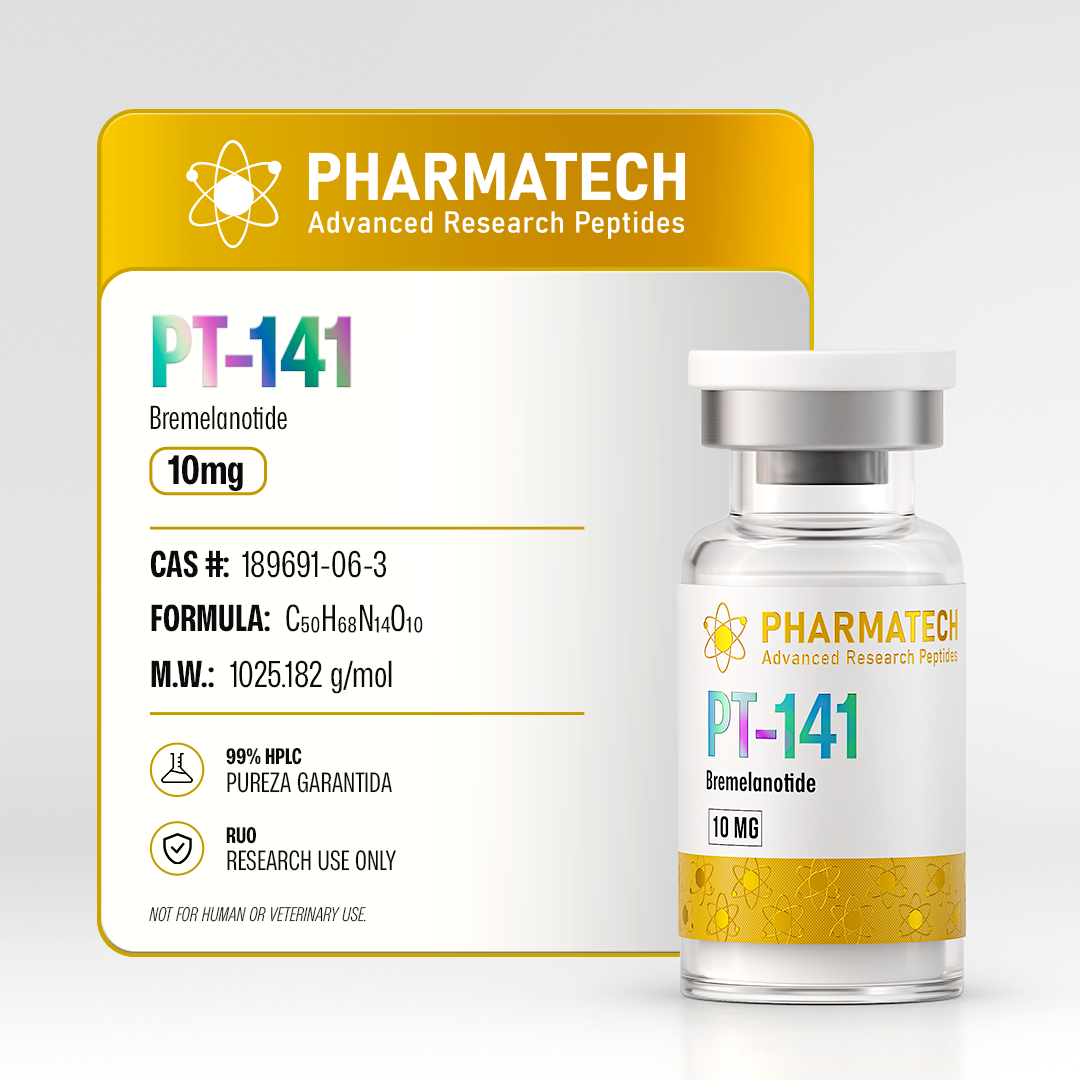
PT-141 10mg – PharmaTech
PT-141, also known as Bremelanotide, is a synthetic cyclic heptapeptide analogue of α-melanocyte-stimulating hormone (α-MSH) and a member of the melanocortin receptor agonist class.
Unlike peptides that primarily act through peripheral hormonal pathways, PT-141 interacts with the melanocortin receptor system, particularly MC3R and MC4R, which are expressed in multiple regions of the central nervous system. The compound has been investigated extensively in relation to sexual-function neurobiology, melanocortin signaling, central nervous system pathways, appetite regulation, and neuroendocrine signaling.
Bremelanotide was previously investigated under the designation PT-141 and subsequently developed as an approved pharmaceutical compound for a specific indication in premenopausal women.
OVERVIEW
PT-141, also known as Bremelanotide, is a synthetic cyclic heptapeptide analogue of α-melanocyte-stimulating hormone (α-MSH) and a member of the melanocortin receptor agonist class.
Unlike peptides that primarily act through peripheral hormonal pathways, PT-141 interacts with the melanocortin receptor system, particularly MC3R and MC4R, which are expressed in multiple regions of the central nervous system. The compound has been investigated extensively in relation to sexual-function neurobiology, melanocortin signaling, central nervous system pathways, appetite regulation, and neuroendocrine signaling.
Bremelanotide was previously investigated under the designation PT-141 and subsequently developed as an approved pharmaceutical compound for a specific indication in premenopausal women.
MECHANISM OF ACTION
Melanocortin Receptor Activation
PT-141 is a nonselective melanocortin receptor agonist with activity across several melanocortin receptor subtypes.
Its relative receptor-binding profile has been characterized as:
MC1R > MC4R > MC3R > MC5R > MC2R
with MC1R and MC4R considered particularly relevant to its pharmacological activity at therapeutic exposure levels.
MC4R & Central Signaling
MC4R is extensively expressed within the CNS and participates in neural pathways associated with:
- Sexual behavior
- Appetite regulation
- Energy balance
- Autonomic signaling
- Neuroendocrine function
PT-141 research has therefore provided an important pharmacological model for studying melanocortin-mediated CNS signaling.
Sexual-Function Neurobiology
The melanocortin system participates in central neural pathways involved in sexual motivation and behavior.
PT-141 has been investigated in both male and female sexual-function research, with subsequent clinical development focused on hypoactive sexual desire disorder in premenopausal women. The precise mechanism connecting melanocortin receptor activation to clinical effects remains incompletely defined.
KEY BENEFITS
Research interest in PT-141 includes:
- Melanocortin receptor signaling
- MC3R and MC4R pharmacology
- Sexual-function neurobiology
- Central nervous system signaling
- Neuroendocrine regulation
- Appetite and energy-balance pathways
- Behavioral neuroscience
- Autonomic signaling
- α-MSH-related pharmacology
- Peptide-receptor interaction studies
PT-141 is particularly valuable as a research tool for investigating how melanocortin receptor activation influences central neural and neuroendocrine pathways.
RESEARCH AREAS
Melanocortin Biology
Investigation of melanocortin receptor activation and signaling across the MC1R–MC5R receptor family.
MC4R Signaling
Research into MC4R-mediated CNS pathways associated with neural, behavioral, metabolic, and neuroendocrine processes.
Sexual-Function Research
PT-141 has been extensively studied as a pharmacological tool for investigating melanocortin-mediated sexual-function pathways.
Neuroendocrine Research
Investigation of interactions between melanocortin signaling and central neuroendocrine regulation.
Appetite & Energy Balance
MC4R is an important component of neural circuits regulating food intake and energy homeostasis, making PT-141 relevant to experimental metabolic neuroscience.
Behavioral Neuroscience
Research involving melanocortin receptors provides a model for examining interactions between neural signaling, motivation, reward, and behavior.
SCIENTIFIC EVIDENCE
PT-141 has a comparatively well-characterized pharmacological history among melanocortin peptides.
The compound was originally investigated as PT-141 and subsequently developed as bremelanotide. FDA regulatory documentation describes it as a synthetic cyclic heptapeptide analogue of α-MSH and a nonselective melanocortin receptor agonist.
Clinical development demonstrated pharmacological activity relevant to sexual-function research, ultimately leading to FDA approval of bremelanotide for acquired, generalized hypoactive sexual desire disorder in premenopausal women.
However, the precise mechanism through which melanocortin receptor activation produces the observed clinical effect remains incompletely understood. FDA labeling specifically notes that the mechanism connecting receptor activation with improvement in HSDD is unknown.
The broader research literature also demonstrates that melanocortin receptors participate in several biological systems beyond sexual-function pathways, including pigmentation, appetite, energy balance, and CNS regulation.
MOLECULAR PROFILE
| Parameter | PT-141 / Bremelanotide |
|---|---|
| Compound class | Synthetic cyclic heptapeptide |
| Alternative name | Bremelanotide |
| Original development code | PT-141 |
| Structural origin | α-MSH analogue |
| Peptide length | 7 amino acids |
| Sequence | Ac-Nle-Asp-His-D-Phe-Arg-Trp-Lys |
| Molecular formula | C₅₀H₆₈N₁₄O₁₀ |
| Molecular weight | ~1,025.2 Da |
| CAS | 189691-06-3 |
| Primary receptor family | Melanocortin receptors |
| Major research targets | MC3R / MC4R |
| Molecular structure | Cyclic peptide |
| Physical form | Lyophilized peptide |
The free-base molecular formula and molecular weight are reported by PubChem.
The acetate form has a different molecular composition and molecular weight; therefore, analytical specifications should identify the exact salt form supplied by the manufacturer.
PHARMACOKINETIC & PHARMACODYNAMIC PROFILE
Pharmacokinetic Profile
Bremelanotide has been characterized clinically following subcutaneous administration.
The approved pharmaceutical formulation contains bremelanotide acetate, and pharmacokinetic characteristics depend on the salt form, formulation, route of administration, and systemic exposure.
For a PharmaTech research formulation, pharmacokinetic parameters should be interpreted according to the exact chemical form and analytical specification of the product.
Pharmacodynamic Profile
The principal pharmacodynamic pathway can be represented as:
PT-141 → melanocortin receptor activation → CNS melanocortin signaling → neuroendocrine / behavioral pathways
The most relevant receptor activity at therapeutic exposure is associated with MC1R and MC4R, although PT-141 interacts with multiple melanocortin receptor subtypes.
MC4R activation is particularly relevant to research involving central melanocortin signaling, while MC1R activation is associated with pigmentation-related biology.
The precise downstream neural mechanisms responsible for the compound’s effects on sexual desire remain incompletely characterized.
RESEARCH HIGHLIGHTS
- Synthetic α-MSH analogue
- Cyclic heptapeptide
- Melanocortin receptor agonist
- MC3R / MC4R research
- CNS melanocortin signaling
- Sexual-function neurobiology
- Neuroendocrine research
- Appetite and energy-balance pathways
- Behavioral neuroscience
- Autonomic signaling
- Central receptor pharmacology
- Peptide-receptor interaction research
TECHNICAL SPECIFICATIONS
| Parameter | PharmaTech Specification |
|---|---|
| Product | PT-141 |
| Alternative name | Bremelanotide |
| Product type | Synthetic cyclic peptide |
| Peptide length | 7 amino acids |
| Sequence | Ac-Nle-Asp-His-D-Phe-Arg-Trp-Lys |
| Total quantity | [PharmaTech specification] |
| Chemical form | [Free base / Acetate — specification] |
| Purity | ≥ [PharmaTech specification]% |
| Physical form | Lyophilized powder |
| Appearance | White to off-white lyophilized material |
| Molecular weight | Form-dependent |
| Batch | [Batch specification] |
| Storage | Controlled refrigerated storage |
| Research category | Melanocortin / CNS / neuroendocrine signaling |
STORAGE & HANDLING
Store the lyophilized product under controlled conditions according to the applicable PharmaTech product specification.
Protect from:
- Excessive heat
- Direct light
- Moisture
- Repeated temperature fluctuations
- Physical contamination
Maintain the container sealed until laboratory use and handle under appropriate controlled conditions.