

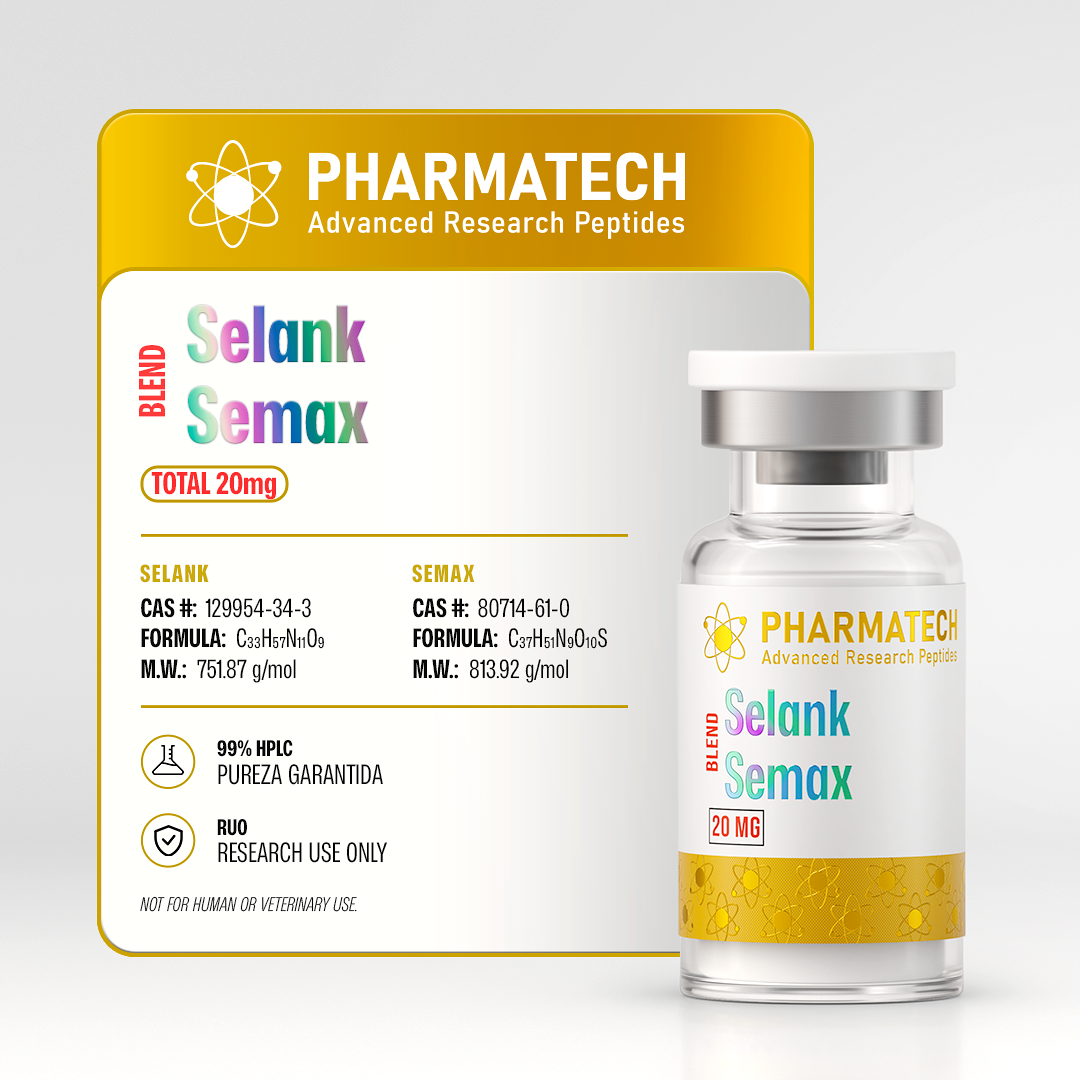
Selank + Semax Blend 20mg – PharmaTech
Selank + Semax Blend is a combination of two synthetic neuropeptide-based compounds, Selank and Semax, investigated independently for their potential effects on cognitive function, neuroplasticity, stress-related pathways, and central nervous system activity.
Selank is a synthetic peptide analogue derived from the naturally occurring immunomodulatory peptide tuftsin, while Semax is a synthetic peptide analogue based on a fragment of adrenocorticotropic hormone (ACTH).
The combination brings together two distinct peptide structures that have been studied in the fields of neurobiology, cognitive research, stress physiology, and neuroprotective mechanisms.
OVERVIEW
Selank + Semax Blend is a combination of two synthetic neuropeptide-based compounds, Selank and Semax, investigated independently for their potential effects on cognitive function, neuroplasticity, stress-related pathways, and central nervous system activity.
Selank is a synthetic peptide analogue derived from the naturally occurring immunomodulatory peptide tuftsin, while Semax is a synthetic peptide analogue based on a fragment of adrenocorticotropic hormone (ACTH).
The combination brings together two distinct peptide structures that have been studied in the fields of neurobiology, cognitive research, stress physiology, and neuroprotective mechanisms.
MECHANISM OF ACTION
Selank
Selank research has focused on its potential modulation of neurotransmitter systems and neuroendocrine signaling.
Experimental studies have investigated interactions involving GABAergic signaling, serotonin, dopamine, and other neurotransmitter pathways. Selank has also been studied in relation to expression of genes associated with neurotrophic and neuroplastic processes.
Semax
Semax has been investigated for its effects on neurotrophic signaling, neurotransmitter systems, and neuronal survival pathways.
Research has particularly focused on pathways involving brain-derived neurotrophic factor (BDNF) and other molecular mechanisms associated with neuroplasticity and neuronal adaptation.
Combined Research Profile
The combination of Selank and Semax brings together two peptides with overlapping but distinct areas of neurobiological research, particularly involving:
- Neurotransmitter regulation
- Neuroplasticity
- Neurotrophic signaling
- Stress-response pathways
- Cognitive and neurological research
The precise pharmacological interaction between the two compounds when administered as a blend has not been comprehensively established.
KEY BENEFITS
Research involving Selank and Semax has focused on:
- Cognitive function research
- Neuroplasticity
- Neurotrophic signaling
- Stress-response research
- Memory and learning
- Attention and cognitive performance
- Neuroprotective mechanisms
- Central nervous system research
These areas represent subjects investigated in experimental and clinical literature involving the individual peptides.
RESEARCH AREAS
Cognitive Research
Investigation of peptide-mediated effects on learning, memory, attention, and cognitive processes.
Neuroplasticity
Research examining signaling pathways associated with neuronal adaptation and synaptic plasticity.
Neurotrophic Signaling
Semax research has particularly focused on pathways involving BDNF and other neurotrophic factors.
Stress Physiology
Selank has been investigated in relation to stress responses and neuroendocrine regulation.
Neuroprotection
Experimental research has examined Semax and related mechanisms in models of neuronal stress and injury.
Neurotransmitter Research
Both peptides have been investigated for potential modulation of neurotransmitter systems within the central nervous system.
SCIENTIFIC EVIDENCE
Both Selank and Semax have been studied in experimental and clinical research, particularly within Russian scientific literature.
Research involving Selank has investigated its effects on anxiety-related behavior, stress adaptation, cognitive processes, and neurochemical signaling. Experimental studies have also examined its relationship with GABAergic and neurotrophic pathways.
Semax has been investigated extensively in experimental models of neurological function, cognitive performance, neuroprotection, and recovery following neurological stress. Research has identified potential effects involving BDNF expression and other neurotrophic mechanisms.
However, the majority of mechanistic evidence concerns the individual peptides, and direct scientific evidence specifically evaluating a standardized Selank + Semax combination remains limited.
MOLECULAR PROFILE
| Parameter | Selank | Semax |
|---|---|---|
| Molecular Class | Synthetic peptide | Synthetic peptide |
| Peptide Length | 7 amino acids | 7 amino acids |
| Sequence | Thr-Lys-Pro-Arg-Pro-Gly-Pro | Met-Glu-His-Phe-Pro-Gly-Pro |
| One-Letter Sequence | TKPRPGP | MEHFPGP |
| Primary Research Area | Neurobiology & stress physiology | Neurobiology & neuroprotection |
| Primary Molecular Focus | GABAergic & neuroendocrine signaling | Neurotrophic & neuroplastic signaling |
Blend Composition
Total Blend: 20 mg
Selank: [PharmaTech specification]
Semax: [PharmaTech specification]
PHARMACOKINETIC & PHARMACODYNAMIC PROFILE
The pharmacokinetic characteristics of Selank and Semax are not as comprehensively characterized as those of conventional small-molecule pharmaceuticals.
Both peptides have been investigated primarily in experimental and clinical research involving central nervous system activity.
Selank research has explored its relationship with neurotransmitter and neuroendocrine pathways, while Semax research has focused extensively on neurotrophic signaling and neuronal adaptation.
The pharmacokinetic and pharmacodynamic characteristics of the combined formulation depend on the specific composition and formulation of the product.
RESEARCH HIGHLIGHTS
Dual Neuropeptide Research
Combines two distinct synthetic peptides investigated in central nervous system research.
Cognitive Research
Both compounds have been studied in relation to learning, memory, attention, and cognitive processes.
Neuroplasticity
Semax research has investigated molecular pathways associated with neuronal plasticity and neurotrophic signaling.
Stress & Adaptation
Selank has been investigated for its potential involvement in stress-response and neuroendocrine pathways.
Neuroprotective Research
Semax has been extensively studied in experimental models investigating neuronal stress and neuroprotection.
TECHNICAL SPECIFICATIONS
| Specification | Details |
|---|---|
| Product | Selank + Semax Blend |
| Brand | PharmaTech |
| Presentation | 20 mg |
| Category | Neuropeptide Blend |
| Components | Selank + Semax |
| Selank Sequence | TKPRPGP |
| Semax Sequence | MEHFPGP |
| Selank Length | 7 amino acids |
| Semax Length | 7 amino acids |
| Physical Form | Lyophilized peptide blend |
| Total Net Content | 20 mg |
| Purity | [PharmaTech specification] |
| Storage | [PharmaTech specification] |
| Batch / Lot | [Batch-specific information] |
STORAGE & HANDLING
Store according to the specific storage conditions established for the PharmaTech formulation.
Protect the product from excessive heat, moisture, direct light, and inappropriate environmental exposure.
Product-specific storage and handling specifications should follow the information provided with the product and its technical documentation.
SCIENTIFIC REFERENCES
- Ashmarin IP, et al. Research on Semax and its neurotropic properties.
- Kozlovsky I, et al. Experimental studies investigating Semax, neurotrophic signaling, and cognitive-related mechanisms.
- Zozulya AA, et al. Research concerning Selank and its effects on neurochemical and behavioral parameters.
- PubChem. Selank — molecular structure and chemical information.
- PubChem. Semax — molecular structure and chemical information.
- NCBI / PubMed. Published literature concerning Selank, Semax, neuroplasticity, cognitive function, neuroprotection, and stress physiology.