

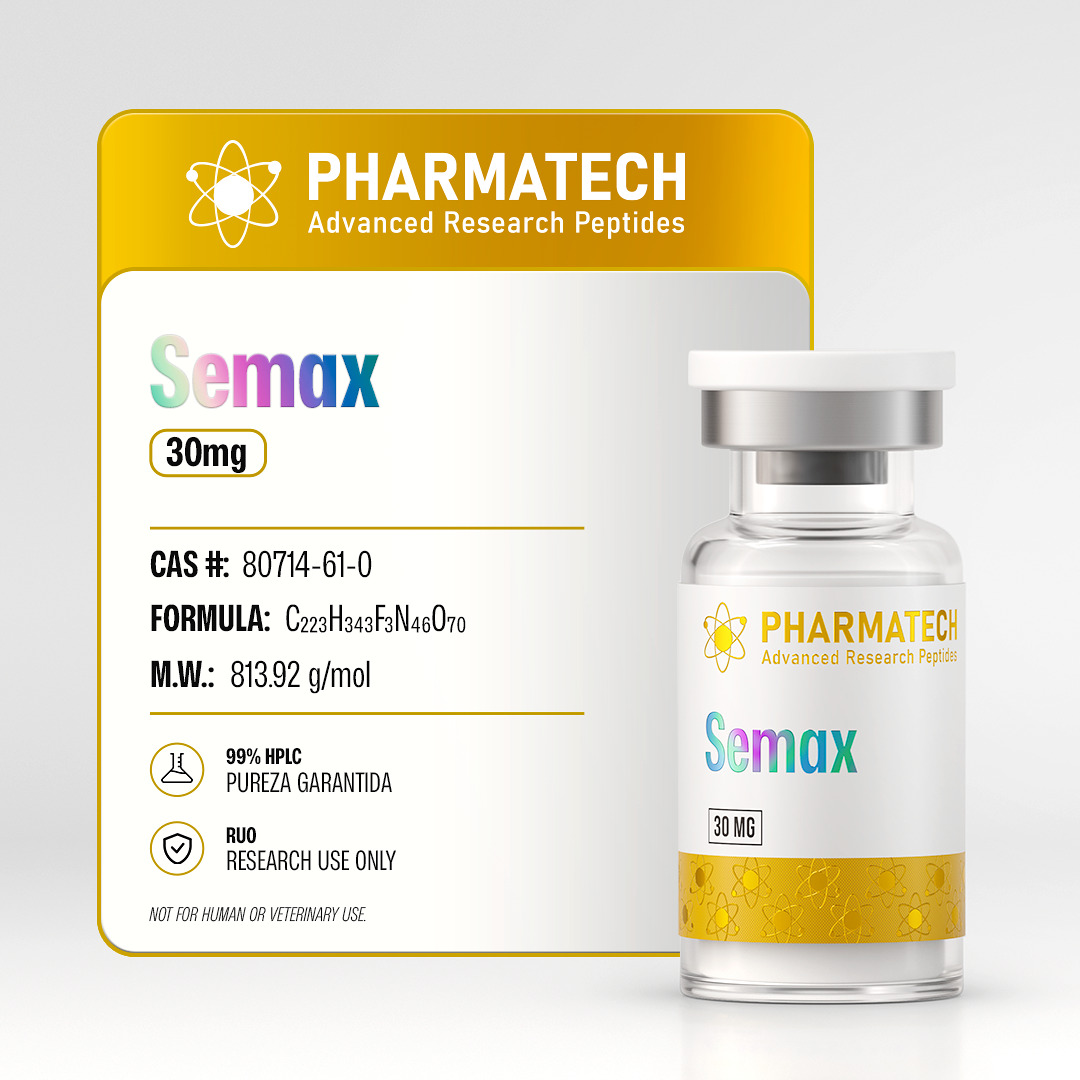
Semax 30mg – PharmaTech
Semax is a synthetic heptapeptide derived from a fragment of adrenocorticotropic hormone (ACTH). Unlike the parent ACTH molecule, Semax does not retain the classical hormonal activity associated with the full-length hormone.
Semax has been investigated extensively in neurobiology, with research focusing on neurotrophic signaling, neuroplasticity, cognitive processes, neuronal adaptation, and neuroprotective mechanisms.
The peptide consists of seven amino acids and has been studied particularly in experimental models involving central nervous system function.
OVERVIEW
Semax is a synthetic heptapeptide derived from a fragment of adrenocorticotropic hormone (ACTH). Unlike the parent ACTH molecule, Semax does not retain the classical hormonal activity associated with the full-length hormone.
Semax has been investigated extensively in neurobiology, with research focusing on neurotrophic signaling, neuroplasticity, cognitive processes, neuronal adaptation, and neuroprotective mechanisms.
The peptide consists of seven amino acids and has been studied particularly in experimental models involving central nervous system function.
MECHANISM OF ACTION
The precise molecular mechanism of Semax has not been completely established.
Experimental research suggests that Semax may influence several neurobiological pathways associated with neurotrophic signaling and neuronal adaptation.
Research has particularly investigated effects involving:
- Brain-derived neurotrophic factor (BDNF)
- Neurotrophin signaling
- Neuroplasticity
- Neurotransmitter regulation
- Oxidative stress pathways
- Neuronal survival mechanisms
- Gene expression associated with neuronal adaptation
Semax has also been investigated for potential modulation of dopaminergic, serotonergic, and other neurotransmitter systems.
KEY BENEFITS
Scientific research involving Semax has primarily focused on:
- Neuroplasticity
- Neurotrophic signaling
- Cognitive function
- Memory and learning
- Neuroprotection
- Neuronal adaptation
- Stress-response research
- Central nervous system physiology
These areas reflect the principal subjects investigated in experimental and clinical literature surrounding the peptide.
RESEARCH AREAS
Neuroplasticity
Research examining molecular pathways involved in neuronal adaptation, synaptic plasticity, and neural remodeling.
Neurotrophic Signaling
Semax has been investigated for its relationship with BDNF and other neurotrophic signaling pathways.
Cognitive Research
Experimental studies have examined effects associated with learning, memory, attention, and cognitive performance.
Neuroprotection
Research has investigated Semax in experimental models involving neuronal stress, ischemia, oxidative stress, and other forms of neurological injury.
Neurotransmitter Research
Studies have examined potential effects on several neurotransmitter systems involved in central nervous system function.
Stress Physiology
Research has investigated interactions between Semax and physiological responses to stress.
SCIENTIFIC EVIDENCE
Semax has been investigated for several decades, particularly in Russian and Eastern European scientific research.
Experimental studies have reported effects involving BDNF expression, neurotrophic signaling, cognitive performance, and neuronal survival mechanisms.
Preclinical research has also examined Semax in models of cerebral ischemia, oxidative stress, and neurological injury, with findings suggesting potential neuroprotective and neurotrophic activity.
Clinical research has primarily focused on neurological and cognitive applications, although the overall body of evidence varies in study design, population, and methodological quality.
The molecular mechanisms responsible for the observed effects of Semax remain an active area of investigation.
MOLECULAR PROFILE
| Parameter | Specification |
|---|---|
| Compound | Semax |
| Molecular Class | Synthetic peptide |
| Peptide Length | 7 amino acids |
| Sequence | Met-Glu-His-Phe-Pro-Gly-Pro |
| One-Letter Sequence | MEHFPGP |
| Parent Molecule | ACTH(4–7) analogue |
| Molecular Formula | C₃₇H₅₁N₉O₉ |
| Molecular Weight | ~813.9 Da |
| Primary Research Area | Neurobiology |
| Key Research Pathways | BDNF & neurotrophic signaling |
PHARMACOKINETIC & PHARMACODYNAMIC PROFILE
The pharmacokinetic properties of Semax have not been characterized to the same extent as conventional pharmaceutical compounds.
As a short peptide, Semax is subject to enzymatic metabolism and peptide degradation. Research has investigated its biological activity following administration and its potential effects on central nervous system signaling.
The relationship between peripheral peptide exposure and central nervous system activity remains an important area of pharmacological research.
RESEARCH HIGHLIGHTS
Neurotrophic Signaling
Semax research has identified potential relationships with BDNF and other neurotrophic pathways involved in neuronal adaptation.
Neuroplasticity
Experimental research has investigated the peptide’s influence on mechanisms associated with synaptic and neuronal plasticity.
Cognitive Research
Studies have examined potential effects on learning, memory, attention, and other cognitive processes.
Neuroprotection
Semax has been extensively studied in experimental models involving ischemia, oxidative stress, and neuronal injury.
Central Nervous System Research
The peptide provides a research model for investigating how short synthetic peptides can influence complex neurobiological signaling networks.
TECHNICAL SPECIFICATIONS
| Specification | Details |
|---|---|
| Product | Semax |
| Brand | PharmaTech |
| Category | Synthetic Neuropeptide |
| Presentation | [PharmaTech specification] |
| Peptide Length | 7 amino acids |
| Sequence | MEHFPGP |
| Molecular Formula | C₃₇H₅₁N₉O₉ |
| Molecular Weight | ~813.9 Da |
| Physical Form | Lyophilized peptide |
| Purity | [PharmaTech specification] |
| Net Content | [Product specification] |
| Storage | [PharmaTech specification] |
| Batch / Lot | [Batch-specific information] |
STORAGE & HANDLING
Store according to the specific storage conditions established for the PharmaTech formulation.
Protect the material from excessive heat, moisture, direct light, and inappropriate environmental exposure.
Product-specific storage and handling specifications should follow the information provided with the product and its technical documentation.
SCIENTIFIC REFERENCES
- Ashmarin IP, et al. Research concerning Semax and its neurotropic and neuroprotective properties.
- Gusev EI, et al. Research examining Semax in neurological and cerebrovascular models.
- Levitskaya NG, et al. Experimental research concerning Semax, neurotrophic activity, and central nervous system function.
- PubChem. Semax — molecular structure and chemical information.
- NCBI / PubMed. Published literature concerning Semax, BDNF, neuroplasticity, neuroprotection, cognition, and neurological research.