

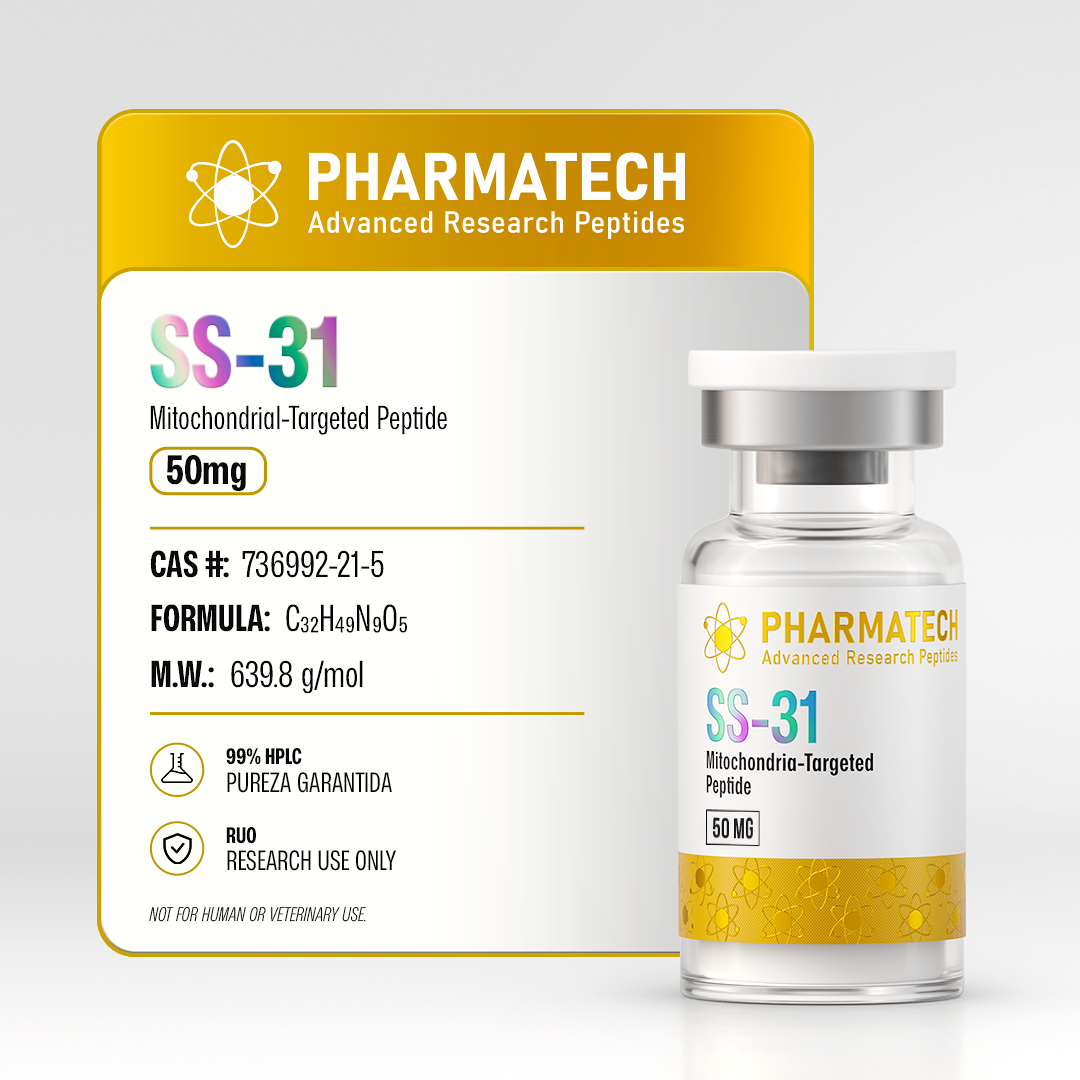
SS-31 50mg – PharmaTech
SS-31, also known as Elamipretide, MTP-131, or Bendavia, is a synthetic mitochondria-targeted tetrapeptide designed to selectively interact with cardiolipin, a phospholipid located within the inner mitochondrial membrane.
Unlike conventional antioxidants that act broadly throughout the cell, SS-31 is designed to concentrate within mitochondrial membranes, where it has been extensively studied for its effects on mitochondrial structure, oxidative phosphorylation, electron transport, ATP production, and cellular bioenergetics.
Elamipretide has progressed from extensive experimental research into clinical development, with particular interest in disorders characterized by mitochondrial dysfunction and impaired cellular energy metabolism.
OVERVIEW
SS-31, also known as Elamipretide, MTP-131, or Bendavia, is a synthetic mitochondria-targeted tetrapeptide designed to selectively interact with cardiolipin, a phospholipid located within the inner mitochondrial membrane.
Unlike conventional antioxidants that act broadly throughout the cell, SS-31 is designed to concentrate within mitochondrial membranes, where it has been extensively studied for its effects on mitochondrial structure, oxidative phosphorylation, electron transport, ATP production, and cellular bioenergetics.
Elamipretide has progressed from extensive experimental research into clinical development, with particular interest in disorders characterized by mitochondrial dysfunction and impaired cellular energy metabolism.
MECHANISM OF ACTION
SS-31 is a small, positively charged, cell-permeable peptide with a high affinity for mitochondrial cardiolipin.
Following cellular uptake, the peptide preferentially localizes to the inner mitochondrial membrane, where its interaction with cardiolipin is associated with changes in mitochondrial membrane organization and function.
Proposed mechanisms include:
- Selective cardiolipin binding
- Mitochondrial membrane stabilization
- Preservation of mitochondrial cristae architecture
- Modulation of cytochrome c–cardiolipin interactions
- Reduction of cardiolipin oxidation
- Optimization of electron-transfer processes
- Support of oxidative phosphorylation
- Improvement of mitochondrial ATP production
- Modulation of mitochondrial oxidative stress
The cardiolipin-targeting properties of SS-31 distinguish it from conventional antioxidants that primarily act through nonspecific scavenging of reactive oxygen species.
KEY BENEFITS
Research involving SS-31 has focused on several interconnected aspects of mitochondrial function:
- Mitochondrial membrane protection
- Cardiolipin stabilization
- Mitochondrial bioenergetics
- Oxidative phosphorylation
- ATP production
- Electron transport
- Mitochondrial structural integrity
- Oxidative-stress modulation
- Cellular energy metabolism
- Mitochondrial resilience under stress
RESEARCH AREAS
Mitochondrial Biology
Investigation of mitochondrial membrane organization, cardiolipin biology, respiratory-chain activity, cristae structure, and mitochondrial energy production.
Cellular Bioenergetics
Research involving oxygen consumption, oxidative phosphorylation, electron transport, ATP synthesis, and cellular energy metabolism.
Cardiovascular Research
SS-31 has been investigated in experimental models involving cardiac mitochondrial dysfunction, ischemia, cardiomyopathy, heart failure, and vascular biology.
Neurological Research
Research has examined mitochondrial dysfunction, neuronal energy metabolism, oxidative stress, neuroinflammation, and mitochondrial mechanisms associated with neurological disorders.
Ophthalmology
Elamipretide has been investigated in ocular research involving mitochondrial dysfunction, retinal biology, and optic-nerve cellular metabolism.
Renal Research
Experimental studies have examined mitochondrial responses to renal ischemia, cellular stress, and mitochondrial injury.
Metabolic Research
Research has investigated mitochondrial bioenergetics, metabolic stress, oxidative metabolism, and cellular energy regulation.
Aging & Cellular Stress
The mitochondria-targeted properties of SS-31 have generated interest in age-associated mitochondrial dysfunction, oxidative stress, and cellular resilience.
SCIENTIFIC EVIDENCE
SS-31 has been extensively investigated in preclinical models of mitochondrial dysfunction and cellular energy impairment.
Experimental research has demonstrated interactions between SS-31 and cardiolipin, with reported effects on mitochondrial membrane organization, respiratory activity, oxidative phosphorylation, and ATP generation.
The compound has subsequently progressed into human clinical research programs involving mitochondrial and cardiometabolic disorders.
Its clinical development has been particularly focused on conditions in which mitochondrial dysfunction represents an important component of disease biology.
SS-31 therefore represents one of the most extensively investigated mitochondria-targeted peptide platforms, combining a defined molecular target with a broad experimental research profile.
MOLECULAR PROFILE
| Property | Specification |
|---|---|
| Molecule | SS-31 |
| Generic Name | Elamipretide |
| Alternative Names | MTP-131, Bendavia |
| Peptide Class | Mitochondria-targeted tetrapeptide |
| Sequence | D-Arg-Dmt-Lys-Phe-NH₂ |
| Dmt | 2′,6′-Dimethyl-L-tyrosine |
| Molecular Formula | C₃₂H₄₉N₉O₅ |
| Molecular Weight | 639.8 g/mol |
| CAS Number | 736992-21-5 |
| Primary Target | Cardiolipin |
| Primary Localization | Inner mitochondrial membrane |
| Peptide Length | 4 amino acids |
| C-Terminus | Amidated |
PHARMACOKINETIC & PHARMACODYNAMIC PROFILE
Pharmacokinetic Profile
SS-31 is a small, water-soluble peptide designed to cross cellular membranes and selectively accumulate within mitochondrial membranes.
Its pharmacokinetic characteristics have been investigated in both experimental and clinical development programs, including systemic exposure, distribution, clearance, and mitochondrial localization.
The molecule’s small size and physicochemical properties facilitate cellular penetration and mitochondrial targeting.
Pharmacodynamic Profile
The principal pharmacodynamic mechanism can be represented as:
SS-31 → Cardiolipin binding → Mitochondrial membrane stabilization → Improved electron transport → Oxidative phosphorylation → ATP production
Additional downstream effects investigated experimentally include:
- Preservation of mitochondrial morphology
- Reduced cardiolipin oxidation
- Improved mitochondrial respiratory function
- Modulation of oxidative stress
- Preservation of cellular energy metabolism
RESEARCH HIGHLIGHTS
Mitochondrial Targeting
SS-31 was specifically engineered to preferentially target mitochondrial membranes.
Cardiolipin Interaction
Cardiolipin represents the principal molecular target associated with the mitochondrial localization of SS-31.
Mitochondrial Bioenergetics
Research has investigated SS-31 in relation to mitochondrial respiration, oxidative phosphorylation, electron transport, and ATP synthesis.
Cytochrome c Modulation
The peptide has been studied for its ability to influence the interaction between cardiolipin and cytochrome c, a central component of mitochondrial electron transport.
Mitochondrial Structural Preservation
SS-31 has been investigated for its effects on mitochondrial membrane organization and cristae architecture under conditions of cellular stress.
Cellular Energy Metabolism
Research has explored the potential relationship between SS-31 activity and preservation of cellular ATP production during mitochondrial dysfunction.
TECHNICAL SPECIFICATIONS
| Specification | SS-31 — PharmaTech |
|---|---|
| Product Name | SS-31 |
| Active Molecule | Elamipretide |
| Chemical Class | Mitochondria-targeted tetrapeptide |
| Sequence | D-Arg-Dmt-Lys-Phe-NH₂ |
| Formula | C₃₂H₄₉N₉O₅ |
| Molecular Weight | 639.8 g/mol |
| CAS | 736992-21-5 |
| Primary Target | Cardiolipin |
| Primary Cellular Site | Inner mitochondrial membrane |
| Physical Form | Lyophilized peptide |
| Purity | [PharmaTech specification] |
| Presentation | [PharmaTech specification] |
STORAGE & HANDLING
- Store the lyophilized peptide under controlled conditions according to the applicable PharmaTech specification.
- Protect from excessive heat, moisture, and direct light.
- Keep the original container sealed until handling.
- Avoid unnecessary exposure to repeated freeze–thaw cycles after reconstitution.
- Handle peptide material using appropriate laboratory procedures.
- Reconstituted material should be handled according to the applicable PharmaTech product specification.