

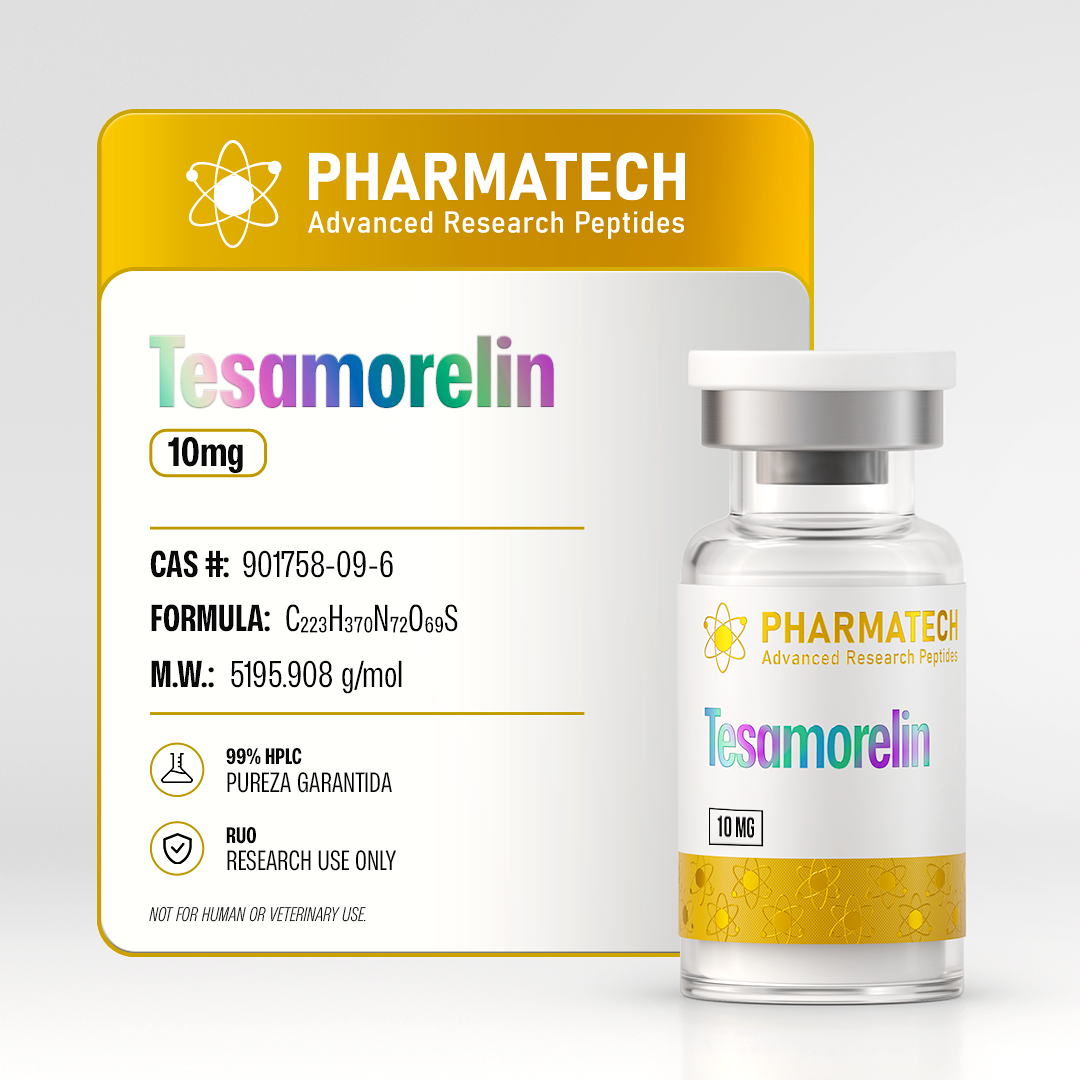
Tesamorelin 10mg – PharmaTech
Tesamorelin is a synthetic, stabilized analogue of human growth hormone–releasing hormone (GHRH), designed to activate the growth hormone–releasing factor receptor and stimulate endogenous pulsatile growth hormone secretion.
The molecule is based on the 44-amino-acid sequence of human GHRH with an N-terminal hexenoyl modification that increases molecular stability. Tesamorelin has been extensively investigated in growth hormone physiology, body-composition research, visceral adipose tissue biology, metabolic regulation, and endocrine signaling.
OVERVIEW
Tesamorelin is a synthetic, stabilized analogue of human growth hormone–releasing hormone (GHRH), designed to activate the growth hormone–releasing factor receptor and stimulate endogenous pulsatile growth hormone secretion.
The molecule is based on the 44-amino-acid sequence of human GHRH with an N-terminal hexenoyl modification that increases molecular stability. Tesamorelin has been extensively investigated in growth hormone physiology, body-composition research, visceral adipose tissue biology, metabolic regulation, and endocrine signaling.
MECHANISM OF ACTION
Tesamorelin acts primarily as an agonist of the growth hormone–releasing hormone receptor (GHRHR) located on pituitary somatotroph cells.
Receptor activation stimulates intracellular signaling that promotes the synthesis and pulsatile secretion of endogenous growth hormone (GH). Increased GH signaling subsequently influences hepatic and peripheral production of insulin-like growth factor-1 (IGF-1) and IGF-binding protein-3 (IGFBP-3).
Primary Signaling Axis
Tesamorelin → GHRHR → GH secretion → IGF-1 / IGFBP-3 → metabolic and tissue-level effects
The physiological effects associated with this pathway include modulation of lipid metabolism, adipocyte biology, protein metabolism, and other processes regulated by the GH/IGF-1 axis.
KEY BENEFITS
Growth Hormone Axis Research
- Activation of endogenous GHRH/GH signaling
- Investigation of pulsatile GH secretion
- Modulation of IGF-1 and IGFBP-3
- Endocrine regulation research
Metabolic Research
- Visceral adipose tissue biology
- Lipid metabolism
- Adipocyte function
- Glucose and insulin metabolism
- Energy-balance research
Body Composition Research
- Investigation of abdominal visceral fat
- GH-dependent changes in body composition
- Adipose tissue remodeling
- Lean and fat mass research
Cellular & Molecular Research
- GHRHR-mediated signaling
- GH-responsive cellular pathways
- IGF-1 signaling
- Hormonal regulation of metabolism
RESEARCH AREAS
Tesamorelin is investigated across several interconnected areas of molecular and physiological research:
| Research Area | Focus |
|---|---|
| Growth Hormone Biology | GHRH receptor activation and endogenous GH secretion |
| Endocrinology | GH/IGF-1 axis regulation |
| Metabolic Research | Lipid, glucose and energy metabolism |
| Adipose Biology | Visceral adipose tissue and adipocyte signaling |
| Body Composition | Changes in visceral fat and lean tissue |
| Neuroendocrine Research | Hypothalamic-pituitary signaling |
| Molecular Pharmacology | GHRHR-mediated intracellular pathways |
| Clinical Research | Metabolic and body-composition outcomes |
SCIENTIFIC EVIDENCE
Tesamorelin has a comparatively well-characterized pharmacological profile among GHRH analogues. Clinical development demonstrated that GHRHR stimulation increases endogenous GH secretion and subsequently raises circulating IGF-1 and IGFBP-3 concentrations.
Clinical research has particularly investigated tesamorelin in the context of excess visceral abdominal adipose tissue associated with HIV-related lipodystrophy, where the compound demonstrated effects on visceral adipose tissue and body composition.
The broader research significance of tesamorelin derives from its ability to stimulate the body’s endogenous GH axis rather than directly supplying exogenous GH.
MOLECULAR PROFILE
| Parameter | Specification |
|---|---|
| Compound Name | Tesamorelin |
| Synonyms | TH9507, Growth Hormone-Releasing Factor Analogue |
| Molecular Class | Synthetic GHRH analogue |
| Peptide Length | 44 amino acids |
| Molecular Formula | C₂₂₁H₃₆₆N₇₂O₆₇S |
| Molecular Weight | ~5,136 g/mol |
| CAS Number | 218949-48-5 |
| Primary Target | Growth Hormone-Releasing Hormone Receptor (GHRHR) |
| Structural Modification | N-terminal hexenoyl modification |
| Physical Form | Lyophilized peptide |
The molecular composition and sequence are consistent with the stabilized synthetic analogue of human GHRH described in regulatory and chemical characterization records.
Peptide Sequence
Y-A-D-A-I-F-T-N-S-Y-R-K-V-L-G-Q-L-S-A-R-K-L-L-Q-D-I-M-S-R-Q-Q-G-E-S-N-Q-E-R-G-A-R-A-R-L
The N-terminal region contains the characteristic chemical modification used to generate the stabilized tesamorelin molecule.
PHARMACOKINETIC & PHARMACODYNAMIC PROFILE
Pharmacodynamic Profile
Tesamorelin stimulates endogenous GH secretion through activation of GHRHR.
Pharmacodynamic studies demonstrate subsequent increases in:
- Growth hormone
- IGF-1
- IGFBP-3
The effect occurs through stimulation of the physiological GH axis rather than direct administration of growth hormone.
Pharmacokinetic Profile
Tesamorelin displays rapid absorption following subcutaneous administration.
For the currently characterized EGRIFTA WR formulation, the median Tmax is approximately 0.15 hours, while the reported mean elimination half-life following a single subcutaneous administration is approximately 11 minutes in healthy subjects. Earlier tesamorelin formulations reported half-lives of approximately 26–38 minutes depending on the population studied. DailyMed
| Parameter | Reported Profile |
|---|---|
| Administration Studied | Subcutaneous |
| Tmax | ~0.15 h |
| Elimination Half-Life | ~11 min in current WR formulation |
| Primary Target | GHRHR |
| Primary Pharmacodynamic Effect | Increased endogenous GH secretion |
| Downstream Biomarkers | IGF-1 and IGFBP-3 |
RESEARCH HIGHLIGHTS
GHRHR Activation
Tesamorelin directly stimulates the human growth hormone–releasing factor receptor with pharmacological activity comparable to endogenous GHRH.
GH/IGF-1 Axis
Activation of GHRHR increases endogenous GH secretion and subsequently modulates IGF-1 and IGFBP-3 concentrations.
Visceral Adipose Research
Tesamorelin has been extensively studied in relation to visceral abdominal adipose tissue and body-composition regulation.
Metabolic Biology
The GH/IGF-1 pathway activated by tesamorelin interacts with lipid and glucose metabolism, making the molecule relevant to metabolic and endocrine research.
Molecular Stability
The N-terminal hexenoyl modification differentiates tesamorelin from native GHRH and was incorporated to improve molecular stability.
TECHNICAL SPECIFICATIONS
| Specification | PharmaTech Standard |
|---|---|
| Product Name | Tesamorelin |
| Molecular Formula | C₂₂₁H₃₆₆N₇₂O₆₇S |
| Molecular Weight | ~5,136 g/mol |
| CAS | 218949-48-5 |
| Peptide Length | 44 amino acids |
| Appearance | White to off-white lyophilized powder |
| Identity Testing | Mass Spectrometry |
| Purity Testing | HPLC |
| Sequence Verification | MS/MS / analytical characterization |
| Packaging | PharmaTech specification |
| Lot Number | PharmaTech lot-specific |
| Certificate of Analysis | Available by lot |
STORAGE & HANDLING
Tesamorelin should be maintained as a lyophilized peptide under controlled storage conditions and protected from:
- Excessive heat
- Moisture
- Direct light
- Repeated temperature fluctuations
PharmaTech lot-specific storage and handling specifications should be followed according to the corresponding product documentation and Certificate of Analysis.